謎題生成演算法:從回溯法到約束滿足問題
深入了解謎題生成的技術原理
🎯 引言:謎題生成的挑戰
謎題生成是一個迷人的演算法挑戰,它結合了數學、邏輯和計算機科學的多個領域。無論是經典的數獨、迷宮,還是現代的單詞搜尋遊戲,每個謎題背後都有精心設計的生成演算法。
💡 謎題生成的核心挑戰
- 解的存在性:確保生成的謎題至少有一個解
- 唯一解性:保證謎題只有一個唯一解(對於某些類型)
- 難度控制:能夠生成不同難度級別的謎題
- 生成效率:在合理時間內完成謎題生成
- 品質保證:避免平凡或過於簡單的解決方案
為什麼需要理解謎題生成演算法?
- 遊戲開發:創建動態、可重玩的謎題遊戲
- 教育應用:生成客製化的練習題和測驗
- AI訓練:提供多樣化的訓練數據
- 演算法學習:理解約束滿足和搜索演算法
- 優化技能:學習如何提升演算法效率
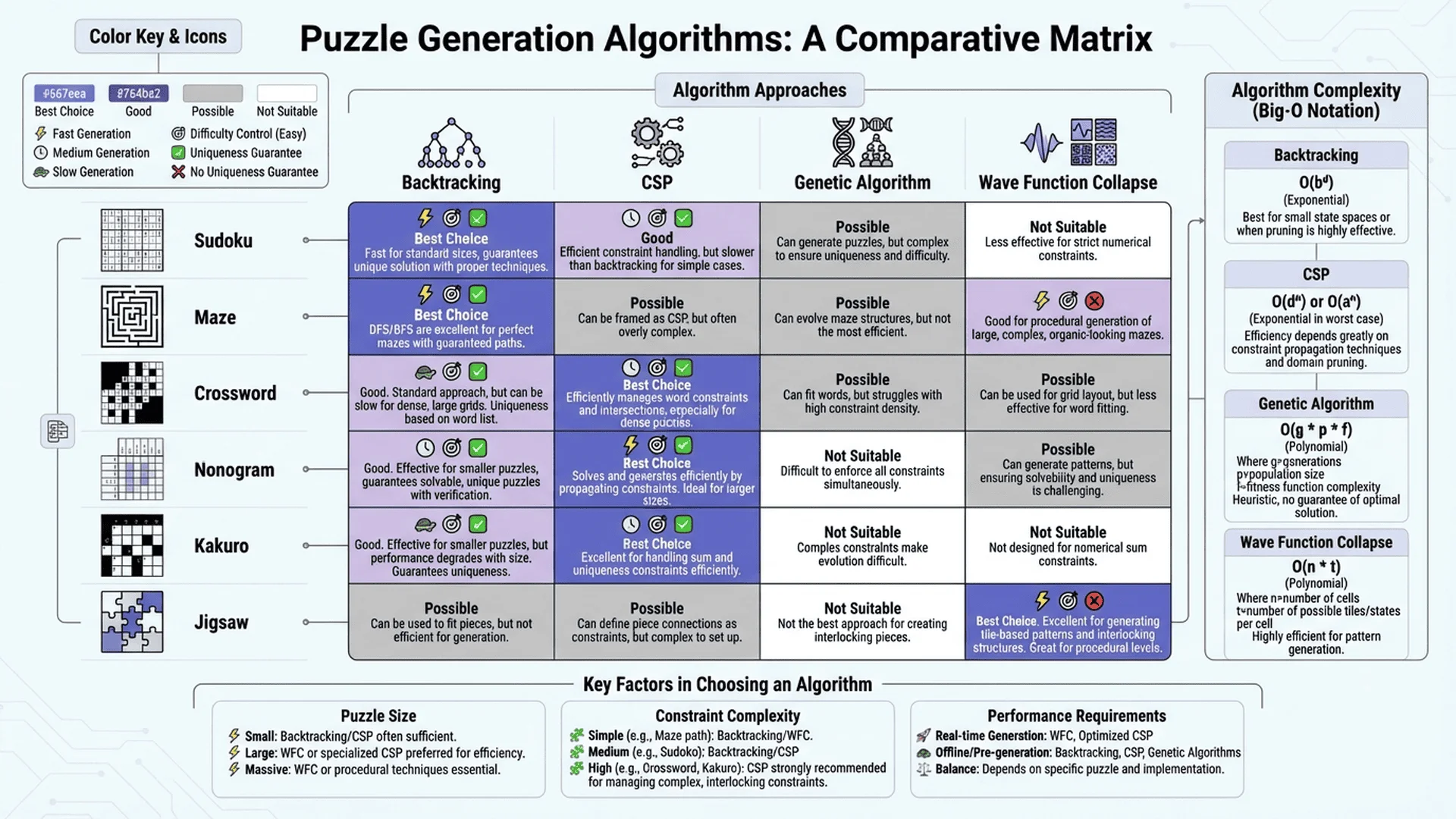
本文將深入探討謎題生成的核心演算法,從基礎的回溯法到高級的約束滿足問題,並提供實用的實現技巧和優化策略。
🔄 回溯演算法基礎
回溯演算法是謎題生成的基石,它透過系統性地嘗試所有可能的解決方案,並在遇到無效狀態時回溯到上一步,直到找到有效解。
回溯演算法的核心概念
基本回溯框架
function backtrack(state, depth) {
    // 1. 檢查是否達到目標
    if (isGoalState(state)) {
        return state;  // 找到解
    }

    // 2. 檢查是否超過深度限制
    if (depth > MAX_DEPTH) {
        return null;  // 搜索失敗
    }

    // 3. 生成所有可能的下一步選擇
    const choices = generateChoices(state);

    // 4. 嘗試每個選擇
    for (const choice of choices) {
        // 做出選擇
        const newState = makeChoice(state, choice);

        // 檢查選擇是否有效
        if (isValid(newState)) {
            // 遞迴搜索
            const result = backtrack(newState, depth + 1);

            // 如果找到解,返回
            if (result !== null) {
                return result;
            }
        }

        // 回溯(撤銷選擇)
        // JavaScript 中通過創建新狀態自動實現
    }

    // 5. 所有選擇都失敗
    return null;
}
數獨生成器的回溯實現
完整數獨生成器
class SudokuBacktrackGenerator {
    constructor() {
        this.grid = Array(9).fill(null).map(() => Array(9).fill(0));
    }

    // 生成完整的數獨解
    generate() {
        this.fillGrid(0, 0);
        return this.grid;
    }

    // 回溯填充網格
    fillGrid(row, col) {
        // 到達最後一格,完成
        if (row === 9) {
            return true;
        }

        // 計算下一個位置
        const nextRow = col === 8 ? row + 1 : row;
        const nextCol = col === 8 ? 0 : col + 1;

        // 生成隨機數字順序
        const numbers = this.shuffleArray([1, 2, 3, 4, 5, 6, 7, 8, 9]);

        // 嘗試每個數字
        for (const num of numbers) {
            if (this.isValidPlacement(row, col, num)) {
                // 做出選擇
                this.grid[row][col] = num;

                // 遞迴填充下一格
                if (this.fillGrid(nextRow, nextCol)) {
                    return true;
                }

                // 回溯
                this.grid[row][col] = 0;
            }
        }

        // 所有數字都不行
        return false;
    }

    // 檢查數字放置是否有效
    isValidPlacement(row, col, num) {
        // 檢查行
        for (let c = 0; c < 9; c++) {
            if (this.grid[row][c] === num) return false;
        }

        // 檢查列
        for (let r = 0; r < 9; r++) {
            if (this.grid[r][col] === num) return false;
        }

        // 檢查 3x3 宮格
        const boxRow = Math.floor(row / 3) * 3;
        const boxCol = Math.floor(col / 3) * 3;
        for (let r = boxRow; r < boxRow + 3; r++) {
            for (let c = boxCol; c < boxCol + 3; c++) {
                if (this.grid[r][c] === num) return false;
            }
        }

        return true;
    }

    // Fisher-Yates 洗牌算法
    shuffleArray(array) {
        const arr = [...array];
        for (let i = arr.length - 1; i > 0; i--) {
            const j = Math.floor(Math.random() * (i + 1));
            [arr[i], arr[j]] = [arr[j], arr[i]];
        }
        return arr;
    }
}
🎯 回溯演算法優化技巧
- 隨機化選擇順序:避免生成相同的謎題
- 早期失敗檢測:盡快識別無效狀態
- 約束傳播:在做出選擇時立即檢查相關約束
- 啟發式排序:優先嘗試更可能成功的選擇
🧩 約束滿足問題(CSP)
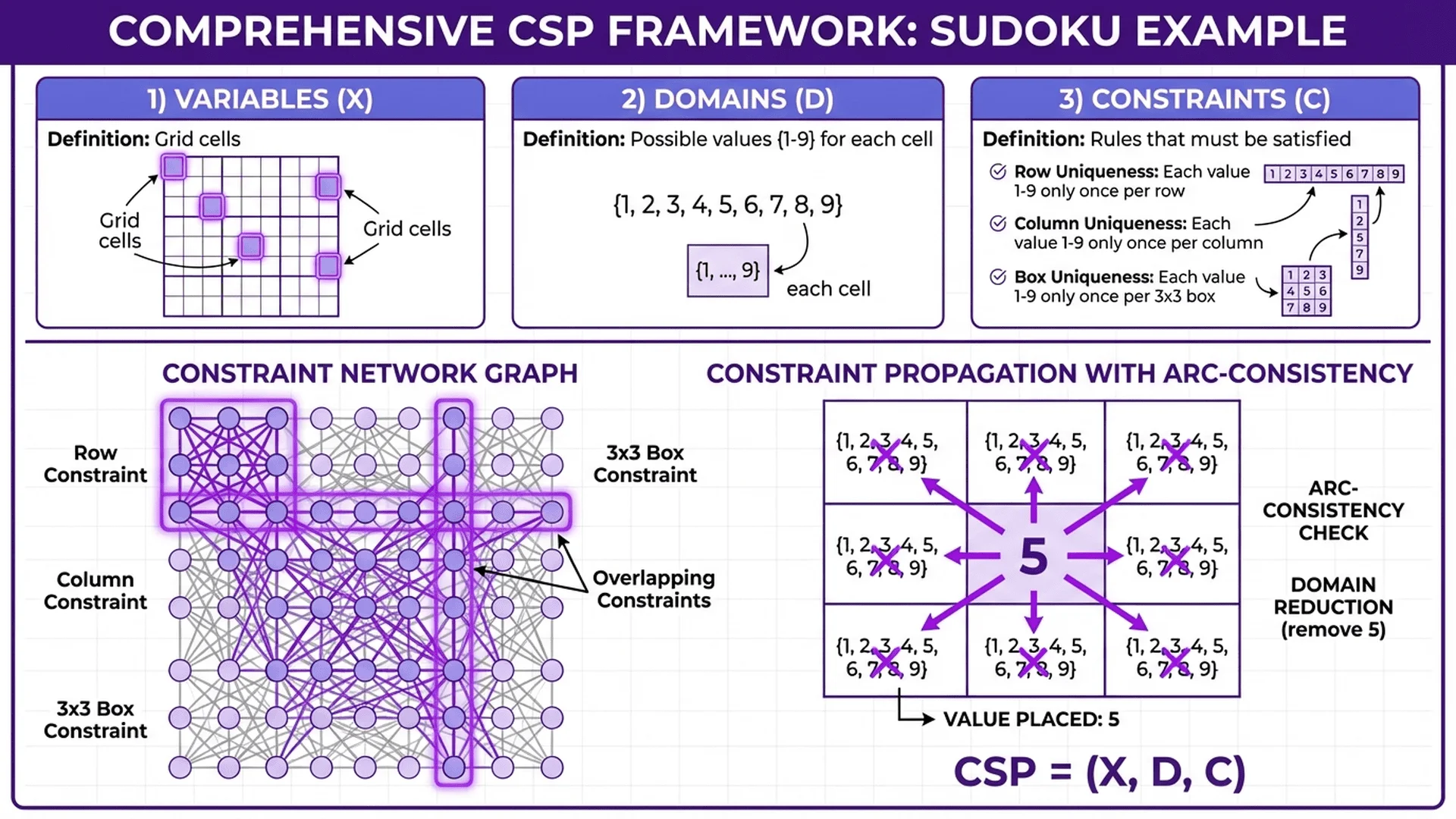
約束滿足問題(Constraint Satisfaction Problem, CSP)是一種更通用的問題建模方法,它將謎題生成形式化為變數、域和約束的組合。
CSP 的組成要素
📋 CSP 三要素
- 變數(Variables):需要賦值的對象(如數獨中的每個格子)
- 域(Domains):每個變數可能的取值範圍(如 1-9)
- 約束(Constraints):變數之間的限制關係(如同行不重複)
CSP 求解器實現
通用 CSP 求解器
class CSPSolver {
    constructor(variables, domains, constraints) {
        this.variables = variables;
        this.domains = domains;
        this.constraints = constraints;
        this.assignment = {};
    }

    // 主求解方法
    solve() {
        return this.backtrackSearch({});
    }

    // 回溯搜索
    backtrackSearch(assignment) {
        // 所有變數都已賦值
        if (Object.keys(assignment).length === this.variables.length) {
            return assignment;
        }

        // 選擇下一個變數(MRV 啟發式)
        const variable = this.selectUnassignedVariable(assignment);

        // 獲取變數的域值(LCV 啟發式)
        const values = this.orderDomainValues(variable, assignment);

        // 嘗試每個值
        for (const value of values) {
            if (this.isConsistent(variable, value, assignment)) {
                // 做出選擇
                assignment[variable] = value;

                // 前向檢查和約束傳播
                const inferences = this.inference(variable, value, assignment);

                if (inferences !== null) {
                    // 遞迴求解
                    const result = this.backtrackSearch(assignment);
                    if (result !== null) {
                        return result;
                    }
                }

                // 回溯
                delete assignment[variable];
                this.restoreInferences(inferences);
            }
        }

        return null;
    }

    // MRV(最少剩餘值)啟發式
    selectUnassignedVariable(assignment) {
        let minVariable = null;
        let minCount = Infinity;

        for (const variable of this.variables) {
            if (!(variable in assignment)) {
                const count = this.countLegalValues(variable, assignment);
                if (count < minCount) {
                    minCount = count;
                    minVariable = variable;
                }
            }
        }

        return minVariable;
    }

    // LCV(最少約束值)啟發式
    orderDomainValues(variable, assignment) {
        const values = [...this.domains[variable]];

        // 按照限制其他變數的程度排序
        values.sort((a, b) => {
            const constraintsA = this.countConstraints(variable, a, assignment);
            const constraintsB = this.countConstraints(variable, b, assignment);
            return constraintsA - constraintsB;
        });

        return values;
    }

    // 檢查賦值是否一致
    isConsistent(variable, value, assignment) {
        for (const constraint of this.constraints) {
            if (!constraint.isSatisfied(variable, value, assignment)) {
                return false;
            }
        }
        return true;
    }

    // 前向檢查和 AC-3 約束傳播
    inference(variable, value, assignment) {
        const inferences = {};

        // 對每個相關變數
        for (const neighbor of this.getNeighbors(variable)) {
            if (!(neighbor in assignment)) {
                // 從鄰居的域中移除不一致的值
                const removedValues = [];
                for (const neighborValue of this.domains[neighbor]) {
                    if (!this.isConsistent(neighbor, neighborValue,
                        {...assignment, [variable]: value})) {
                        removedValues.push(neighborValue);
                    }
                }

                // 如果域為空,失敗
                if (removedValues.length === this.domains[neighbor].length) {
                    return null;
                }

                inferences[neighbor] = removedValues;
            }
        }

        return inferences;
    }

    // 獲取相關變數
    getNeighbors(variable) {
        const neighbors = new Set();
        for (const constraint of this.constraints) {
            if (constraint.involves(variable)) {
                neighbors.add(...constraint.getOtherVariables(variable));
            }
        }
        return Array.from(neighbors);
    }

    // 計算合法值數量
    countLegalValues(variable, assignment) {
        let count = 0;
        for (const value of this.domains[variable]) {
            if (this.isConsistent(variable, value, assignment)) {
                count++;
            }
        }
        return count;
    }

    // 計算約束數量
    countConstraints(variable, value, assignment) {
        let count = 0;
        const testAssignment = {...assignment, [variable]: value};

        for (const neighbor of this.getNeighbors(variable)) {
            if (!(neighbor in assignment)) {
                for (const neighborValue of this.domains[neighbor]) {
                    if (!this.isConsistent(neighbor, neighborValue, testAssignment)) {
                        count++;
                    }
                }
            }
        }

        return count;
    }

    // 恢復推論
    restoreInferences(inferences) {
        // 實現推論恢復邏輯
    }
}
🚀 CSP 優化策略
- 變數排序:MRV(最少剩餘值)優先選擇約束最多的變數
- 值排序:LCV(最少約束值)優先嘗試約束最少的值
- 前向檢查:立即檢測不一致並剪枝
- AC-3 算法:強制弧一致性,提前發現衝突
📊 難度評估技術
生成不同難度的謎題是謎題生成器的關鍵功能。難度評估需要考慮多個因素,從表面特徵到求解複雜度。
難度評估的多維度方法
🎯 難度評估因素
- 提示數量:給定的初始線索數量
- 求解技巧:需要使用的解題技巧類型
- 分支因子:每步選擇的平均數量
- 搜索深度:找到解需要的步驟數
- 對稱性:謎題的對稱模式
- 回溯次數:求解器回溯的次數
數獨難度評估器
智能難度評估系統
class SudokuDifficultyAssessor {
    constructor(puzzle) {
        this.puzzle = puzzle;
        this.techniques = {
            nakedSingle: 1,
            hiddenSingle: 2,
            nakedPair: 3,
            hiddenPair: 4,
            pointing: 5,
            xWing: 7,
            swordfish: 8,
            xyWing: 9,
            coloring: 10
        };
    }

    // 評估難度
    assessDifficulty() {
        const metrics = {
            clueCount: this.countClues(),
            requiredTechniques: this.analyzeRequiredTechniques(),
            branchingFactor: this.calculateBranchingFactor(),
            symmetry: this.checkSymmetry(),
            backtrackCount: this.countBacktracks()
        };

        const difficulty = this.calculateOverallDifficulty(metrics);

        return {
            level: this.getDifficultyLevel(difficulty),
            score: difficulty,
            metrics: metrics,
            explanation: this.generateExplanation(metrics)
        };
    }

    // 計算線索數量
    countClues() {
        let count = 0;
        for (let row = 0; row < 9; row++) {
            for (let col = 0; col < 9; col++) {
                if (this.puzzle[row][col] !== 0) {
                    count++;
                }
            }
        }
        return count;
    }

    // 分析需要的解題技巧
    analyzeRequiredTechniques() {
        const usedTechniques = [];
        const solver = new SudokuSolver(this.puzzle);

        // 嘗試使用不同技巧求解
        if (solver.tryNakedSingles()) {
            usedTechniques.push('nakedSingle');
        }
        if (solver.tryHiddenSingles()) {
            usedTechniques.push('hiddenSingle');
        }
        if (solver.tryNakedPairs()) {
            usedTechniques.push('nakedPair');
        }
        if (solver.tryXWing()) {
            usedTechniques.push('xWing');
        }

        // 計算最高技巧難度
        let maxDifficulty = 0;
        for (const technique of usedTechniques) {
            if (this.techniques[technique] > maxDifficulty) {
                maxDifficulty = this.techniques[technique];
            }
        }

        return {
            techniques: usedTechniques,
            maxDifficulty: maxDifficulty
        };
    }

    // 計算分支因子
    calculateBranchingFactor() {
        let totalChoices = 0;
        let emptyCells = 0;

        for (let row = 0; row < 9; row++) {
            for (let col = 0; col < 9; col++) {
                if (this.puzzle[row][col] === 0) {
                    emptyCells++;
                    totalChoices += this.countPossibleValues(row, col);
                }
            }
        }

        return emptyCells > 0 ? totalChoices / emptyCells : 0;
    }

    // 計算可能值數量
    countPossibleValues(row, col) {
        const possible = new Set([1, 2, 3, 4, 5, 6, 7, 8, 9]);

        // 移除行中的值
        for (let c = 0; c < 9; c++) {
            possible.delete(this.puzzle[row][c]);
        }

        // 移除列中的值
        for (let r = 0; r < 9; r++) {
            possible.delete(this.puzzle[r][col]);
        }

        // 移除宮格中的值
        const boxRow = Math.floor(row / 3) * 3;
        const boxCol = Math.floor(col / 3) * 3;
        for (let r = boxRow; r < boxRow + 3; r++) {
            for (let c = boxCol; c < boxCol + 3; c++) {
                possible.delete(this.puzzle[r][c]);
            }
        }

        return possible.size;
    }

    // 檢查對稱性
    checkSymmetry() {
        // 檢查 180° 旋轉對稱
        let rotation180 = true;
        for (let row = 0; row < 9; row++) {
            for (let col = 0; col < 9; col++) {
                const oppositeRow = 8 - row;
                const oppositeCol = 8 - col;
                const cell1 = this.puzzle[row][col];
                const cell2 = this.puzzle[oppositeRow][oppositeCol];

                if ((cell1 === 0) !== (cell2 === 0)) {
                    rotation180 = false;
                    break;
                }
            }
            if (!rotation180) break;
        }

        return rotation180 ? 'rotation180' : 'none';
    }

    // 計算回溯次數
    countBacktracks() {
        const solver = new SudokuBacktrackSolver(this.puzzle);
        return solver.solveWithBacktrackCount();
    }

    // 計算整體難度
    calculateOverallDifficulty(metrics) {
        let score = 0;

        // 線索數量影響(線索越少越難)
        score += (81 - metrics.clueCount) * 0.5;

        // 技巧難度影響
        score += metrics.requiredTechniques.maxDifficulty * 10;

        // 分支因子影響
        score += metrics.branchingFactor * 5;

        // 回溯次數影響
        score += Math.log(metrics.backtrackCount + 1) * 3;

        // 對稱性影響(對稱謎題通常更簡單)
        if (metrics.symmetry !== 'none') {
            score -= 5;
        }

        return score;
    }

    // 獲取難度級別
    getDifficultyLevel(score) {
        if (score < 20) return 'Easy';
        if (score < 40) return 'Medium';
        if (score < 60) return 'Hard';
        if (score < 80) return 'Expert';
        return 'Evil';
    }

    // 生成解釋
    generateExplanation(metrics) {
        const parts = [];

        parts.push(`線索數量: ${metrics.clueCount}/81`);
        parts.push(`需要技巧: ${metrics.requiredTechniques.techniques.join(', ')}`);
        parts.push(`平均分支因子: ${metrics.branchingFactor.toFixed(2)}`);
        parts.push(`回溯次數: ${metrics.backtrackCount}`);
        parts.push(`對稱性: ${metrics.symmetry}`);

        return parts.join(' | ');
    }
}
✅ 唯一解保證方法
許多謎題類型要求有且僅有一個解。保證唯一解是謎題生成中最具挑戰性的部分之一。
唯一解驗證策略
唯一解驗證器
class UniqueSolutionVerifier {
    constructor(puzzle) {
        this.puzzle = puzzle;
        this.solutionCount = 0;
        this.maxSolutions = 2;  // 只需要知道是否多於1個解
    }

    // 驗證是否有唯一解
    hasUniqueSolution() {
        this.solutionCount = 0;
        this.countSolutions(this.copyPuzzle(), 0, 0);
        return this.solutionCount === 1;
    }

    // 計算解的數量
    countSolutions(grid, row, col) {
        // 已找到足夠的解,提前結束
        if (this.solutionCount >= this.maxSolutions) {
            return;
        }

        // 找到下一個空格
        while (row < 9 && grid[row][col] !== 0) {
            col++;
            if (col === 9) {
                col = 0;
                row++;
            }
        }

        // 到達末尾,找到一個解
        if (row === 9) {
            this.solutionCount++;
            return;
        }

        // 嘗試每個數字
        for (let num = 1; num <= 9; num++) {
            if (this.isValid(grid, row, col, num)) {
                grid[row][col] = num;
                this.countSolutions(grid, row, col);
                grid[row][col] = 0;  // 回溯
            }
        }
    }

    // 檢查放置是否有效
    isValid(grid, row, col, num) {
        // 檢查行
        for (let c = 0; c < 9; c++) {
            if (grid[row][c] === num) return false;
        }

        // 檢查列
        for (let r = 0; r < 9; r++) {
            if (grid[r][col] === num) return false;
        }

        // 檢查宮格
        const boxRow = Math.floor(row / 3) * 3;
        const boxCol = Math.floor(col / 3) * 3;
        for (let r = boxRow; r < boxRow + 3; r++) {
            for (let c = boxCol; c < boxCol + 3; c++) {
                if (grid[r][c] === num) return false;
            }
        }

        return true;
    }

    // 複製謎題
    copyPuzzle() {
        return this.puzzle.map(row => [...row]);
    }
}

// 帶唯一解保證的謎題生成器
class UniquePuzzleGenerator {
    generateUniquePuzzle(cluesCount) {
        // 1. 生成完整的解
        const solution = this.generateCompleteSolution();

        // 2. 創建空謎題
        const puzzle = solution.map(row => [...row]);

        // 3. 隨機移除數字直到達到目標線索數
        const cellsToRemove = 81 - cluesCount;
        let removed = 0;

        // 創建所有格子的列表
        const cells = [];
        for (let r = 0; r < 9; r++) {
            for (let c = 0; c < 9; c++) {
                cells.push([r, c]);
            }
        }

        // 隨機打亂格子順序
        this.shuffleArray(cells);

        // 嘗試移除每個格子
        for (const [row, col] of cells) {
            if (removed >= cellsToRemove) break;

            // 備份當前值
            const backup = puzzle[row][col];
            puzzle[row][col] = 0;

            // 檢查是否仍有唯一解
            const verifier = new UniqueSolutionVerifier(puzzle);
            if (!verifier.hasUniqueSolution()) {
                // 恢復值
                puzzle[row][col] = backup;
            } else {
                removed++;
            }
        }

        return puzzle;
    }

    // 生成完整解(使用前面的回溯生成器)
    generateCompleteSolution() {
        const generator = new SudokuBacktrackGenerator();
        return generator.generate();
    }

    // 洗牌
    shuffleArray(array) {
        for (let i = array.length - 1; i > 0; i--) {
            const j = Math.floor(Math.random() * (i + 1));
            [array[i], array[j]] = [array[j], array[i]];
        }
    }
}
⚠️ 唯一解驗證的性能考慮
唯一解驗證可能非常耗時,特別是對於線索較少的謎題。優化策略:
- 早期終止:找到第二個解時立即停止
- 對稱性:利用對稱性減少驗證次數
- 智能移除:優先移除約束較強的格子
- 批量驗證:一次移除多個格子再驗證
🚀 演算法優化技巧
謎題生成可能計算密集,特別是對於大型或複雜的謎題。以下是一些關鍵的優化技術。
性能優化策略
💡 優化技術總覽
- 位運算:使用位元來表示域和約束
- 記憶化:快取重複計算的結果
- 啟發式搜索:使用智能策略引導搜索
- 並行化:利用多核心同時生成多個謎題
- 漸進式生成:分階段生成,避免一次性計算
位運算優化實現
使用位運算的高效求解器
class BitBasedSudokuSolver {
    constructor(puzzle) {
        this.grid = puzzle;
        // 使用位元表示每個單元的可能值
        // 例如: 0b111111111 表示 1-9 都可能
        this.possibilities = Array(9).fill(null)
            .map(() => Array(9).fill(0b111111111));
        this.initializePossibilities();
    }

    // 初始化可能性位元
    initializePossibilities() {
        for (let row = 0; row < 9; row++) {
            for (let col = 0; col < 9; col++) {
                if (this.grid[row][col] !== 0) {
                    const num = this.grid[row][col];
                    this.possibilities[row][col] = 1 << (num - 1);
                    this.propagateConstraint(row, col, num);
                }
            }
        }
    }

    // 傳播約束
    propagateConstraint(row, col, num) {
        const mask = ~(1 << (num - 1));

        // 移除行中的可能性
        for (let c = 0; c < 9; c++) {
            if (c !== col) {
                this.possibilities[row][c] &= mask;
            }
        }

        // 移除列中的可能性
        for (let r = 0; r < 9; r++) {
            if (r !== row) {
                this.possibilities[r][col] &= mask;
            }
        }

        // 移除宮格中的可能性
        const boxRow = Math.floor(row / 3) * 3;
        const boxCol = Math.floor(col / 3) * 3;
        for (let r = boxRow; r < boxRow + 3; r++) {
            for (let c = boxCol; c < boxCol + 3; c++) {
                if (r !== row || c !== col) {
                    this.possibilities[r][c] &= mask;
                }
            }
        }
    }

    // 計算位元中設置的位數(可能值數量)
    countBits(n) {
        let count = 0;
        while (n) {
            count += n & 1;
            n >>= 1;
        }
        return count;
    }

    // 獲取位元中最低的設置位(最小的可能值)
    getLowestBit(n) {
        return n & -n;
    }

    // 位元到數字
    bitToNumber(bit) {
        for (let i = 0; i < 9; i++) {
            if (bit & (1 << i)) {
                return i + 1;
            }
        }
        return 0;
    }

    // 求解
    solve() {
        return this.backtrack();
    }

    // 回溯搜索
    backtrack() {
        // 找到可能性最少的空格(MRV 啟發式)
        let minRow = -1, minCol = -1, minCount = 10;

        for (let row = 0; row < 9; row++) {
            for (let col = 0; col < 9; col++) {
                if (this.grid[row][col] === 0) {
                    const count = this.countBits(this.possibilities[row][col]);

                    // 發現矛盾
                    if (count === 0) {
                        return false;
                    }

                    if (count < minCount) {
                        minCount = count;
                        minRow = row;
                        minCol = col;
                    }
                }
            }
        }

        // 所有格子都填滿,完成
        if (minRow === -1) {
            return true;
        }

        // 保存當前狀態
        const savedPossibilities = this.savePossibilities();

        // 嘗試每個可能的值
        let possible = this.possibilities[minRow][minCol];
        while (possible) {
            const bit = this.getLowestBit(possible);
            const num = this.bitToNumber(bit);

            // 做出選擇
            this.grid[minRow][minCol] = num;
            this.possibilities[minRow][minCol] = bit;
            this.propagateConstraint(minRow, minCol, num);

            // 遞迴求解
            if (this.backtrack()) {
                return true;
            }

            // 回溯
            this.restorePossibilities(savedPossibilities);
            this.grid[minRow][minCol] = 0;

            // 移除已嘗試的位元
            possible &= ~bit;
        }

        return false;
    }

    // 保存可能性狀態
    savePossibilities() {
        return this.possibilities.map(row => [...row]);
    }

    // 恢復可能性狀態
    restorePossibilities(saved) {
        for (let row = 0; row < 9; row++) {
            for (let col = 0; col < 9; col++) {
                this.possibilities[row][col] = saved[row][col];
            }
        }
    }
}
🎯 實戰優化建議
- 選擇合適的數據結構:使用位元、哈希表等高效結構
- 減少冗餘計算:快取和記憶化重複結果
- 智能剪枝:盡早識別無效分支
- 使用啟發式:MRV、LCV 等引導搜索
- 分段驗證:在生成過程中逐步驗證,而非最後驗證
🎓 結論與資源
關鍵要點總結
- 回溯演算法是基礎:理解回溯是掌握謎題生成的第一步
- CSP 提供通用框架:約束滿足問題可以建模各種謎題
- 難度評估需多維度:綜合考慮多個因素才能準確評估
- 唯一解驗證很重要:但要注意性能影響
- 優化是持續過程:從位運算到並行化,都能提升性能
進階學習資源
📚 推薦書籍
- Artificial Intelligence: A Modern Approach - Russell & Norvig
- Algorithm Design Manual - Steven Skiena
- Heuristics: Intelligent Search Strategies - Judea Pearl
🔗 線上資源
- Constraint Programming (Wikipedia)
- CSP-Solver GitHub 專案
- Algorithm Visualizations (VisuAlgo)