隨機數產生器完整指南
Random Number Generator Complete Guide【2025】| 7 Online Tools, Python/Excel Code & Real Applications
Ever wondered how online lottery systems pick winning numbers? Or how games decide random outcomes?
Random number generators power everything from casino slots to cryptographic security. In this comprehensive guide, you'll discover how to generate random numbers instantly, implement them in your code, and apply them to real-world scenarios.
💻 Quick Start: Try our Random Number Generator now - supports 1-10, 1-100, custom ranges, no-repeat mode, and wheel visualization. Completely free, no registration required!
Introduction: Understanding Random Number Generators
A random number generator (RNG) is a tool or algorithm that produces a sequence of numbers with no predictable pattern. These numbers appear random and independent of each other, making them essential for applications requiring unpredictability.
In our digital world, random numbers are everywhere. When you shuffle a Spotify playlist, the system uses a random number generator to create an unpredictable order. When websites generate secure passwords, they rely on cryptographically secure random numbers. Even weather simulations and financial modeling depend on random number generation.
But here's the interesting part: most "random" numbers generated by computers aren't truly random. They're pseudo-random, created by mathematical algorithms that produce sequences appearing random but are actually deterministic. This raises fascinating questions about randomness, predictability, and security.
What is a Random Number Generator? Basic Concepts Explained
Defining Random Number Generation
At its core, a random number generator produces numbers that lack any discernible pattern. Think of rolling a fair die - each outcome (1 through 6) has an equal probability of appearing, and the result of one roll doesn't influence the next.
Random number generators serve three primary purposes:
- Unpredictability: Each generated number cannot be predicted from previous numbers
- Uniform Distribution: All possible numbers within a range have equal probability
- Independence: Each number generation is independent of others
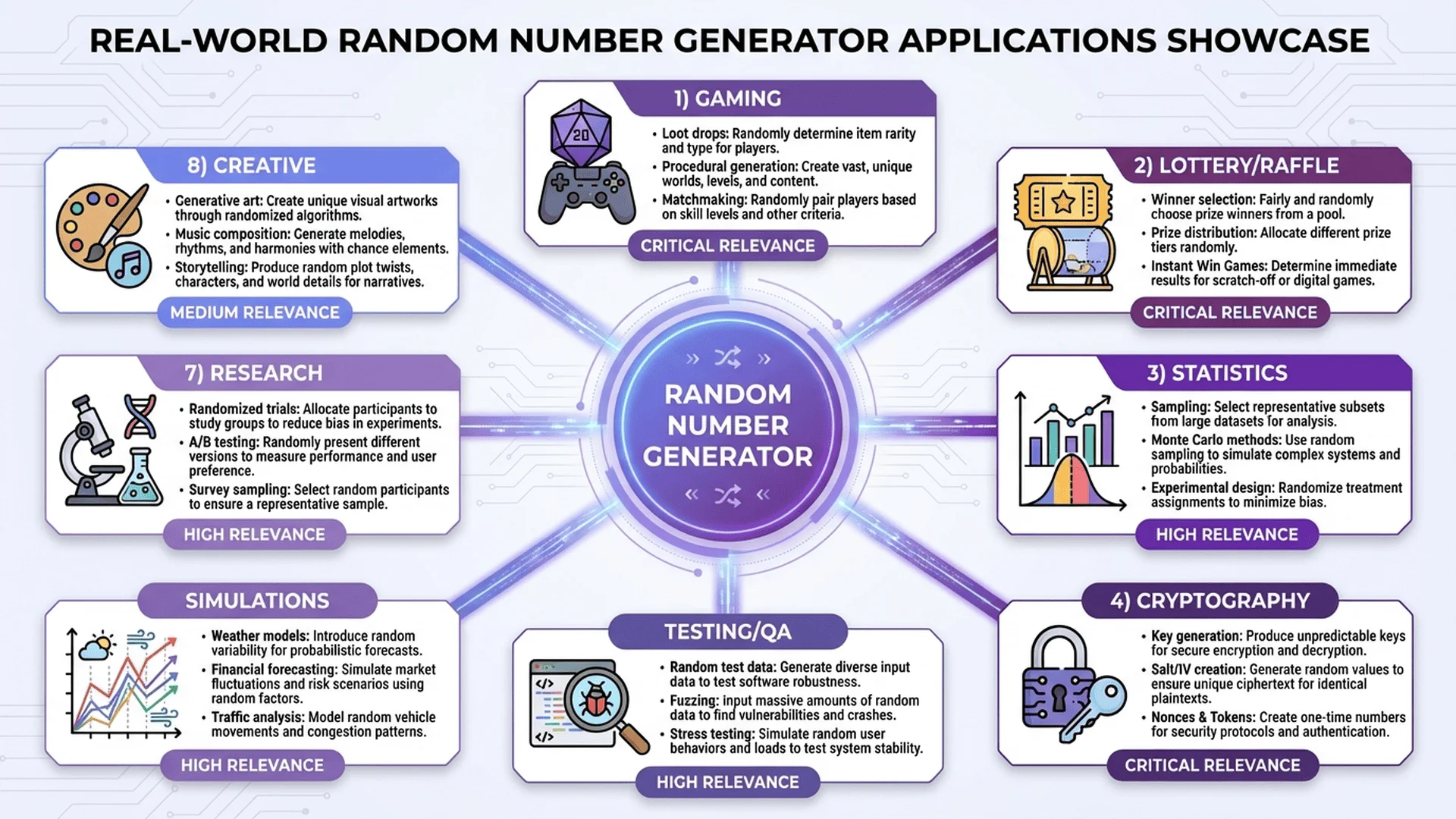
Real-World Applications
Random numbers aren't just theoretical concepts. They power critical functions in our daily lives:
- Gaming: Determining loot drops, enemy spawns, procedural terrain generation
- Security: Creating encryption keys, session IDs, password salts
- Statistics: Random sampling for surveys, Monte Carlo simulations
- Lotteries: Selecting winning numbers for Powerball, Mega Millions
- Quality Control: Random product testing in manufacturing
- A/B Testing: Randomly assigning users to test groups
Why We Need Random Numbers
The need for randomness might seem counterintuitive in a world of computers designed for precision. But randomness provides unique value:
Fairness: Random selection ensures equal opportunity. When a teacher randomly picks students to answer questions, it's perceived as fairer than systematic selection.
Security: Cryptographic systems rely on unpredictability. A truly random encryption key is virtually impossible to crack through brute force.
Simulation: Complex systems like weather patterns or financial markets require random variables to model real-world uncertainty accurately.
Testing: Random data helps developers test edge cases and discover bugs that might not appear with predictable test data.
Want to start generating random numbers immediately? Use our Random Number Generator with customizable ranges from 1-10 to any value you need.
Types of Random Number Generators Comparison
Not all random number generators are created equal. Understanding the differences helps you choose the right tool for your needs.
Pseudo-Random Number Generator (PRNG)
Definition: A PRNG uses mathematical algorithms to generate sequences that appear random but are actually deterministic. Given the same starting point (seed), a PRNG will always produce the same sequence.
How It Works:
PRNGs use complex mathematical formulas to transform an initial seed value into a seemingly random sequence. The most common algorithm is the Linear Congruential Generator (LCG), which uses this formula:
X(n+1) = (a × X(n) + c) mod m
Where:
- X(n) is the current random number
- a, c, m are carefully chosen constants
- X(n+1) is the next random number
Advantages:
- Fast: Computationally efficient, generates millions of numbers per second
- Reproducible: Same seed produces identical sequences (useful for debugging)
- No special hardware required: Works on any computer
- Predictable storage needs: Requires minimal memory
Disadvantages:
- Theoretically predictable: With enough output samples, the sequence can be reverse-engineered
- Periodic: Eventually repeats (though periods can be astronomically long)
- Not suitable for cryptography: Insufficient randomness for security applications
Common Algorithms:
- Linear Congruential Generator (LCG)
- Mersenne Twister (widely used in programming languages)
- Xorshift family
- PCG (Permuted Congruential Generator)
Typical Use Cases: Games, simulations, general-purpose random number needs, statistical sampling
True Random Number Generator (TRNG)
Definition: A TRNG generates numbers from physical phenomena that are inherently unpredictable, such as atmospheric noise, radioactive decay, or quantum mechanical events.
How It Works:
TRNGs measure physical processes:
- Atmospheric Noise: Radio receivers capture unpredictable atmospheric electromagnetic noise
- Radioactive Decay: Detects timing of radioactive particle emissions (truly quantum random)
- Thermal Noise: Measures random electrical noise in resistors
- Quantum Phenomena: Observes quantum superposition collapse (most secure)
Advantages:
- True unpredictability: Impossible to predict even with complete knowledge of the system
- Non-periodic: Never repeats (unlike PRNGs)
- Cryptographically secure: Suitable for encryption keys, security tokens
- Highest entropy: Maximum randomness quality
Disadvantages:
- Slower: Physical measurements take time
- Hardware dependent: Requires specialized equipment
- Expensive: Quantum RNGs cost thousands of dollars
- Environmental sensitivity: Can be affected by electromagnetic interference
Sources of True Randomness:
- Random.org: Uses atmospheric noise from radio receivers
- Quantum RNGs: Measure quantum photon behavior
- Hardware RNG chips: Built into some modern CPUs (Intel's RdRand)
- Lava lamps: Cloudflare uses lava lamp images as entropy source
Typical Use Cases: Cryptographic key generation, security tokens, blockchain, military applications, high-stakes lottery systems
Comparison Table
| Feature | Pseudo-Random (PRNG) | True Random (TRNG) |
|---|---|---|
| Generation Speed | Very fast (millions/sec) | Slower (thousands/sec) |
| Reproducibility | Yes (with same seed) | No |
| Predictability | Theoretically predictable | Completely unpredictable |
| Cost | Free (software only) | Expensive (hardware required) |
| Use Case | Games, simulations, general use | Cryptography, security keys |
| Entropy Source | Mathematical algorithm | Physical phenomena |
| Security Level | Low to Medium | High to Maximum |
| Availability | Everywhere | Limited to special hardware |
Which Should You Use?
Choose PRNG when:
- Building games or simulations
- Need reproducible results for debugging
- Speed is critical
- Security isn't a concern
- Running statistical experiments
Choose TRNG when:
- Generating encryption keys
- Creating security tokens
- Building financial systems
- Maximum unpredictability required
- Cryptographic applications
Hybrid Approach:
Many systems combine both. They use TRNG to generate a seed, then use PRNG for day-to-day random number generation, periodically re-seeding from the TRNG. This provides both security and performance.
For most practical applications, modern PRNGs like Mersenne Twister provide sufficient randomness. Our Random Number Generator tool uses cryptographically secure algorithms for balanced performance and security.
How to Use a Random Number Generator? Practical Tutorial
Online Random Number Generator Tools
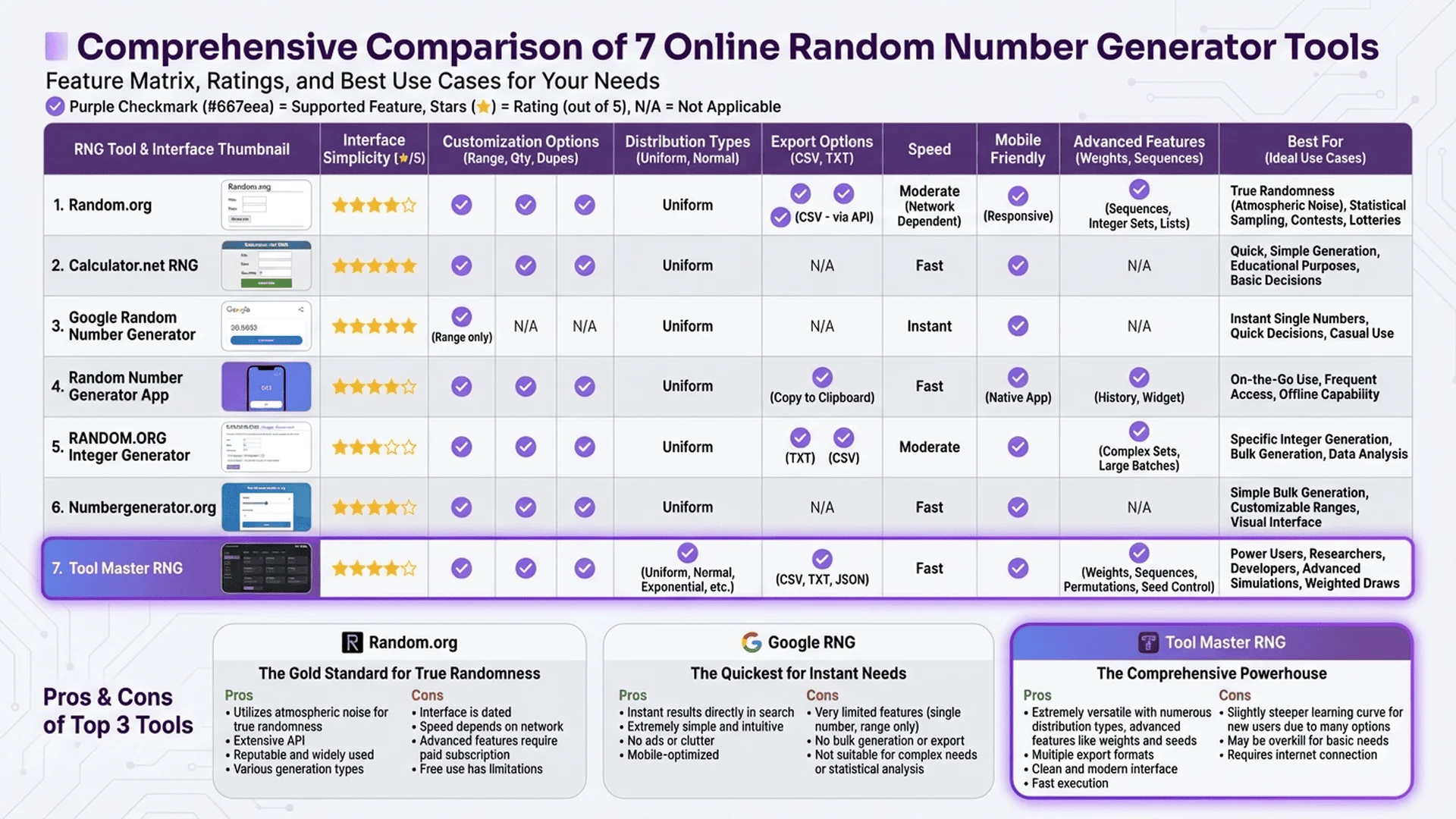
The easiest way to generate random numbers is using online tools. Here's a comparison of the top options:
1. Tool Master Random Number Generator (Recommended)
Our platform offers the most comprehensive features:
- Custom ranges: Any range from 1-10 to millions
- No-repeat mode: Generate unique numbers without duplicates
- Batch generation: Create multiple numbers at once
- Wheel visualization: Interactive spinning wheel for engaging presentations
- 100% local processing: Your data never leaves your browser
- No registration: Instant access, completely free
→ Try Tool Master Random Number Generator
2. Random.org
Uses atmospheric noise for true randomness:
- True random numbers (TRNG)
- API access available
- Historical data archiving
- Paid premium features for higher limits
3. Google Random Number Generator
Built into Google Search:
- Type "random number generator" in Google
- Default range 1-100
- Instant results
- Limited to single number generation
4. Calculator Soup
Feature-rich online calculator:
- Multiple random number types
- Statistical distribution options
- Educational explanations
- Free with ads
Step-by-Step Usage Guide
Using an online random number generator is straightforward:
Step 1: Set Your Range
Decide the minimum and maximum values. Common ranges:
- 1-10: Small group selection, simple decisions
- 1-100: Percentages, test scores, general randomization
- 1-6: Dice simulation
- Custom: Any range you need
Step 2: Choose Quantity
Specify how many random numbers you need:
- Single number for simple decisions
- Multiple numbers for lottery picks or sampling
- Large batches for data analysis or testing
Step 3: Enable/Disable Duplicates
- Allow duplicates: Each number independent (like rolling dice multiple times)
- No duplicates: Each number unique (like drawing cards from a deck)
Step 4: Generate
Click the generate button. Most tools display results instantly.
Step 5: Copy or Export
- Copy individual numbers
- Download as CSV for spreadsheet import
- Export as TXT for programming use
Common Range Quick Access
Most tools offer preset ranges for convenience:
1-10 Random Number Generator:
- Perfect for small group selection
- Dice simulation (1-6 subset)
- Rating scales
- Quick decisions
1-100 Random Number Generator:
- Most popular range
- Percentage calculations
- Test score randomization
- General-purpose randomization
1-6 Random Number Generator:
- Standard die simulation
- Board game mechanics
- Probability teaching
1-2 Random Number Generator:
- Binary decisions (yes/no)
- Coin flip simulation
- A/B testing assignment
Custom Range:
- Define any minimum and maximum
- Lottery number ranges (1-49, 1-69, etc.)
- Specific application needs
Need to generate numbers in a specific range? Our Random Number Generator supports any range with instant results.
🎯 Recommended Tool Combinations
When working with random data, these tools can significantly boost your efficiency:
| Tool | Use Case | Key Feature |
|---|---|---|
| Random Number Generator | Generate numbers, lottery picks | No-repeat mode, wheel visualization |
| JSON Parser | Process API data with random values | Intelligent format validation |
| Unit Converter | Convert random measurement values | 79 unit types supported |
| Password Generator | Create secure random passwords | Cryptographically secure |
💡 Pro Tip: All Tool Master tools are completely free and process data locally in your browser for maximum privacy and security.
Programming Language Implementation Tutorials
For developers, implementing random number generation in code provides flexibility and automation capabilities.
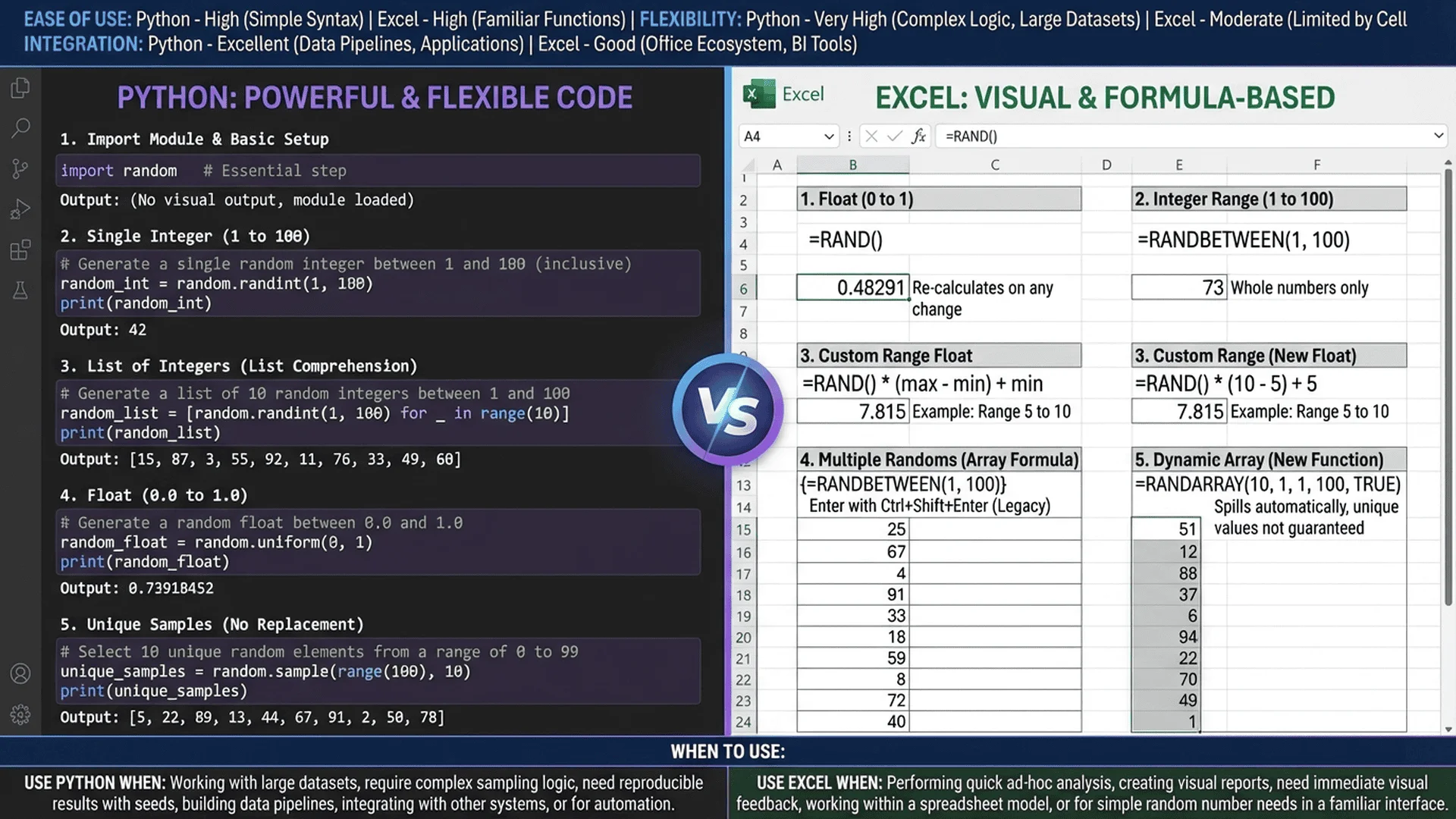
Python Random Number Generation
Python's random module provides comprehensive random number generation:
Basic Random Integer:
import random

# Generate random integer between 1-100
number = random.randint(1, 100)
print(f"Random number: {number}")
Random Float (0-1):
# Generate random float between 0.0 and 1.0
float_number = random.random()
print(f"Random float: {float_number}")

# Scale to specific range (e.g., 0-100)
scaled = random.random() * 100
print(f"Scaled float: {scaled}")
Random Choice from List:
# Select random item from list
options = ['Rock', 'Paper', 'Scissors']
result = random.choice(options)
print(f"Selected: {result}")
Generate Unique Random Numbers (No Repeats):
# Generate 10 unique random numbers from 1-100
unique_numbers = random.sample(range(1, 101), 10)
print(f"Unique numbers: {unique_numbers}")
Set Seed for Reproducibility:
# Set seed to get same sequence every time
random.seed(42)
print(random.randint(1, 100))  # Always produces same number

# Reset to time-based seed
random.seed()
Advanced: Weighted Random Selection:
# Random selection with weights
items = ['common', 'uncommon', 'rare', 'legendary']
weights = [50, 30, 15, 5]  # Probabilities
result = random.choices(items, weights=weights, k=1)[0]
print(f"Loot drop: {result}")
For comprehensive Python random number generation techniques, check our detailed Python Random Number Tutorial.
Excel Random Number Generation
Excel provides built-in functions for random number generation:
RANDBETWEEN Function:
# Generate random integer between 1-100
=RANDBETWEEN(1, 100)
RAND Function (0-1 decimal):
# Generate random decimal between 0 and 1
=RAND()

# Scale to 0-100 range
=RAND() * 100

# Convert to integer
=INT(RAND() * 100) + 1
Generate Unique Random Numbers (No Duplicates):
Method 1 - Using RANK:
# Step 1: In A1:A100, enter =RAND()
# Step 2: In B1:B100, enter =RANK(A1, $A$1:$A$100)
# Column B now contains 1-100 in random order (no duplicates)
Method 2 - Using UNIQUE + RANDARRAY (Excel 365):
=UNIQUE(RANDARRAY(10, 1, 1, 100, TRUE))
Fix Random Numbers (Prevent Auto-Recalculation):
# After generating random numbers:
# 1. Copy the cells
# 2. Right-click → Paste Special → Values
# Numbers are now fixed and won't change
Random Selection from List:
# If list is in A1:A10
=INDEX(A1:A10, RANDBETWEEN(1, 10))
Want to master Excel random functions? Our Excel Random Number Generator Tutorial provides detailed formulas, VBA scripts, and troubleshooting tips.
JavaScript Random Number Generation
JavaScript uses Math.random() for random number generation:
Basic Random Float (0-1):
const randomFloat = Math.random();
console.log(`Random float: ${randomFloat}`);
Random Integer in Range:
// Function to generate random integer between min and max (inclusive)
function getRandomInt(min, max) {
  return Math.floor(Math.random() * (max - min + 1)) + min;
}

const randomNumber = getRandomInt(1, 100);
console.log(`Random number: ${randomNumber}`);
Generate Unique Random Numbers Array:
function generateUniqueRandomNumbers(min, max, count) {
  const numbers = [];

  while (numbers.length < count) {
    const num = getRandomInt(min, max);
    if (!numbers.includes(num)) {
      numbers.push(num);
    }
  }

  return numbers;
}

const uniqueNumbers = generateUniqueRandomNumbers(1, 100, 10);
console.log(`Unique numbers: ${uniqueNumbers}`);
Shuffle Array (Fisher-Yates Algorithm):
function shuffleArray(array) {
  const shuffled = [...array]; // Create copy

  for (let i = shuffled.length - 1; i > 0; i--) {
    const j = Math.floor(Math.random() * (i + 1));
    [shuffled[i], shuffled[j]] = [shuffled[j], shuffled[i]]; // Swap
  }

  return shuffled;
}

const deck = [1, 2, 3, 4, 5, 6, 7, 8, 9, 10];
console.log(`Shuffled: ${shuffleArray(deck)}`);
Weighted Random Selection:
function weightedRandom(items, weights) {
  const totalWeight = weights.reduce((sum, weight) => sum + weight, 0);
  let random = Math.random() * totalWeight;

  for (let i = 0; i < items.length; i++) {
    random -= weights[i];
    if (random <= 0) {
      return items[i];
    }
  }
}

const loot = ['common', 'uncommon', 'rare', 'legendary'];
const dropRates = [50, 30, 15, 5];
console.log(`Dropped: ${weightedRandom(loot, dropRates)}`);
Java Random Number Generation
Java provides multiple approaches for random number generation:
Method 1: Random Class:
import java.util.Random;

public class RandomExample {
    public static void main(String[] args) {
        Random rand = new Random();

        // Random integer 1-100
        int randomNum = rand.nextInt(100) + 1;
        System.out.println("Random number: " + randomNum);

        // Random double 0.0-1.0
        double randomDouble = rand.nextDouble();
        System.out.println("Random double: " + randomDouble);
    }
}
Method 2: Math.random():
public class MathRandomExample {
    public static void main(String[] args) {
        // Random integer 1-100
        int randomNum = (int)(Math.random() * 100) + 1;
        System.out.println("Random number: " + randomNum);
    }
}
Method 3: ThreadLocalRandom (Multi-threaded):
import java.util.concurrent.ThreadLocalRandom;

public class ThreadLocalRandomExample {
    public static void main(String[] args) {
        // More efficient in multi-threaded environments
        int randomNum = ThreadLocalRandom.current().nextInt(1, 101);
        System.out.println("Random number: " + randomNum);
    }
}
Generate Unique Random Numbers:
import java.util.*;
import java.util.stream.*;

public class UniqueRandomExample {
    public static void main(String[] args) {
        // Generate 10 unique random numbers from 1-100
        List<Integer> numbers = IntStream.rangeClosed(1, 100)
            .boxed()
            .collect(Collectors.toList());

        Collections.shuffle(numbers);
        List<Integer> uniqueRandom = numbers.subList(0, 10);

        System.out.println("Unique random numbers: " + uniqueRandom);
    }
}
Set Seed for Reproducibility:
import java.util.Random;

public class SeededRandomExample {
    public static void main(String[] args) {
        // Using seed produces same sequence
        Random rand = new Random(42);

        System.out.println(rand.nextInt(100)); // Always same number
        System.out.println(rand.nextInt(100)); // Always same sequence
    }
}
Other Programming Languages Quick Reference
C/C++:
#include <stdlib.h>
#include <time.h>

// Initialize random seed
srand(time(NULL));

// Generate random number
int random = rand() % 100 + 1; // 1-100
C#:
using System;

Random rand = new Random();
int randomNum = rand.Next(1, 101); // 1-100
PHP:
// Random integer 1-100
$random = rand(1, 100);

// Or use mt_rand (faster)
$random = mt_rand(1, 100);
R:
# Random integer 1-100
random <- sample(1:100, 1)

# Multiple unique random numbers
random_10 <- sample(1:100, 10, replace=FALSE)
Ruby:
# Random integer 1-100
random = rand(1..100)

# Random sample from array
array = [1, 2, 3, 4, 5]
random_item = array.sample
Need code examples for your specific language? Visit our programming tutorials section for comprehensive guides.
Advanced Features & Special Requirements
No-Repeat Random Number Generation
One of the most common requirements is generating random numbers without duplicates. This is essential for:
Use Cases:
- Raffle drawings: Each participant can only win once
- Survey randomization: Avoid order bias in questionnaires
- Card shuffling: Each card appears exactly once
- Sampling: Select unique items from a population
Implementation Methods:
1. Fisher-Yates Shuffle Algorithm (Best Performance):
The Fisher-Yates shuffle is the gold standard for generating non-repeating random sequences:
import random

def fisher_yates_shuffle(n):
    """Generate numbers 1 to n in random order"""
    numbers = list(range(1, n + 1))

    for i in range(len(numbers) - 1, 0, -1):
        j = random.randint(0, i)
        numbers[i], numbers[j] = numbers[j], numbers[i]

    return numbers

# Generate 1-100 in random order
shuffled = fisher_yates_shuffle(100)
print(f"First 10: {shuffled[:10]}")
Time Complexity: O(n)
Space Complexity: O(n)
Best for: Large datasets, optimal performance
2. Set/HashSet Method (Simple Implementation):
import random

def generate_unique_random(min_val, max_val, count):
    """Generate 'count' unique random numbers between min_val and max_val"""
    if count > (max_val - min_val + 1):
        raise ValueError("Cannot generate more unique numbers than range")

    numbers = set()
    while len(numbers) < count:
        numbers.add(random.randint(min_val, max_val))

    return list(numbers)

# Generate 10 unique numbers from 1-100
unique = generate_unique_random(1, 100, 10)
print(f"Unique numbers: {unique}")
Time Complexity: O(count) average, O(infinity) worst case
Best for: Small count relative to range
3. Reservoir Sampling (Memory Efficient):
import random

def reservoir_sampling(range_start, range_end, count):
    """Memory-efficient sampling for large ranges"""
    reservoir = list(range(range_start, range_start + count))

    for i in range(range_start + count, range_end + 1):
        j = random.randint(range_start, i)
        if j < range_start + count:
            reservoir[j - range_start] = i

    return reservoir

# Efficiently sample 10 numbers from huge range
sample = reservoir_sampling(1, 1000000, 10)
print(f"Sample: {sample}")
Best for: Very large ranges with small sample size
Performance Comparison:
| Method | Time Complexity | Space | Best Use Case |
|---|---|---|---|
| Fisher-Yates | O(n) | O(n) | Shuffling entire range |
| Set/HashSet | O(count) avg | O(count) | Small samples from large ranges |
| Reservoir | O(range) | O(count) | Huge ranges, limited memory |
| random.sample() | O(n) | O(n) | Python built-in, general use |
Want to dive deeper into no-repeat random generation? Check our specialized guide: No-Repeat Random Number Generator - 5 Implementation Methods.
Fixed-Digit Random Number Generation
Generating random numbers with specific digit counts is crucial for:
4-Digit Random Numbers:
- Verification codes
- PIN numbers
- Temporary passwords
- Test data
import random

# Method 1: Using randint
four_digit = random.randint(1000, 9999)

# Method 2: Zero-padded (allows leading zeros)
four_digit_padded = str(random.randint(0, 9999)).zfill(4)

print(f"4-digit: {four_digit_padded}")
6-Digit Random Numbers:
- Two-factor authentication codes
- Verification tokens
- Order numbers
six_digit = str(random.randint(0, 999999)).zfill(6)
print(f"2FA Code: {six_digit}")
8-Digit Random Numbers:
- Temporary passwords
- Session IDs
- Reference numbers
Phone Number Generation (Testing):
def generate_test_phone():
    """Generate realistic-looking test phone number"""
    area_code = random.randint(200, 999)
    exchange = random.randint(200, 999)
    number = random.randint(1000, 9999)
    return f"({area_code}) {exchange}-{number}"

print(generate_test_phone())  # e.g., (555) 123-4567
Wheel/Spinner Visualization
Interactive spinning wheels create engaging user experiences for:
Use Cases:
- Live stream giveaways
- In-person event raffles
- Gamification elements
- Decision-making tools
Key Features:
- Smooth animation: CSS transitions and JavaScript timing
- Customizable options: Text, images, colors
- Weighted probabilities: Control outcome frequency
- Sound effects: Enhance user engagement
Basic Implementation:
<div id="wheel">
  <canvas id="wheelCanvas"></canvas>
  <button onclick="spin()">Spin</button>
</div>

<script>
function spin() {
  const randomDegree = Math.random() * 360 + 1800; // 5+ rotations
  document.getElementById('wheelCanvas').style.transform =
    `rotate(${randomDegree}deg)`;
}
</script>
Try our built-in Random Number Generator Wheel with smooth animations and customizable options.
For complete implementation guide with code examples, see: Random Wheel Generator - 5 Methods for Interactive Raffles.
Batch Random Number Generation
Generating multiple random numbers efficiently:
Sequence Generation:
# Generate 1000 random numbers
batch = [random.randint(1, 100) for _ in range(1000)]
Export to CSV:
import csv

numbers = [random.randint(1, 100) for _ in range(1000)]

with open('random_numbers.csv', 'w', newline='') as f:
    writer = csv.writer(f)
    writer.writerow(['Random Number'])
    for num in numbers:
        writer.writerow([num])
Statistical Analysis:
import numpy as np
import matplotlib.pyplot as plt

# Generate large sample
numbers = [random.randint(1, 100) for _ in range(10000)]

# Analyze distribution
plt.hist(numbers, bins=100)
plt.title('Distribution of Random Numbers')
plt.xlabel('Value')
plt.ylabel('Frequency')
plt.show()

print(f"Mean: {np.mean(numbers)}")
print(f"Std Dev: {np.std(numbers)}")
Weighted Random Number Generation
Sometimes you need non-uniform probability distributions:
Use Cases:
- Game loot systems (rare items have lower probability)
- Ad rotation (premium ads show more frequently)
- Randomized testing (focus on edge cases)
Implementation:
import random

def weighted_random(items, weights):
    """
    items: list of possible values
    weights: list of corresponding probabilities
    """
    return random.choices(items, weights=weights, k=1)[0]

# Game loot example
loot_items = ['Common', 'Uncommon', 'Rare', 'Legendary']
drop_rates = [60, 25, 12, 3]  # percentages

result = weighted_random(loot_items, drop_rates)
print(f"You got: {result}")
Cumulative Distribution Function (CDF) Approach:
def weighted_random_cdf(items, weights):
    """More efficient for repeated calls"""
    import bisect

    # Build cumulative distribution
    cumulative = []
    total = 0
    for weight in weights:
        total += weight
        cumulative.append(total)

    # Random selection
    rand = random.random() * total
    index = bisect.bisect_right(cumulative, rand)
    return items[index]
Application Scenarios Examples
Lottery and Raffles
Random number generators are fundamental to lottery systems worldwide.
Lottery Number Generation:
def generate_powerball():
    """Generate Powerball lottery numbers"""
    # 5 white balls (1-69)
    white_balls = random.sample(range(1, 70), 5)
    white_balls.sort()

    # 1 red Powerball (1-26)
    powerball = random.randint(1, 26)

    return white_balls, powerball

white, red = generate_powerball()
print(f"Numbers: {white} | Powerball: {red}")
# Example: [12, 23, 45, 57, 69] | Powerball: 15
Mega Millions:
def generate_mega_millions():
    main_numbers = random.sample(range(1, 71), 5)
    mega_ball = random.randint(1, 26)
    return sorted(main_numbers), mega_ball
Social Media Giveaway:
def random_winner(participants):
    """Select random winner from participant list"""
    if not participants:
        return None

    winner = random.choice(participants)
    print(f"🎉 Winner: {winner}")
    return winner

participants = ['Alice', 'Bob', 'Charlie', 'Diana', 'Eve']
winner = random_winner(participants)
Fair Employee Task Assignment:
def assign_tasks(employees, tasks):
    """Randomly and fairly distribute tasks"""
    random.shuffle(tasks)
    assignments = {}

    for i, task in enumerate(tasks):
        employee = employees[i % len(employees)]
        if employee not in assignments:
            assignments[employee] = []
        assignments[employee].append(task)

    return assignments

employees = ['Alice', 'Bob', 'Charlie']
tasks = ['Task1', 'Task2', 'Task3', 'Task4', 'Task5', 'Task6']
print(assign_tasks(employees, tasks))
Discover more lottery applications in: Lottery Number Generator - 7 Application Scenarios.
Gaming Applications
Random number generators are the backbone of modern gaming:
Dice Simulator:
def roll_dice(num_dice=1, num_sides=6):
    """Simulate rolling dice"""
    rolls = [random.randint(1, num_sides) for _ in range(num_dice)]
    print(f"Rolled {num_dice}d{num_sides}: {rolls} (Total: {sum(rolls)})")
    return rolls

# Roll 2d6 for board game
roll_dice(2, 6)  # e.g., [4, 5] (Total: 9)

# Roll d20 for RPG
roll_dice(1, 20)  # e.g., [17] (Total: 17)
Card Shuffling:
def create_and_shuffle_deck():
    """Create and shuffle a standard 52-card deck"""
    suits = ['Hearts', 'Diamonds', 'Clubs', 'Spades']
    ranks = ['A', '2', '3', '4', '5', '6', '7', '8', '9', '10', 'J', 'Q', 'K']

    deck = [f"{rank} of {suit}" for suit in suits for rank in ranks]
    random.shuffle(deck)

    return deck

deck = create_and_shuffle_deck()
print(f"Top 5 cards: {deck[:5]}")
Loot Drop System:
def generate_loot():
    """Game loot generation with rarity system"""
    rarities = ['Common', 'Uncommon', 'Rare', 'Epic', 'Legendary']
    weights = [50, 30, 15, 4, 1]  # Drop rates (%)

    rarity = random.choices(rarities, weights=weights)[0]

    # Generate item stats based on rarity
    multiplier = {'Common': 1, 'Uncommon': 1.5, 'Rare': 2,
                  'Epic': 3, 'Legendary': 5}[rarity]

    base_damage = random.randint(10, 20)
    final_damage = int(base_damage * multiplier)

    return {
        'rarity': rarity,
        'damage': final_damage,
        'name': f"{rarity} Sword"
    }

loot = generate_loot()
print(f"Dropped: {loot['name']} ({loot['damage']} damage)")
Bingo Number Generator:
def bingo_caller():
    """Generate bingo numbers 1-75"""
    called = set()

    while len(called) < 75:
        number = random.randint(1, 75)
        if number not in called:
            called.add(number)

            # Determine letter
            letter = ['B', 'I', 'N', 'G', 'O'][(number - 1) // 15]
            print(f"{letter}-{number}")

            yield f"{letter}-{number}"

# Use in game
caller = bingo_caller()
print(next(caller))  # e.g., "B-7"
print(next(caller))  # e.g., "N-42"
Statistics and Scientific Research
Random numbers are essential for rigorous statistical analysis:
Monte Carlo Simulation:
import random

def estimate_pi(num_samples=1000000):
    """Estimate Pi using Monte Carlo method"""
    inside_circle = 0

    for _ in range(num_samples):
        x = random.random()
        y = random.random()

        if x*x + y*y <= 1:
            inside_circle += 1

    pi_estimate = 4 * inside_circle / num_samples
    return pi_estimate

pi = estimate_pi(1000000)
print(f"Pi estimate: {pi}")  # Approximately 3.14159
Random Sampling for Surveys:
def random_sample(population, sample_size):
    """Select random sample from population"""
    if sample_size > len(population):
        raise ValueError("Sample size cannot exceed population")

    return random.sample(population, sample_size)

# Survey 100 random customers from 10,000
all_customers = list(range(1, 10001))
survey_sample = random_sample(all_customers, 100)
print(f"Survey customers: {survey_sample[:10]}...")
A/B Testing Assignment:
def assign_ab_test(users):
    """Randomly assign users to A or B group"""
    assignments = {}

    for user in users:
        group = random.choice(['A', 'B'])
        assignments[user] = group

    return assignments

users = [f"user_{i}" for i in range(1000)]
test_groups = assign_ab_test(users)

# Check distribution
a_count = sum(1 for group in test_groups.values() if group == 'A')
print(f"Group A: {a_count}, Group B: {1000 - a_count}")
Security and Cryptography
Important: For security-critical applications, always use cryptographically secure random number generators.
Secure Password Generation:
import secrets
import string

def generate_secure_password(length=16):
    """Generate cryptographically secure password"""
    alphabet = string.ascii_letters + string.digits + string.punctuation
    password = ''.join(secrets.choice(alphabet) for _ in range(length))
    return password

secure_pwd = generate_secure_password(20)
print(f"Secure password: {secure_pwd}")
Session ID Generation:
import secrets

def generate_session_id():
    """Generate secure session identifier"""
    return secrets.token_hex(32)  # 64 character hex string

session_id = generate_session_id()
print(f"Session ID: {session_id}")
OTP (One-Time Password):
import secrets

def generate_otp(digits=6):
    """Generate secure OTP code"""
    return ''.join(str(secrets.randbelow(10)) for _ in range(digits))

otp = generate_otp(6)
print(f"Your OTP: {otp}")
Important Security Note: Never use random.randint() or Math.random() for security purposes. Always use:
- Python: secrets module
- JavaScript: crypto.getRandomValues()
- Java: SecureRandom class
- C#: RNGCryptoServiceProvider
For security-focused random generation, read: True Random vs Pseudo Random - Complete Security Analysis.
Education and Testing
Exam Question Randomization:
def randomize_exam(questions):
    """Shuffle exam questions to prevent cheating"""
    shuffled = questions.copy()
    random.shuffle(shuffled)
    return shuffled

questions = [
    "Question 1: What is 2+2?",
    "Question 2: What is the capital of France?",
    "Question 3: Who wrote Romeo and Juliet?"
]

exam_version = randomize_exam(questions)
for i, q in enumerate(exam_version, 1):
    print(f"{i}. {q}")
Random Student Selection:
def select_students(class_roster, num_students=1):
    """Randomly select students to answer questions"""
    selected = random.sample(class_roster, num_students)
    return selected

class_roster = ['Alice', 'Bob', 'Charlie', 'Diana', 'Eve', 'Frank']
today_presenters = select_students(class_roster, 3)
print(f"Today's presenters: {', '.join(today_presenters)}")
Random Group Assignment:
def create_random_groups(students, group_size=4):
    """Divide students into random groups"""
    shuffled = students.copy()
    random.shuffle(shuffled)

    groups = []
    for i in range(0, len(shuffled), group_size):
        groups.append(shuffled[i:i + group_size])

    return groups

students = [f"Student_{i}" for i in range(1, 21)]
project_groups = create_random_groups(students, 4)

for i, group in enumerate(project_groups, 1):
    print(f"Group {i}: {', '.join(group)}")
Math Practice Problem Generator:
def generate_math_problem(difficulty='easy'):
    """Generate random math practice problems"""
    if difficulty == 'easy':
        a = random.randint(1, 20)
        b = random.randint(1, 20)
        operation = random.choice(['+', '-'])
    elif difficulty == 'medium':
        a = random.randint(10, 100)
        b = random.randint(10, 100)
        operation = random.choice(['+', '-', '*'])
    else:  # hard
        a = random.randint(10, 100)
        b = random.randint(2, 12)
        operation = random.choice(['+', '-', '*', '/'])

    if operation == '+':
        answer = a + b
    elif operation == '-':
        answer = a - b
    elif operation == '*':
        answer = a * b
    else:  # division
        a = a * b  # Ensure clean division
        answer = a // b

    return f"{a} {operation} {b} = ?", answer

problem, answer = generate_math_problem('medium')
print(f"Problem: {problem}")
print(f"Answer: {answer}")
Random Number Generator FAQ
Q1: Are random number generators truly random? Can they be predicted?
Short Answer: Most computer-generated random numbers are pseudo-random, meaning they're not truly random but appear random enough for most purposes. True random numbers come from physical phenomena and are genuinely unpredictable.
Detailed Explanation:
Computer random number generators fall into two categories:
Pseudo-Random Number Generators (PRNGs):
- Based on mathematical algorithms
- Deterministic (same seed = same sequence)
- Theoretically predictable if you know the algorithm and seed
- Sufficient for games, simulations, general use
- Examples: Mersenne Twister, Linear Congruential Generator
True Random Number Generators (TRNGs):
- Based on physical phenomena (atmospheric noise, radioactive decay, quantum events)
- Genuinely unpredictable
- Cannot be reproduced
- Required for cryptography and security
- Examples: Random.org (atmospheric noise), quantum RNGs
Can They Be Predicted?:
- PRNGs: Yes, theoretically - but modern algorithms make this extremely difficult
- TRNGs: No - based on quantum mechanics which is fundamentally random
For Security Applications: Always use cryptographically secure RNGs:
- Python: secrets module
- JavaScript: crypto.getRandomValues()
- Java: SecureRandom
For General Use: Standard PRNGs (like Python's random module) are perfectly adequate for games, lottery picks, simulations, and general randomization.
Learn more about randomness quality and predictability in our guide: True Random vs Pseudo Random - Complete Analysis.
Q2: How do I use a random number generator in Excel?
Quick Answer: Use =RANDBETWEEN(1, 100) to generate random integers, or =RAND() for decimals between 0 and 1.
Complete Excel Random Number Guide:
Basic Random Integer:
=RANDBETWEEN(1, 100)
Generates random integer between 1 and 100 (inclusive).
Random Decimal (0 to 1):
=RAND()
Generates random decimal between 0.0 and 1.0.
Scale RAND to Specific Range:
=RAND() * 100           # 0 to 100 (decimal)
=INT(RAND() * 100) + 1  # 1 to 100 (integer)
Generate Unique Random Numbers (No Duplicates):
Method 1 - RANK Function:
# In column A (A1:A100), enter:
=RAND()

# In column B (B1:B100), enter:
=RANK(A1, $A$1:$A$100)
Column B now contains 1-100 in random order with no duplicates.
Method 2 - UNIQUE + RANDARRAY (Excel 365):
=UNIQUE(RANDARRAY(10, 1, 1, 100, TRUE))
Generates 10 unique random integers between 1-100.
Fix Random Numbers (Stop Auto-Recalculation):
Excel recalculates RAND functions whenever the sheet changes. To freeze random numbers:
1. Generate your random numbers
2. Select the cells
3. Copy (Ctrl+C)
4. Right-click → Paste Special → Values
5. Numbers are now fixed
Random Selection from List:
# If your list is in A1:A10
=INDEX(A1:A10, RANDBETWEEN(1, 10))
Advanced: VBA for Complex Randomization:
Function GenerateRandomArray(min As Integer, max As Integer, count As Integer)
    Dim numbers() As Integer
    ReDim numbers(1 To count)

    For i = 1 To count
        numbers(i) = Int((max - min + 1) * Rnd + min)
    Next i

    GenerateRandomArray = numbers
End Function
Common Issues & Solutions:
Problem: Numbers keep changing
Solution: Use Paste Special → Values to convert formulas to static values
Problem: RANDBETWEEN not available
Solution: Update Excel or use =INT(RAND()*(max-min+1)+min)
Problem: Need truly random numbers
Solution: Excel uses PRNG; for true randomness, use external sources like Random.org
For comprehensive Excel random number techniques, including advanced formulas and troubleshooting, check our detailed tutorial: Excel Random Number Generator Complete Guide.
Q3: How do I generate random numbers without repeats?
Quick Answer: Use random.sample() in Python, or implement the Fisher-Yates shuffle algorithm.
Complete No-Repeat Guide:
Python - Built-in Method:
import random

# Generate 10 unique numbers from 1-100
unique_numbers = random.sample(range(1, 101), 10)
print(unique_numbers)
# Example: [42, 7, 89, 15, 3, 67, 91, 28, 54, 12]
JavaScript - Set-based Approach:
function generateUniqueRandom(min, max, count) {
  const numbers = new Set();

  while (numbers.size < count) {
    numbers.add(Math.floor(Math.random() * (max - min + 1)) + min);
  }

  return Array.from(numbers);
}

const unique = generateUniqueRandom(1, 100, 10);
console.log(unique);
Fisher-Yates Shuffle (Most Efficient):
def fisher_yates_shuffle(min_val, max_val):
    """Generate all numbers in range in random order"""
    numbers = list(range(min_val, max_val + 1))

    for i in range(len(numbers) - 1, 0, -1):
        j = random.randint(0, i)
        numbers[i], numbers[j] = numbers[j], numbers[i]

    return numbers

# Get all numbers 1-100 in random order
shuffled = fisher_yates_shuffle(1, 100)
first_10 = shuffled[:10]  # Take first 10 as unique sample
Excel - No Duplicates:
# Column A: =RAND()
# Column B: =RANK(A1, $A$1:$A$100)
# Column B contains 1-100 in random order
Online Tools:
Our Random Number Generator has built-in no-repeat mode - just enable the "No Duplicates" checkbox.
When to Use Each Method:
- Small sample from large range: Set-based approach
- All numbers in range: Fisher-Yates shuffle
- Python: random.sample() (optimized C implementation)
- Need maximum efficiency: Fisher-Yates
For in-depth comparison of algorithms with performance benchmarks, see: No-Repeat Random Number Generator - 5 Implementation Methods.
Q4: What is a seed? Why would I need to set a seed?
Quick Answer: A seed is the initial value that starts a pseudo-random number generator. Using the same seed produces the same "random" sequence, enabling reproducible results.
Complete Seed Explanation:
Definition:
A seed is a starting number that initializes the pseudo-random number generator's algorithm. Think of it as a "recipe number" - the same recipe (seed) produces the same dish (random sequence) every time.
Why Set a Seed?:
1. Reproducibility in Research:
import random

# Scientific experiment needs reproducible results
random.seed(42)
experiment_1 = [random.randint(1, 100) for _ in range(10)]

# Run again with same seed
random.seed(42)
experiment_2 = [random.randint(1, 100) for _ in range(10)]

print(experiment_1 == experiment_2)  # True - identical results
2. Debugging Code:
# Bug appears randomly - hard to debug
random.seed(12345)  # Set seed
game_simulation()    # Now bug appears consistently
3. Synchronized Random Sequences:
# Multiplayer game - all clients generate same "random" map
random.seed(game_room_id)
map = generate_random_map()  # Identical on all clients
4. Testing:
import unittest

class TestRandomFunction(unittest.TestCase):
    def test_random_output(self):
        random.seed(1)
        result = my_random_function()
        self.assertEqual(result, expected_value)  # Predictable test
How to Set Seeds:
Python:
import random
random.seed(42)  # Any integer
JavaScript:
// No built-in seed support in Math.random()
// Use library like seedrandom
const seedrandom = require('seedrandom');
const rng = seedrandom('42');
console.log(rng());  // Reproducible
Java:
Random rand = new Random(42);
int num = rand.nextInt(100);
R:
set.seed(42)
random_numbers <- sample(1:100, 10)
Important Security Note:
Never use predictable seeds for security applications. Attackers can reproduce your "random" sequence.
# ❌ NEVER do this for security
random.seed(1)  # Predictable
password = generate_password()

# ✅ Use cryptographically secure RNG
import secrets
password = secrets.token_hex(16)  # Unpredictable
When to Use Seeded RNG:
- ✅ Scientific simulations requiring reproducibility
- ✅ Debugging random behavior
- ✅ Testing with predictable outcomes
- ✅ Synchronized multiplayer game states
- ❌ Password generation
- ❌ Encryption keys
- ❌ Security tokens
Q5: What are the application scenarios for random number generators?
Random number generators have surprisingly diverse applications across industries:
1. Entertainment & Gaming:
- Video Games: Loot drops, critical hit calculations, procedural generation, enemy AI behavior
- Board Games: Digital dice, card shuffling, random events
- Gambling: Slot machines, lottery drawings, casino games
- Music: Shuffle playlists, generative music composition
2. Security & Cryptography:
- Password Generation: Creating strong, unpredictable passwords
- Encryption Keys: Generating cryptographic keys for SSL/TLS
- Session IDs: Web application session management
- Security Tokens: Two-factor authentication codes
- Blockchain: Nonce generation for mining
3. Scientific Research:
- Monte Carlo Simulations: Financial modeling, physics simulations, risk analysis
- Random Sampling: Survey participant selection, quality control testing
- Clinical Trials: Random patient assignment to treatment groups
- Statistical Analysis: Bootstrap sampling, hypothesis testing
- Machine Learning: Data shuffling, random forest algorithms, dropout layers
4. Software Development:
- Testing: Generating random test data, fuzzing for security vulnerabilities
- Load Balancing: Distributing requests randomly across servers
- Feature Flags: Gradual rollout to random user percentages
- Unique IDs: Generating collision-resistant identifiers
5. Business & Marketing:
- A/B Testing: Randomly assigning users to test groups
- Giveaways: Fair winner selection for contests
- Sample Selection: Market research participant selection
- Queue Management: Random customer service assignment
6. Education:
- Exam Randomization: Preventing cheating by shuffling questions
- Group Formation: Fair random team assignments
- Flashcard Apps: Randomized learning sequences
- Practice Problems: Generating unique math problems
7. Art & Creativity:
- Generative Art: Creating unique algorithmic artwork
- Procedural Content: Random level generation, texture creation
- Writing Prompts: Random story idea generation
- Music Composition: Algorithmic music generation
Real-World Examples:
Netflix Shuffle: Randomizes episode order in shuffle play mode
Spotify Shuffle: Creates pseudo-random playlist order (with anti-repeat logic)
Google Search: A/B tests new features on random user percentages
Amazon: Randomizes product recommendation order for testing
Minecraft: Procedurally generates unique worlds using seed-based RNG
Explore practical applications in depth: Lottery Number Generator - 7 Application Scenarios.
Q6: How do I use Google's random number generator?
Quick Answer: Simply type "random number generator" in Google Search.
Complete Guide:
Step-by-Step:
1. Open Google Search (google.com)
2. Type: random number generator
3. Press Enter
Interface:
Google displays an interactive widget:
- Default Range: 1 to 100
- Minimum Value: Adjustable (click to edit)
- Maximum Value: Adjustable (click to edit)
- Generate Button: Click to generate new number
Customizing Range:
- Click on minimum or maximum value
- Type your desired number
- Click "Generate" button
- New random number appears instantly
Features:
✅ Instant results
✅ Adjustable range
✅ Clean, simple interface
✅ No registration required
✅ Mobile-friendly
Limitations:
❌ Generates only one number at a time
❌ No batch generation
❌ No no-repeat mode
❌ No export/save functionality
❌ No history of generated numbers
❌ No weighted randomization
❌ No visualization options
When to Use Google's RNG:
- Quick single number generation
- Simple random selection
- Immediate need without setup
- Mobile access
When to Use Advanced Tools:
- Need multiple numbers
- Require no-repeat functionality
- Want to export results
- Need visualization (wheel/spinner)
- Building applications
For advanced features like batch generation, no-repeat mode, and wheel visualization, use dedicated tools like our Random Number Generator.
How Google's RNG Works:
Google uses a pseudo-random number generator (PRNG) similar to most programming languages. It's suitable for general use but not for security-critical applications.
Privacy:
Google's random number generator runs in your browser (client-side), so generated numbers aren't sent to Google servers.
Q7: Can I use a random number generator for lottery number selection?
Short Answer: Absolutely! Using a random number generator for lottery picks gives you statistically equal odds to any other selection method, while avoiding common human biases.
Why Random Selection Works:
Statistics Don't Lie:
Each lottery draw is independent. The numbers 1, 2, 3, 4, 5, 6 have the exact same probability of winning as any "random-looking" combination like 7, 18, 23, 31, 42, 47.
Human Bias Problem:
People tend to choose:
- Birthdays (limiting numbers to 1-31)
- "Lucky" numbers (7, 8, 13)
- Patterns (consecutive numbers, multiples of 5)
- Previous winning numbers
These biases mean if these numbers win, you're more likely to split the jackpot with others.
Random Selection Advantages:
✅ Eliminates psychological biases
✅ Uses full number range
✅ Saves decision-making time
✅ Statistically equivalent to any method
✅ Reduces jackpot sharing probability
How to Generate Lottery Numbers:
Powerball (5 numbers 1-69, 1 Powerball 1-26):
import random

def generate_powerball():
    white_balls = random.sample(range(1, 70), 5)
    powerball = random.randint(1, 26)
    return sorted(white_balls), powerball

numbers, pb = generate_powerball()
print(f"Your Powerball numbers: {numbers} | PB: {pb}")
Mega Millions (5 numbers 1-70, 1 Mega Ball 1-25):
def generate_mega_millions():
    main = random.sample(range(1, 71), 5)
    mega = random.randint(1, 26)
    return sorted(main), mega
EuroMillions (5 numbers 1-50, 2 Lucky Stars 1-12):
def generate_euromillions():
    main = random.sample(range(1, 51), 5)
    stars = random.sample(range(1, 13), 2)
    return sorted(main), sorted(stars)
Using Online Tool:
1. Visit our Random Number Generator
2. Set range (e.g., 1-69 for Powerball)
3. Set quantity (e.g., 5 numbers)
4. Enable "No Duplicates"
5. Click Generate
6. Repeat for special ball (Powerball, Mega Ball, etc.)
Important Mindset:
Realistic Expectations:
- Lottery odds are extremely low (Powerball: 1 in 292 million)
- Random generation doesn't increase odds
- No method can predict winning numbers
- Treat lottery as entertainment, not investment
Responsible Gaming:
- Set a budget and stick to it
- Never spend money you can't afford to lose
- Understand that expected value is negative
- Lottery is gambling, not a financial strategy
The Truth: Whether you pick numbers yourself, use birthdays, or generate randomly, your odds of winning are identical. Random generation simply removes biases and saves you time.
Explore more lottery strategies and applications: Lottery Number Generator - 7 Application Scenarios.
Q8: How do I create my own random number generator?
Short Answer: Implement a simple Linear Congruential Generator (LCG) algorithm, but for production use, rely on language built-in libraries which are rigorously tested.
Basic LCG Implementation:
The Linear Congruential Generator uses this formula:
X(n+1) = (a × X(n) + c) mod m
Python Implementation:
class SimpleRNG:
    def __init__(self, seed=1):
        self.current = seed
        # Commonly used LCG parameters
        self.a = 1664525
        self.c = 1013904223
        self.m = 2**32

    def random(self):
        """Generate next random number (0 to m-1)"""
        self.current = (self.a * self.current + self.c) % self.m
        return self.current

    def random_range(self, min_val, max_val):
        """Generate random number in specific range"""
        rand = self.random()
        range_size = max_val - min_val + 1
        return min_val + (rand % range_size)

# Usage
rng = SimpleRNG(seed=42)
print(rng.random_range(1, 100))  # Random number 1-100
print(rng.random_range(1, 100))  # Next random number
JavaScript Implementation:
class SimpleRNG {
    constructor(seed = 1) {
        this.current = seed;
        this.a = 1664525;
        this.c = 1013904223;
        this.m = Math.pow(2, 32);
    }

    random() {
        this.current = (this.a * this.current + this.c) % this.m;
        return this.current;
    }

    randomRange(min, max) {
        const rand = this.random();
        const rangeSize = max - min + 1;
        return min + (rand % rangeSize);
    }
}

const rng = new SimpleRNG(42);
console.log(rng.randomRange(1, 100));
How It Works:
- Start with seed: Initial value (e.g., 42)
- Apply formula:
X(n+1) = (a × X(n) + c) mod m - Parameters matter:
a = 1664525(multiplier)c = 1013904223(increment)m = 2^32(modulus)- Iterate: Each call produces next number in sequence
Quality Considerations:
Good LCG Parameters (Hull-Dobell Theorem):
- m should be large (power of 2 common)
- a - 1 divisible by all prime factors of m
- If m divisible by 4, a - 1 should be divisible by 4
- c and m relatively prime (gcd = 1)
Improving Quality:
Middle Square Method (historical, poor quality):
def middle_square(seed, digits=4):
    """Poor RNG - for educational purposes only"""
    current = seed

    def next_random():
        nonlocal current
        squared = current ** 2
        # Extract middle digits
        squared_str = str(squared).zfill(digits * 2)
        start = (len(squared_str) - digits) // 2
        current = int(squared_str[start:start + digits])
        return current

    return next_random
Xorshift (Better quality, modern):
class XorshiftRNG:
    def __init__(self, seed=1):
        self.state = seed

    def random(self):
        x = self.state
        x ^= (x << 13) & 0xFFFFFFFFFFFFFFFF
        x ^= (x >> 7)
        x ^= (x << 17) & 0xFFFFFFFFFFFFFFFF
        self.state = x
        return x
Why Use Built-in Libraries?:
Production-ready libraries are:
- Rigorously tested for statistical quality
- Optimized for performance (often in C)
- Peer-reviewed by cryptography experts
- Handle edge cases properly
- Thread-safe (in many languages)
Recommendation:
For Learning: Implement your own LCG to understand algorithms
For Production: Use language built-ins:
- Python: random module (Mersenne Twister)
- JavaScript: Math.random() (browser-dependent, usually Xorshift128+)
- Java: java.util.Random (Linear Congruential Generator)
- C++: <random> library (multiple algorithms available)
Security Note:
Custom RNGs should never be used for security purposes. Cryptographically secure PRNGs require:
- Larger state space
- Cryptographic primitives
- Protection against state compromise
- Rigorous security analysis
For security, always use:
- Python: secrets module
- JavaScript: crypto.getRandomValues()
- Java: SecureRandom
Q9: What is a quantum random number generator?
Short Answer: A quantum random number generator (QRNG) uses quantum mechanical phenomena - like photon polarization or electron spin - to generate truly random numbers that are fundamentally unpredictable.
Complete Explanation:
Definition:
A QRNG exploits quantum mechanics' inherent randomness. Unlike pseudo-random generators (deterministic algorithms) or even some true random generators (based on thermal noise), quantum randomness is fundamentally unpredictable due to the laws of physics.
How It Works:
Quantum Superposition:
In quantum mechanics, particles exist in superposition - simultaneously in multiple states - until measured. The measurement outcome is genuinely random.
Common Methods:
1. Photon Path Detection:
              / → Detector A (output: 0)
Light → Beam Splitter
              \ → Detector B (output: 1)
A single photon randomly goes to A or B - truly unpredictable.
2. Photon Polarization:
Measure polarization of single photons through filters - outcome is quantum random.
3. Vacuum Fluctuations:
Measure quantum fluctuations in electromagnetic vacuum - inherently random.
4. Radioactive Decay:
Nuclear decay timing is quantum random (though slower than photonic methods).
Advantages:
✅ Absolute unpredictability: Even with complete knowledge of the system, outcomes cannot be predicted
✅ Highest security: Impossible to hack or reproduce
✅ Certifiable randomness: Can prove randomness using Bell's inequality tests
✅ Future-proof: Quantum computing cannot predict quantum randomness
Disadvantages:
❌ Expensive: Devices cost thousands to millions of dollars
❌ Specialized hardware: Requires photon detectors, lasers, quantum optics
❌ Slower: Typically kilobits per second vs. gigabits for PRNGs
❌ Environmental sensitivity: Can be affected by electromagnetic interference
❌ Complex: Requires expertise to operate and verify
Applications:
High-Security Uses:
- Government/Military Cryptography: Encryption keys for classified communications
- Financial Systems: Secure transaction tokens, cryptographic operations
- Blockchain: Random number generation for consensus algorithms
- Quantum Key Distribution: Quantum cryptography systems
- Lotteries: High-stakes lotteries use quantum RNGs for ultimate fairness
Real-World Examples:
ID Quantique: Swiss company sells quantum RNG devices
QuintessenceLabs: Australian quantum cybersecurity company
Whitewood: Quantum entropy for cryptographic systems
China's Micius Satellite: Uses quantum RNG for satellite-to-ground encryption
Cost:
- Consumer QRNG USB devices: $1,000-$5,000
- Professional systems: $10,000-$100,000+
- Research-grade equipment: $500,000+
Do You Need a QRNG?:
You DON'T need QRNG for:
- Games and entertainment
- Simulations and modeling
- Lottery picks (personal use)
- General randomization
- Statistical sampling
You MIGHT need QRNG for:
- National security applications
- Cryptocurrency exchange security
- Financial institution cryptography
- High-stakes legal lotteries
- Quantum computing research
Practical Alternative:
For most security needs, cryptographically secure pseudo-random number generators (CSPRNGs) provide sufficient security at zero cost:
import secrets

# Cryptographically secure random number
secure_number = secrets.randbelow(100)

# Secure token generation
token = secrets.token_hex(32)
CSPRNGs are computationally secure (no feasible attack exists with current technology), while QRNGs are information-theoretically secure (no attack possible even with infinite computing power).
The Bottom Line: Quantum RNGs represent the gold standard of randomness, but for 99.99% of applications, modern cryptographically secure PRNGs provide more than adequate security at negligible cost.
Q10: What are the best random number generator apps?
Quick Answer: For mobile convenience, Random Number Generator by Random.org (iOS) and Random Number Generator Pro (Android) are top choices. For maximum features without installation, use web-based tools like Tool Master.
iOS App Recommendations:
1. Random Number Generator by Random.org
- ⭐ Rating: 4.7/5
- 💰 Price: Free (ads), $2.99 (ad-free)
- ✅ Features:
- True random numbers (atmospheric noise)
- Custom ranges
- No-repeat mode
- History tracking
- Multiple generators simultaneously
- ❌ Limitations: Requires internet for true randomness
2. Random - Number Generator
- ⭐ Rating: 4.8/5
- 💰 Price: Free (in-app purchases)
- ✅ Features:
- Clean interface
- Quick access presets (dice, coin flip, card draw)
- Batch generation
- Favorites
- ❌ Limitations: Uses pseudo-random (not true random)
3. Simple Random - Number Generator
- ⭐ Rating: 4.6/5
- 💰 Price: Free
- ✅ Features:
- Minimalist design
- Very fast
- Offline capable
- No registration
- ❌ Limitations: Basic features only
Android App Recommendations:
1. Random Number Generator Pro
- ⭐ Rating: 4.5/5
- 💰 Price: Free (ads), $1.49 (pro)
- ✅ Features:
- Multiple generators
- Dice simulator
- Coin flip
- Card deck shuffler
- Export to CSV
- ❌ Limitations: Interface slightly cluttered
2. Number Generator - Random
- ⭐ Rating: 4.4/5
- 💰 Price: Free
- ✅ Features:
- Material Design UI
- Quick presets
- History
- No permissions required
- ❌ Limitations: Ads in free version
3. True Random Number Generator
- ⭐ Rating: 4.3/5
- 💰 Price: Free
- ✅ Features:
- Claims true randomness (sensor-based)
- Lightweight
- Offline
- ❌ Limitations: Randomness quality unverified
Feature Comparison:
| Feature | Random.org App | Random Number Pro | Tool Master Web |
|---|---|---|---|
| True Random | ✅ Yes | ❌ No | ⚡ Crypto-secure PRNG |
| No-Repeat Mode | ✅ Yes | ✅ Yes | ✅ Yes |
| Batch Generation | ✅ Yes | ✅ Yes | ✅ Yes |
| Wheel Visualization | ❌ No | ❌ No | ✅ Yes |
| Export | ✅ CSV | ✅ CSV | ✅ Copy/Download |
| Offline | ❌ No | ✅ Yes | ⚡ After initial load |
| Cost | $2.99 | $1.49 | 💚 Free |
| No Ads | 💰 Paid only | 💰 Paid only | ✅ Yes |
| Privacy | 🌐 Server-based | 📱 Local | 🔒 100% Local |
Web-Based Alternative (Recommended):
Tool Master Random Number Generator → Try Now
✅ Advantages over apps:
- No installation required
- Works on all devices (phone, tablet, desktop)
- 100% local processing (maximum privacy)
- Completely free, no ads
- Wheel visualization
- Batch generation
- No-repeat mode
- Custom ranges (any size)
- No registration needed
- Always up-to-date (no app updates needed)
When to Use Apps vs. Web Tools:
Use Mobile App if:
- Need offline access
- Use very frequently
- Want home screen widget
- Prefer native mobile experience
Use Web Tool if:
- Want maximum features
- Value privacy (local processing)
- Use multiple devices
- Don't want to install apps
- Need wheel/spinner visualization
- Want completely free (no ads/in-app purchases)
Security Note:
For security-critical applications (password generation, cryptographic keys), avoid mobile apps that don't clearly specify their randomness source. Use:
- Web: Tool Master (cryptographically secure)
- iOS: Built-in SecRandomCopyBytes API
- Android: SecureRandom class
- Python: secrets module
Bottom Line:
For casual use (games, lottery picks, decisions), any of the recommended apps work well. For maximum features, privacy, and cost-effectiveness, use our web-based Random Number Generator accessible from any device, anytime, completely free.
Conclusion: Mastering Random Number Generation
Key Takeaways
Random number generators are indispensable tools in modern computing, powering everything from games to cryptography. Here's what you've learned:
Understanding Randomness:
- Pseudo-random (PRNG): Fast, reproducible, suitable for general use (games, simulations, lotteries)
- True random (TRNG): Slower, unpredictable, required for security (encryption keys, cryptography)
- Quantum random: Ultimate randomness from quantum mechanics, expensive but theoretically unbreakable
Practical Implementation:
- Online tools: Instant access, no coding required - Random Number Generator
- Python: random.randint(), random.sample(), secrets for security
- Excel: RANDBETWEEN(), RAND(), RANK for unique numbers
- JavaScript: Math.random(), crypto.getRandomValues() for security
- Java: Random class, ThreadLocalRandom, SecureRandom
Advanced Techniques:
- No-repeat generation: Fisher-Yates shuffle, random.sample()
- Weighted randomization: For game loot systems, probabilistic selection
- Batch generation: Efficient large-scale random data creation
- Wheel visualization: Engaging interactive experiences
Next Steps
If you need random numbers now:
1. Try our Random Number Generator - supports custom ranges, no-repeat mode, wheel visualization
2. Bookmark it for quick access anytime
3. 100% free, no registration, completely local processing
If you want to implement in code:
- Beginners: Start with Python Random Number Tutorial - comprehensive code examples
- Excel users: Check Excel Random Number Complete Guide - formulas, VBA, troubleshooting
- Advanced: Explore No-Repeat Random Generator Methods - algorithm comparison
If you're building applications:
- Security-critical: Read True Random vs Pseudo Random - understand security implications
- Game development: Explore Lottery & Gaming Applications - real-world examples
- Interactive features: Learn Random Wheel Implementation - build engaging UIs
If you're evaluating tools:
- Tool selection: Compare Top 10 Random Number Generator Tools - find the best fit for your needs
Explore more tools:
- Unit Converter - 79 unit types for data conversion
- Password Generator - cryptographically secure passwords
- JSON Parser - process API data with random values
- Browse all Developer Tools
Final Thoughts
Random number generation is both simple and profound. At its surface, it's a basic tool for making decisions or adding unpredictability. At deeper levels, it touches on fundamental questions of determinism, probability, and the nature of randomness itself.
For everyday users: Random number generators make decisions easier, games more fun, and selections fairer.
For developers: Understanding randomness quality, algorithm selection, and security implications is crucial for building robust applications.
For researchers: Random numbers enable complex simulations, unbiased sampling, and rigorous statistical analysis.
Privacy & Security Reminder:
Tool Master's random number generator:
- ✅ Processes all data locally in your browser
- ✅ Never sends your numbers to any server
- ✅ No registration or personal information required
- ✅ Completely free forever
- ✅ No cookies or tracking
Your generated numbers are yours alone.
We'd love to hear from you:
If this guide helped you understand random number generation, bookmark Tool Master and share it with others who might benefit. All 33 tools are free, privacy-focused, and built with care.
Happy randomizing! 🎲
References
- Donald E. Knuth, The Art of Computer Programming, Volume 2: Seminumerical Algorithms (Addison-Wesley, 3rd Edition, 1997) - Comprehensive treatment of random number generation algorithms
- Mads Haahr, Introduction to Randomness and Random Numbers (Random.org, 2024) - Accessible explanation of true vs. pseudo-randomness
- Python Software Foundation, random — Generate pseudo-random numbers (Python 3.12 Documentation, 2024) - Official Python documentation
- Microsoft, RANDBETWEEN function (Excel Documentation, 2024) - Excel random function reference
- MDN Web Docs, Math.random() (Mozilla Developer Network, 2024) - JavaScript random number generation
- National Institute of Standards and Technology (NIST), Special Publication 800-90A: Recommendation for Random Number Generation Using Deterministic Random Bit Generators (2015) - Cryptographic RNG standards
- Robert Sedgewick & Kevin Wayne, Algorithms, 4th Edition (Addison-Wesley, 2011) - Fisher-Yates shuffle and randomization algorithms
- Quantum Random Number Generators: ID Quantique Technical Documentation (2024) - Quantum RNG technology overview
- Stack Overflow, Random Number Generation Questions (2024) - Community-driven Q&A and practical solutions
- William H. Press et al., Numerical Recipes: The Art of Scientific Computing (Cambridge University Press, 3rd Edition, 2007) - Random number generation for scientific computing