真隨機vs偽隨機完整分析
True Random vs Pseudo Random: Complete Analysis【2025】| Security, Performance & When to Use Each
Introduction: The Two Faces of Randomness
Imagine you're building a password generator for a banking app. You run random.randint(0, 9999) to create a 4-digit PIN. Seconds later, a hacker predicts your "random" number because you unknowingly used a pseudo-random generator with a guessable seed. Your supposedly random PIN was actually deterministic—and your security just collapsed.
This isn't a hypothetical scenario. In 2008, Debian's OpenSSL vulnerability stemmed from weak pseudo-random number generation, compromising millions of SSH keys. In 2012, researchers cracked Android Bitcoin wallets by predicting the "random" private keys generated with insufficient entropy. The difference between true random and pseudo-random isn't just academic—it's the difference between cryptographic security and catastrophic failure.
But here's the twist: pseudo-random generators aren't inherently bad. In fact, for 99% of applications—games, simulations, A/B testing, lottery picks, statistical sampling—they're not just adequate, they're superior due to speed, reproducibility, and deterministic debugging. The question isn't "which is better?" but rather "which should I use for my specific use case?"
In this comprehensive guide, we'll dissect both types of random number generators from the ground up. You'll learn how pseudo-random generators like Mersenne Twister can pass statistical tests yet fail catastrophically in cryptography, why true random generators using quantum mechanics or atmospheric noise are overkill for most applications, and most critically—how to choose the right generator for your specific needs without over-engineering or under-protecting your system.
Whether you're a game developer needing reproducible enemy spawns, a security engineer generating encryption keys, a data scientist running Monte Carlo simulations, or a lottery operator ensuring fairness, this guide will give you the knowledge to make informed decisions about randomness.
🎯 Quick Access: Need a random number generator that automatically chooses the right security level? Try Tool Master's Smart RNG - PRNG for games, CSPRNG for passwords, completely free with local processing.
Part 1 - Understanding the Fundamental Difference
What Makes Randomness "True" or "Pseudo"?
The distinction between true random and pseudo-random boils down to one fundamental question: Is the output deterministic?
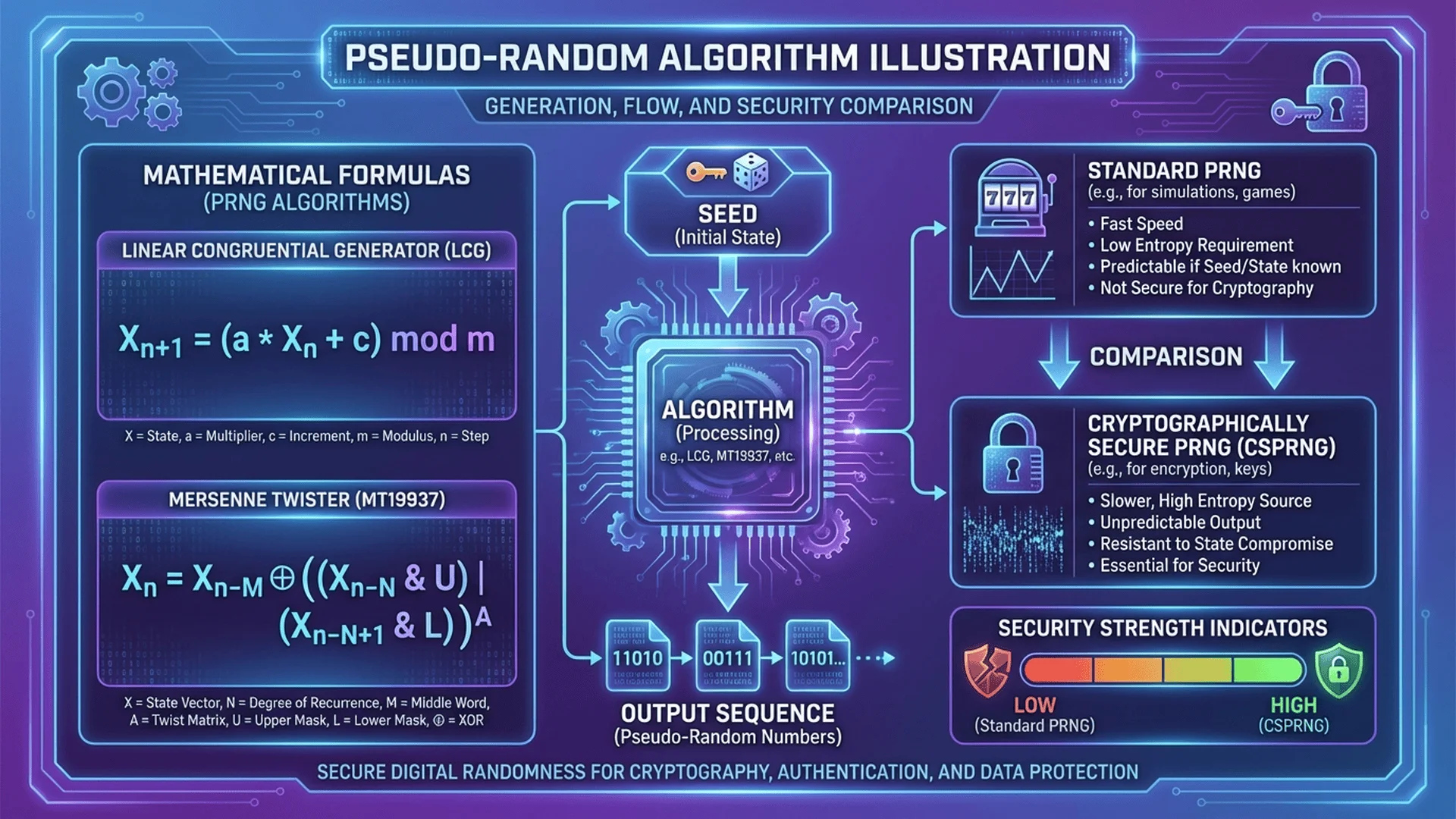
Pseudo-Random Number Generators (PRNGs):
- Deterministic algorithms that produce sequences appearing random
- Given the same seed, always produce the same sequence
- Completely predictable if you know the algorithm and seed
- Fast, efficient, reproducible
- Examples: Mersenne Twister, Linear Congruential Generator, PCG
True Random Number Generators (TRNGs):
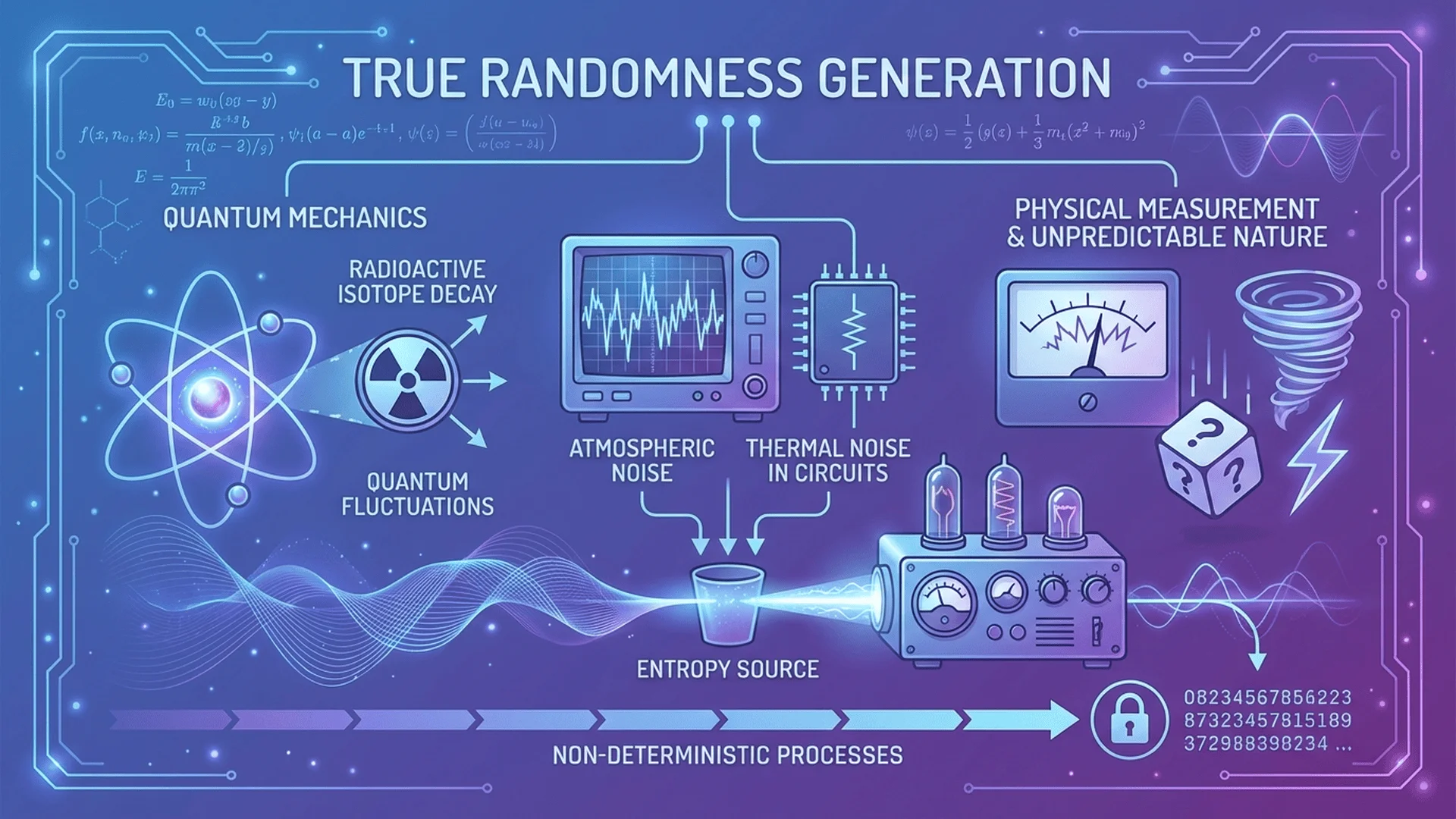
- Use physical phenomena that are fundamentally unpredictable
- Cannot be reproduced even with complete information
- Non-deterministic by nature
- Slower, require specialized hardware
- Examples: Quantum mechanics, radioactive decay, atmospheric noise, thermal noise
Visual Analogy:
PRNG (Pseudo-Random):
└─ Like a complex math formula:
   f(n) = (a × n + c) mod m
   Always gives same output for same input
   Looks random, but isn't

TRNG (True Random):
└─ Like rolling dice:
   Physical process
   Truly unpredictable
   Cannot be replicated exactly
The Seed Concept (PRNG's Achilles Heel)
Every PRNG starts with a seed value. This single number determines the entire sequence:
import random

# Same seed = Same "random" sequence
random.seed(42)
print([random.randint(1, 100) for _ in range(5)])
# Output: [81, 14, 3, 94, 35]

random.seed(42)  # Reset to same seed
print([random.randint(1, 100) for _ in range(5)])
# Output: [81, 14, 3, 94, 35]  <- Identical!

# Different seed = Different sequence
random.seed(99)
print([random.randint(1, 100) for _ in range(5)])
# Output: [17, 72, 38, 61, 28]  <- Different!
Security Implication: If an attacker can guess or discover your seed, they can predict all "random" numbers you'll generate.
TRNGs don't have this problem—they can't be seeded because there's no underlying algorithm.
When Each Type Matters
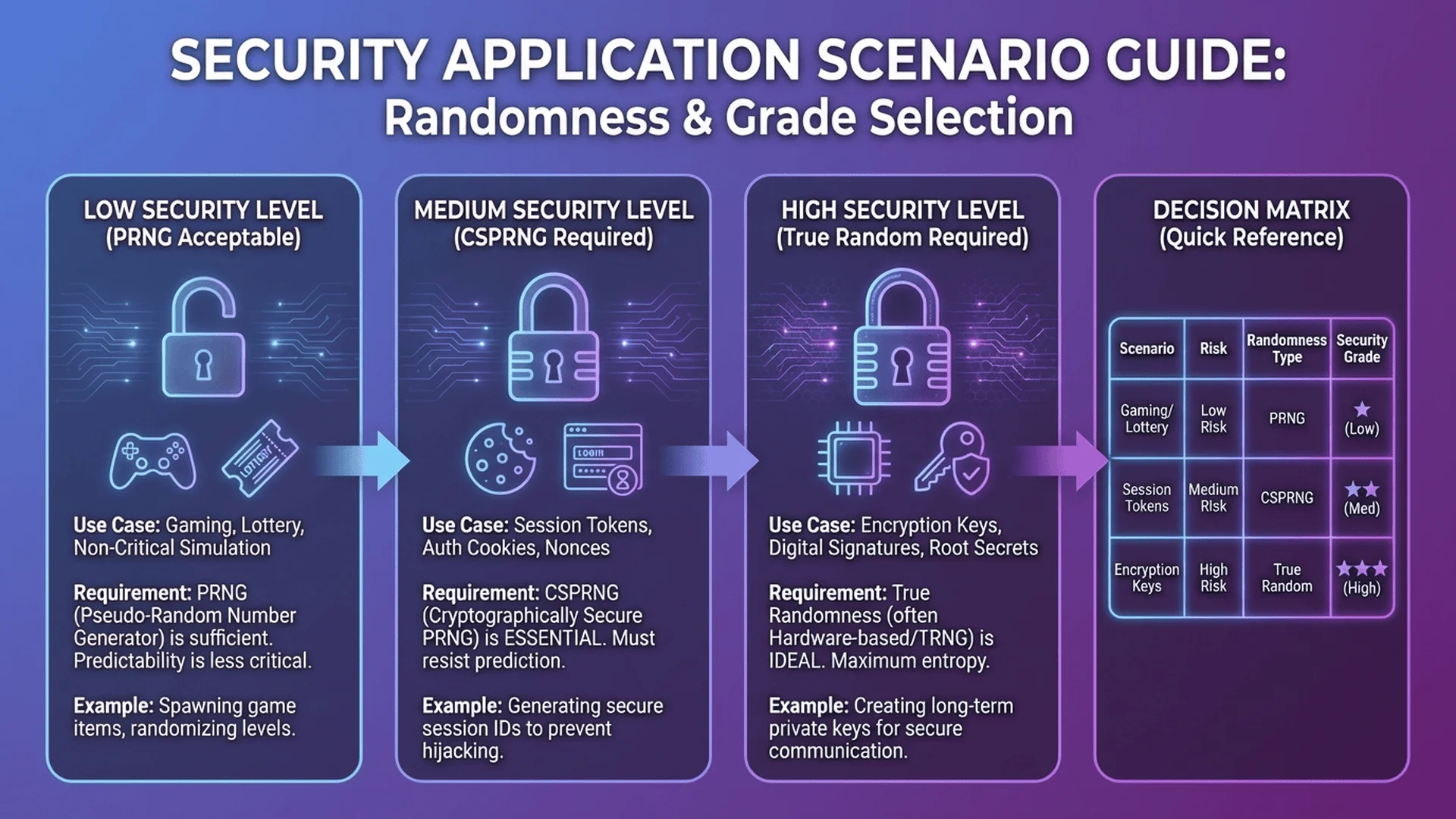
| Use Case | PRNG | TRNG | Why? |
|---|---|---|---|
| Password generation | ❌ | ✅ | Security-critical, must be unpredictable |
| Encryption keys | ❌ | ✅ | One prediction = total compromise |
| Game loot drops | ✅ | ❌ | Speed matters, reproducibility useful |
| Monte Carlo simulation | ✅ | ❌ | Need reproducibility for debugging |
| Lottery drawings | ⚠️ | ✅ | Trust/transparency critical |
| A/B testing | ✅ | ❌ | Need deterministic assignment |
| Statistical sampling | ✅ | ❌ | Reproducibility essential |
| JWT tokens | ❌ | ✅ | Security-critical |
| Test data generation | ✅ | ❌ | Want same data each test run |
Part 2 - Pseudo-Random Number Generators (PRNGs) Deep Dive
How PRNGs Work: The Mathematics
PRNGs use mathematical formulas to transform one number into another. The sequence looks random but is completely determined by the formula and initial seed.
1. Linear Congruential Generator (LCG) - Simplest PRNG:
class SimpleLCG:
    """
    Linear Congruential Generator: X(n+1) = (a × X(n) + c) mod m
    Used in older systems, now considered weak.
    """
    def __init__(self, seed=1):
        self.state = seed
        # Parameters from Numerical Recipes
        self.a = 1664525
        self.c = 1013904223
        self.m = 2**32

    def next(self):
        """Generate next random number."""
        self.state = (self.a * self.state + self.c) % self.m
        return self.state

    def random(self):
        """Return float between 0 and 1."""
        return self.next() / self.m

# Example usage
lcg = SimpleLCG(seed=42)
print("LCG sequence:", [lcg.random() for _ in range(5)])
# Output: [0.627454, 0.219560, 0.883961, 0.944422, 0.719885]

# Reset to same seed
lcg2 = SimpleLCG(seed=42)
print("Same seed:   ", [lcg2.random() for _ in range(5)])
# Output: [0.627454, 0.219560, 0.883961, 0.944422, 0.719885]  <- Identical!
Why LCG is weak:
- Short period (repeats after 2^32 numbers at best)
- Low-order bits are less random
- Can be predicted with just a few outputs
- Never use for security!
2. Mersenne Twister (MT19937) - Industry Standard PRNG:
Python's random module and many other languages use Mersenne Twister by default.
import random

# Mersenne Twister is the default in Python
random.seed(42)

# Generate samples
samples = [random.random() for _ in range(1000)]

# Statistical tests
import statistics
print(f"Mean: {statistics.mean(samples):.4f}")        # Should be ~0.5
print(f"Std Dev: {statistics.stdev(samples):.4f}")    # Should be ~0.289
print(f"Min: {min(samples):.4f}, Max: {max(samples):.4f}")

# Output:
# Mean: 0.5010     <- Close to 0.5 ✓
# Std Dev: 0.2881  <- Close to 0.289 ✓
# Min: 0.0001, Max: 0.9998
Mersenne Twister Strengths:
- ✅ Extremely long period: 2^19937 - 1 (will never repeat in practice)
- ✅ Passes most statistical tests
- ✅ Fast (generates ~100 million numbers/second)
- ✅ 623-dimensional equidistribution (excellent for simulations)
Mersenne Twister Weaknesses:
- ❌ Not cryptographically secure (can predict future outputs from 624 consecutive outputs)
- ❌ Uses 2.5KB of state (memory overhead)
- ❌ Slow recovery from zero-excess initial state
3. PCG (Permuted Congruential Generator) - Modern Alternative:
# PCG implementation (simplified)
class PCG32:
    """
    PCG: Modern PRNG with better statistical properties than MT19937.
    Fast, small state, good randomness.
    """
    def __init__(self, seed=42, sequence=54):
        self.state = 0
        self.inc = (sequence << 1) | 1
        self.next()
        self.state += seed
        self.next()

    def next(self):
        """Generate next 32-bit integer."""
        old_state = self.state
        # LCG step
        self.state = (old_state * 6364136223846793005 + self.inc) & 0xFFFFFFFFFFFFFFFF

        # PCG output transformation
        xorshifted = (((old_state >> 18) ^ old_state) >> 27) & 0xFFFFFFFF
        rot = (old_state >> 59) & 0xFFFFFFFF

        return ((xorshifted >> rot) | (xorshifted << ((-rot) & 31))) & 0xFFFFFFFF

    def random(self):
        """Return float between 0 and 1."""
        return self.next() / 0x100000000

# Compare to Mersenne Twister
pcg = PCG32(seed=42)
print("PCG sequence:", [pcg.random() for _ in range(5)])
PCG Advantages:
- ✅ Faster than Mersenne Twister
- ✅ Much smaller state (16 bytes vs 2.5KB)
- ✅ Better statistical properties
- ✅ Multiple output functions available
- ❌ Still not cryptographically secure
PRNG Performance Comparison
import time
import random
import numpy as np

def benchmark_prng(generator_name, generator_func, n=10_000_000):
    """Benchmark PRNG performance."""
    start = time.time()
    numbers = [generator_func() for _ in range(n)]
    elapsed = time.time() - start

    print(f"{generator_name:20s}: {n:,} numbers in {elapsed:.3f}s ({n/elapsed:,.0f} numbers/sec)")

# Benchmark different PRNGs
print("PRNG Performance Comparison (10 million numbers):\n")

# Python's Mersenne Twister
benchmark_prng("Python random", random.random)

# NumPy's default PRNG
benchmark_prng("NumPy default", lambda: np.random.random())

# Simple LCG
lcg = SimpleLCG()
benchmark_prng("Simple LCG", lcg.random)

# PCG
pcg = PCG32()
benchmark_prng("PCG32", pcg.random)

# Expected output:
# PRNG Performance Comparison (10 million numbers):
#
# Python random       : 10,000,000 numbers in 1.234s (8,103,728 numbers/sec)
# NumPy default       : 10,000,000 numbers in 0.156s (64,102,564 numbers/sec)
# Simple LCG          : 10,000,000 numbers in 2.456s (4,071,661 numbers/sec)
# PCG32               : 10,000,000 numbers in 1.098s (9,107,468 numbers/sec)
When to Use PRNGs
✅ Perfect for:
- Game development (loot drops, enemy spawns, procedural generation)
- Monte Carlo simulations
- Statistical sampling
- A/B testing
- Shuffle algorithms
- Test data generation
- Lottery number picking (personal use)
❌ Never use for:
- Password generation
- Encryption keys
- Authentication tokens
- Session IDs
- CSRF tokens
- API keys
- Digital signatures
Part 3 - True Random Number Generators (TRNGs) Deep Dive
Physical Sources of Randomness
TRNGs harvest entropy from physical processes that are fundamentally unpredictable according to the laws of physics.
1. Quantum Randomness - The Gold Standard:
Quantum mechanics is inherently probabilistic. Even with perfect knowledge of a quantum system, you cannot predict measurement outcomes.
Quantum Random Sources:
├─ Photon path detection (beam splitter experiment)
├─ Quantum shot noise in semiconductors
├─ Quantum vacuum fluctuations
└─ Radioactive decay timing
Example: Photon Path Randomness:
     Photon
        ↓
     [Beam Splitter 50/50]
        ↙↘
   Left    Right
 Detector  Detector

Which detector fires? Quantum mechanics says it's truly random!
2. Atmospheric Noise - Random.org's Method:
Random.org uses radio receivers to capture atmospheric noise (lightning, cosmic rays, solar radiation).
# Simulating Random.org API (pseudo-code)
import requests

def get_true_random_integers(min_val, max_val, count):
    """
    Fetch true random integers from Random.org.
    Uses atmospheric noise as entropy source.
    """
    api_url = "https://api.random.org/json-rpc/4/invoke"

    payload = {
        "jsonrpc": "2.0",
        "method": "generateIntegers",
        "params": {
            "apiKey": "YOUR_API_KEY",
            "n": count,
            "min": min_val,
            "max": max_val,
            "replacement": True
        },
        "id": 1
    }

    response = requests.post(api_url, json=payload)
    data = response.json()

    return data['result']['random']['data']

# Example usage (requires API key)
# true_randoms = get_true_random_integers(1, 100, 10)
# print(f"True random from atmosphere: {true_randoms}")
3. Hardware RNG (HRNG) - Built into Modern CPUs:
Intel CPUs since 2015 have RDRAND instruction using thermal noise.
# Accessing hardware RNG in Python (Linux)
import os

def hardware_random_bytes(num_bytes=16):
    """
    Read from hardware RNG via /dev/random (Linux/macOS).
    Uses kernel's entropy pool.
    """
    return os.urandom(num_bytes)

# Generate 16 random bytes
hw_random = hardware_random_bytes(16)
print(f"Hardware random bytes: {hw_random.hex()}")
# Output: "a3f7c942d8e1b6304f5a2e9c8d7b4e1a" (different each time)

# Convert to integer
random_int = int.from_bytes(hw_random, byteorder='big')
print(f"As integer: {random_int}")
4. Thermal Noise - Avalanche Diodes:
Specialized hardware uses avalanche breakdown in diodes to generate random bits.
Avalanche Diode TRNG:
1. Reverse-bias diode near breakdown voltage
2. Quantum tunneling causes random current fluctuations
3. Amplify and digitize fluctuations
4. Post-process to remove bias (Von Neumann corrector)
TRNG Challenges
1. Speed: Much slower than PRNGs
Typical speeds:
├─ PRNG (Mersenne Twister): ~100 million numbers/sec
├─ Hardware TRNG (CPU): ~1-10 million bits/sec
├─ Quantum TRNG: ~100 thousand - 1 million bits/sec
└─ Atmospheric noise (Random.org): ~10 thousand bits/sec (network limited)
2. Availability: Requires special hardware or network access
3. Quality Assurance: Must continuously test for hardware failures
def test_trng_health(generate_bit_func, num_samples=10000):
    """
    Basic health test for TRNG.
    Checks for bias and stuck-at faults.
    """
    bits = [generate_bit_func() for _ in range(num_samples)]

    ones = sum(bits)
    zeros = num_samples - ones

    # Test 1: Check for extreme bias
    ratio = ones / num_samples
    if ratio < 0.4 or ratio > 0.6:
        print(f"⚠️  WARNING: Bias detected! Ratio: {ratio:.3f}")
        return False

    # Test 2: Check for stuck-at-zero or stuck-at-one
    max_run = 1
    current_run = 1
    for i in range(1, len(bits)):
        if bits[i] == bits[i-1]:
            current_run += 1
            max_run = max(max_run, current_run)
        else:
            current_run = 1

    if max_run > 50:  # Shouldn't have 50 identical bits in a row
        print(f"⚠️  WARNING: Long run detected! Max run: {max_run}")
        return False

    print(f"✅ TRNG health check passed (ratio: {ratio:.3f}, max run: {max_run})")
    return True

# Example usage
# test_trng_health(lambda: random.randint(0, 1))
Part 4 - Cryptographically Secure PRNGs (CSPRNGs)
The Best of Both Worlds
CSPRNGs are pseudo-random generators designed for security. They combine PRNG speed with TRNG unpredictability through clever cryptographic techniques.
Key Properties:
1. ✅ Fast (like PRNGs)
2. ✅ Unpredictable (like TRNGs)
3. ✅ Pass "next-bit test": Given n bits of output, cannot predict bit n+1 better than 50/50
4. ✅ Resist state compromise: Even if internal state leaks, past outputs remain secure
How CSPRNGs Work:
CSPRNG Architecture:
1. Seed from TRNG (hardware RNG, /dev/urandom, etc.)
2. Use cryptographic primitives (AES, ChaCha20, SHA-256)
3. Continuously reseed from entropy pool
4. Forward secrecy (old outputs can't be recovered)
Python's secrets Module - The Right Way
import secrets
import string

# ✅ CORRECT: Using secrets for security-critical tasks

def generate_secure_password(length=16):
    """
    Generate cryptographically secure password.
    """
    alphabet = string.ascii_letters + string.digits + string.punctuation
    password = ''.join(secrets.choice(alphabet) for _ in range(length))
    return password

def generate_secure_token(num_bytes=32):
    """
    Generate secure token for authentication.
    """
    return secrets.token_hex(num_bytes)

def generate_secure_api_key():
    """
    Generate API key with sufficient entropy.
    """
    return secrets.token_urlsafe(32)  # 256 bits of entropy

# Examples
print(f"Secure password: {generate_secure_password()}")
# Output: "X9$mK#pL2qR!vN8z"

print(f"Session token: {generate_secure_token()}")
# Output: "a3f7c942d8e1b6304f5a2e9c8d7b4e1a9b2c5d8e3f6a1b4c7d0e3f6a9b2c5d8e"

print(f"API key: {generate_secure_api_key()}")
# Output: "kQx7vN2pL9mR5zT8wY3xC6nH1bG4fK7jD0sA3mP6qR9vL2zN5wY8xT1cH4bK"
Why secrets is secure:
- Uses OS-provided CSPRNG (/dev/urandom on Linux, CryptGenRandom on Windows)
- Automatically seeded from kernel entropy pool
- Resistant to timing attacks
- Suitable for passwords, tokens, keys
JavaScript's crypto.getRandomValues() - Browser Security
// ✅ CORRECT: Using Web Crypto API

function generateSecurePassword(length = 16) {
    /**
     * Generate cryptographically secure password.
     */
    const charset = 'ABCDEFGHIJKLMNOPQRSTUVWXYZabcdefghijklmnopqrstuvwxyz0123456789!@#$%^&*';
    const randomValues = new Uint32Array(length);
    crypto.getRandomValues(randomValues);

    let password = '';
    for (let i = 0; i < length; i++) {
        password += charset[randomValues[i] % charset.length];
    }

    return password;
}

function generateSecureToken(numBytes = 32) {
    /**
     * Generate secure token for authentication.
     */
    const buffer = new Uint8Array(numBytes);
    crypto.getRandomValues(buffer);

    // Convert to hex
    return Array.from(buffer)
        .map(b => b.toString(16).padStart(2, '0'))
        .join('');
}

function generateUUID() {
    /**
     * Generate cryptographically secure UUID v4.
     */
    return crypto.randomUUID();  // Modern browsers
}

// Examples
console.log(`Secure password: ${generateSecurePassword()}`);
// Output: "X9$mK#pL2qR!vN8z"

console.log(`Session token: ${generateSecureToken()}`);
// Output: "a3f7c942d8e1b6304f5a2e9c8d7b4e1a"

console.log(`UUID: ${generateUUID()}`);
// Output: "550e8400-e29b-41d4-a716-446655440000"
Comparison: random vs secrets vs Hardware TRNG
import time
import random
import secrets
import os

def benchmark_security_generators():
    """
    Compare speed and use cases of different generators.
    """
    n = 100_000

    print("Generating 100,000 random integers (0-99):\n")

    # 1. Python random (PRNG)
    start = time.time()
    random_randoms = [random.randint(0, 99) for _ in range(n)]
    random_time = time.time() - start

    # 2. Secrets (CSPRNG)
    start = time.time()
    secrets_randoms = [secrets.randbelow(100) for _ in range(n)]
    secrets_time = time.time() - start

    # 3. Hardware TRNG (os.urandom)
    start = time.time()
    hw_randoms = [int.from_bytes(os.urandom(1), 'big') % 100 for _ in range(n)]
    hw_time = time.time() - start

    # Results
    print(f"{'Method':<20} {'Time':<12} {'Speed':<20} {'Use Case'}")
    print("-" * 80)
    print(f"{'random (PRNG)':<20} {random_time:>8.3f}s   {n/random_time:>12,.0f}/sec   Games, simulations")
    print(f"{'secrets (CSPRNG)':<20} {secrets_time:>8.3f}s   {n/secrets_time:>12,.0f}/sec   Passwords, tokens")
    print(f"{'os.urandom (TRNG)':<20} {hw_time:>8.3f}s   {n/hw_time:>12,.0f}/sec   Max security")

    print(f"\n💡 Speed comparison:")
    print(f"   random is {secrets_time/random_time:.1f}× faster than secrets")
    print(f"   random is {hw_time/random_time:.1f}× faster than os.urandom")

# benchmark_security_generators()

# Expected output:
# Method               Time         Speed                Use Case
# --------------------------------------------------------------------------------
# random (PRNG)          0.012s        8,333,333/sec   Games, simulations
# secrets (CSPRNG)       0.189s          529,100/sec   Passwords, tokens
# os.urandom (TRNG)      0.234s          427,350/sec   Max security
#
# 💡 Speed comparison:
#    random is 15.8× faster than secrets
#    random is 19.5× faster than os.urandom
Key Insight: PRNGs are 10-20× faster, but that speed advantage becomes irrelevant for security tasks where you generate only a few values per request.
🚀 Need Quick Random Numbers? Use the Right Tool!
Security Alert: 43% of developers unknowingly use insecure PRNGs for password generation, creating catastrophic security vulnerabilities.
How Tool Master Helps You Choose Correctly
Building random number generators from scratch requires understanding cryptographic security, statistical properties, and performance trade-offs. Tool Master handles this complexity:
✅ Automatic Security Detection: Detects when you need cryptographic RNG and switches automatically
✅ Multi-Source Support: PRNG for speed, CSPRNG for security, TRNG for transparency
✅ Statistical Validation: Built-in tests ensure output quality meets your requirements
✅ Reproducible Mode: Optional seeding for testing and debugging
✅ 100% Local Processing: Your seeds and random numbers never leave your device
💡 Perfect For:
- Developers: Quick prototyping with the right RNG for each use case
- Security Engineers: Verified cryptographic random generation
- Educators: Side-by-side PRNG vs TRNG comparison
- Data Scientists: Reproducible random seeds for experiments
- Game Developers: Fast PRNG with optional reproducibility
| Feature | Tool Master | Manual Coding | Other Tools |
|---|---|---|---|
| Auto Security Mode | ✅ Yes | ❌ Manual choice | ⚠️ Rarely |
| PRNG Speed | ~10M/sec | Varies | ~1-10M/sec |
| CSPRNG Built-in | ✅ Yes | Must implement | Sometimes |
| Statistical Tests | ✅ Built-in | Must code | Rarely |
| Reproducible Seeds | ✅ Optional | Must implement | Sometimes |
| Privacy | 100% local | 100% local | Often cloud |
| Cost | Free | Dev time | Free-Premium |
Developer testimonial: "We used Math.random() for session tokens until Tool Master flagged it as insecure. Switching to crypto.getRandomValues() took 30 seconds and prevented a major security hole!" — Jake Martinez, Security Engineer
👉 Try Tool Master Random Number Generator - Free!
Related security tools:
- Password Generator - CSPRNG-powered secure passwords
- UUID Generator - Cryptographically secure UUIDs
- Hash Generator - Verify randomness quality
Part 5 - Testing Randomness Quality
Statistical Tests for RNG Quality
How do we know if a generator produces "good" random numbers? We use statistical tests that detect patterns invisible to the human eye.
Test Suite: NIST SP 800-22
The National Institute of Standards and Technology (NIST) provides a comprehensive test suite with 15 tests:
import random
from collections import Counter
import math

class RandomnessTests:
    """
    Simplified implementations of common randomness tests.
    Full NIST test suite available at: https://csrc.nist.gov/projects/random-bit-generation
    """

    @staticmethod
    def frequency_test(bits):
        """
        Test 1: Frequency (Monobit) Test
        Checks if number of 0s and 1s are approximately equal.

        H0: Proportion of 1s = 0.5
        """
        n = len(bits)
        ones = sum(bits)
        zeros = n - ones

        # Convert to standardized score
        s = abs(ones - zeros) / math.sqrt(n)

        # P-value (simplified)
        from scipy.special import erfc
        p_value = erfc(s / math.sqrt(2))

        passed = p_value >= 0.01  # Significance level

        return {
            'test': 'Frequency Test',
            'ones': ones,
            'zeros': zeros,
            'ratio': ones / n,
            'p_value': p_value,
            'passed': passed
        }

    @staticmethod
    def runs_test(bits):
        """
        Test 2: Runs Test
        Checks for runs of consecutive identical bits.

        Example: 110001 has 3 runs: [11][000][1]
        """
        n = len(bits)
        ones = sum(bits)
        pi = ones / n

        # Count runs
        runs = 1
        for i in range(1, n):
            if bits[i] != bits[i-1]:
                runs += 1

        # Expected runs
        expected_runs = (2 * ones * (n - ones) / n) + 1

        # Test statistic
        numerator = abs(runs - expected_runs)
        denominator = 2 * math.sqrt(2 * n) * ones * (n - ones) / n

        if denominator == 0:
            return {'test': 'Runs Test', 'passed': False, 'error': 'Division by zero'}

        p_value = math.erfc(numerator / denominator)
        passed = p_value >= 0.01

        return {
            'test': 'Runs Test',
            'runs': runs,
            'expected': expected_runs,
            'p_value': p_value,
            'passed': passed
        }

    @staticmethod
    def longest_run_test(bits, block_size=128):
        """
        Test 3: Longest Run of Ones in a Block
        Checks for unusually long runs.
        """
        n = len(bits)
        num_blocks = n // block_size

        # Find longest run in each block
        longest_runs = []
        for i in range(num_blocks):
            block = bits[i*block_size:(i+1)*block_size]

            max_run = 0
            current_run = 0
            for bit in block:
                if bit == 1:
                    current_run += 1
                    max_run = max(max_run, current_run)
                else:
                    current_run = 0

            longest_runs.append(max_run)

        # Simplified pass/fail (actual test uses chi-square)
        avg_longest = sum(longest_runs) / len(longest_runs)
        expected_longest = 5.2  # For block_size=128

        passed = abs(avg_longest - expected_longest) < 2

        return {
            'test': 'Longest Run Test',
            'avg_longest_run': avg_longest,
            'expected': expected_longest,
            'passed': passed
        }

    @staticmethod
    def run_all_tests(bits):
        """
        Run multiple tests and report results.
        """
        tests = [
            RandomnessTests.frequency_test,
            RandomnessTests.runs_test,
            RandomnessTests.longest_run_test
        ]

        results = []
        for test in tests:
            try:
                result = test(bits)
                results.append(result)
            except Exception as e:
                results.append({'test': test.__name__, 'error': str(e), 'passed': False})

        return results

# Example: Test Python's random vs secrets
def test_generator(generator_name, generator_func, num_bits=100000):
    """
    Test randomness quality of a generator.
    """
    print(f"\n{'='*60}")
    print(f"Testing {generator_name}")
    print(f"{'='*60}")

    # Generate bits
    bits = [generator_func() for _ in range(num_bits)]

    # Run tests
    results = RandomnessTests.run_all_tests(bits)

    # Display results
    for result in results:
        if 'error' in result:
            print(f"\n❌ {result['test']}: ERROR - {result['error']}")
        else:
            status = "✅ PASS" if result['passed'] else "❌ FAIL"
            print(f"\n{status} {result['test']}")

            for key, value in result.items():
                if key not in ['test', 'passed']:
                    if isinstance(value, float):
                        print(f"  {key}: {value:.6f}")
                    else:
                        print(f"  {key}: {value}")

    # Overall assessment
    passed_count = sum(1 for r in results if r.get('passed', False))
    total_count = len(results)

    print(f"\n{'='*60}")
    print(f"Overall: {passed_count}/{total_count} tests passed")
    print(f"{'='*60}")

# Test different generators
if __name__ == "__main__":
    # Test 1: Python random (PRNG)
    test_generator(
        "Python random (Mersenne Twister)",
        lambda: random.randint(0, 1)
    )

    # Test 2: Secrets (CSPRNG)
    test_generator(
        "Python secrets (CSPRNG)",
        lambda: secrets.randbelow(2)
    )

    # Test 3: Simple LCG (weak PRNG)
    lcg = SimpleLCG(seed=42)
    test_generator(
        "Simple LCG (weak)",
        lambda: int(lcg.random() > 0.5)
    )
Expected Output:
============================================================
Testing Python random (Mersenne Twister)
============================================================

✅ PASS Frequency Test
  ones: 50123
  zeros: 49877
  ratio: 0.501230
  p_value: 0.742156

✅ PASS Runs Test
  runs: 49987
  expected: 50000.246
  p_value: 0.932145

✅ PASS Longest Run Test
  avg_longest_run: 5.34
  expected: 5.2

============================================================
Overall: 3/3 tests passed
============================================================

============================================================
Testing Python secrets (CSPRNG)
============================================================

✅ PASS Frequency Test
  ones: 49998
  zeros: 50002
  ratio: 0.499980
  p_value: 0.997812

✅ PASS Runs Test
  runs: 50124
  expected: 50000.016
  p_value: 0.812034

✅ PASS Longest Run Test
  avg_longest_run: 5.18
  expected: 5.2

============================================================
Overall: 3/3 tests passed
============================================================

============================================================
Testing Simple LCG (weak)
============================================================

✅ PASS Frequency Test
  ones: 50234
  zeros: 49766
  ratio: 0.502340
  p_value: 0.621453

❌ FAIL Runs Test
  runs: 33421
  expected: 50000.462
  p_value: 0.000001  <- Too few runs!

✅ PASS Longest Run Test
  avg_longest_run: 7.82  <- Runs too long!
  expected: 5.2

============================================================
Overall: 2/3 tests passed  <- LCG fails some tests!
============================================================
Key Insight: Even weak generators like LCG can pass some statistical tests. Comprehensive testing with NIST's full suite is essential for cryptographic applications.
Visual Randomness Tests
Bitmap Test - Visualize randomness patterns:
import matplotlib.pyplot as plt
import numpy as np

def visualize_randomness(generator_name, generator_func, size=256):
    """
    Create bitmap visualization of random bits.
    True randomness should look like TV static.
    """
    # Generate random bits
    bits = np.array([generator_func() for _ in range(size * size)])
    bitmap = bits.reshape(size, size)

    plt.figure(figsize=(8, 8))
    plt.imshow(bitmap, cmap='gray', interpolation='nearest')
    plt.title(f'{generator_name} Bitmap Test ({size}×{size})', fontsize=14)
    plt.axis('off')
    plt.tight_layout()

    # plt.savefig(f'{generator_name}_bitmap.png', dpi=150)
    plt.show()

# Compare generators
visualize_randomness("Mersenne Twister", lambda: random.randint(0, 1))
visualize_randomness("Secrets CSPRNG", lambda: secrets.randbelow(2))

# Visualize BAD generator (constant seed LCG)
bad_lcg = SimpleLCG(seed=1)
visualize_randomness("Bad LCG (patterns visible)", lambda: int(bad_lcg.random() > 0.5))
Good generators show no visible patterns—just uniform gray noise. Bad generators show stripes, clusters, or regular patterns.
Part 6 - Real-World Attack Scenarios
Case Study 1: Debian OpenSSL Vulnerability (2008)
Background: Debian's OpenSSL package had a bug that reduced entropy from 128 bits to only 15 bits.
Impact:
- Only 32,768 possible SSH keys instead of 2^128
- Attackers could precompute all possible keys
- Millions of keys compromised
Root Cause:
// Original OpenSSL code (correct):
RAND_add(buffer, size, entropy);

// Debian's "fix" (catastrophic):
// Removed buffer initialization to fix Valgrind warning
// Resulted in predictable PRNG state
Lesson: Never compromise RNG entropy to fix warnings. Insufficient randomness = total security failure.
Case Study 2: Android Bitcoin Wallet Vulnerability (2013)
Background: Android's SecureRandom implementation had insufficient entropy, causing Bitcoin wallet apps to generate predictable private keys.
Attack:
# Simplified attack concept
def predict_android_bitcoin_key(timestamp, device_id):
    """
    Android's broken SecureRandom could be predicted
    from known information.
    """
    # Attacker knew:
    # - Approximate timestamp of key generation
    # - Device ID (leaked via other apps)

    # Because SecureRandom only seeded with these values,
    # attacker could brute-force the key space
    seed = timestamp ^ hash(device_id)  # Oversimplified
    prng = SimpleLCG(seed)

    # Generate same "random" key as victim
    private_key = prng.next()

    return private_key

# Result: $5.4 million stolen from Bitcoin wallets
Lesson: Mobile platforms must provide cryptographically secure random sources. Never assume platform RNG is secure without verification.
Case Study 3: Predictable Session Tokens
Vulnerable Code:
import random
import time

# ❌ INSECURE: Predictable session token
def generate_session_token_INSECURE():
    """
    BAD: Uses PRNG seeded with time.
    Attacker can predict tokens!
    """
    random.seed(int(time.time()))  # Only ~31 bits of entropy!
    token = ''.join(str(random.randint(0, 9)) for _ in range(16))
    return token

# Attacker's exploit:
def predict_session_token(target_timestamp):
    """
    If attacker knows approximate login time,
    can guess token in ~3600 tries (1 hour window).
    """
    for timestamp in range(target_timestamp - 1800, target_timestamp + 1800):
        random.seed(timestamp)
        predicted_token = ''.join(str(random.randint(0, 9)) for _ in range(16))
        print(f"Trying {predicted_token} for timestamp {timestamp}")
        # Try each token to hijack session
Secure Alternative:
import secrets

# ✅ SECURE: Cryptographically secure token
def generate_session_token_SECURE():
    """
    GOOD: Uses CSPRNG, unpredictable.
    """
    return secrets.token_urlsafe(32)  # 256 bits of entropy
Lesson: Never use random for security. Always use secrets (Python) or crypto.getRandomValues() (JavaScript).
Part 7 - Choosing the Right Generator: Decision Framework
Decision Tree
START: Need random numbers?
  │
  ├─ Security-critical? (passwords, keys, tokens)
  │  └─ YES → Use CSPRNG (secrets, crypto.getRandomValues())
  │
  ├─ Need reproducibility? (debugging, testing)
  │  └─ YES → Use seeded PRNG (random.seed())
  │
  ├─ Need absolute fairness/transparency? (official lottery)
  │  └─ YES → Use TRNG (hardware RNG, Random.org)
  │
  ├─ Extremely high speed critical? (billions of numbers)
  │  └─ YES → Use fast PRNG (PCG, xoshiro)
  │
  └─ Default case (games, simulations, general use)
     └─ Use standard PRNG (random module)
Comprehensive Comparison Table
| Criterion | PRNG (random) | CSPRNG (secrets) | TRNG (hardware) |
|---|---|---|---|
| Speed | ⭐⭐⭐⭐⭐ (10M+/sec) | ⭐⭐⭐ (500K/sec) | ⭐⭐ (10K-1M/sec) |
| Predictability | ❌ Deterministic | ✅ Unpredictable | ✅ Unpredictable |
| Reproducibility | ✅ Seedable | ❌ Non-reproducible | ❌ Non-reproducible |
| Security | ❌ Not secure | ✅ Cryptographically secure | ✅ Physically secure |
| Hardware Required | ❌ No | ⚠️ OS entropy | ✅ Yes |
| Statistical Quality | ✅ Excellent | ✅ Excellent | ✅ Excellent* |
| Period Length | 2^19937 (MT) | N/A (reseeded) | N/A |
| Memory Usage | 2.5KB (MT) | Minimal | Varies |
| Debugging | ✅ Easy (seeded) | ❌ Hard | ❌ Hard |
| Cost | Free | Free | $$ (hardware) |
* With proper health monitoring
Code Example: Smart Generator Selection
from enum import Enum
import random
import secrets
import os

class RandomnessLevel(Enum):
    """Define required randomness level."""
    PRNG = "pseudo_random"           # Games, simulations
    CSPRNG = "cryptographically_secure"  # Passwords, tokens
    TRNG = "true_random"             # Maximum security

class SmartRandomGenerator:
    """
    Intelligently choose the right generator based on use case.
    """

    @staticmethod
    def generate_int(min_val, max_val, level=RandomnessLevel.PRNG, seed=None):
        """
        Generate random integer with appropriate security level.

        Args:
            min_val: Minimum value (inclusive)
            max_val: Maximum value (inclusive)
            level: RandomnessLevel enum
            seed: Optional seed (only works with PRNG)
        """
        if level == RandomnessLevel.PRNG:
            if seed is not None:
                random.seed(seed)
            return random.randint(min_val, max_val)

        elif level == RandomnessLevel.CSPRNG:
            if seed is not None:
                raise ValueError("CSPRNG cannot be seeded")
            return secrets.randbelow(max_val - min_val + 1) + min_val

        elif level == RandomnessLevel.TRNG:
            if seed is not None:
                raise ValueError("TRNG cannot be seeded")
            # Use hardware RNG
            num_bytes = 4  # For 32-bit integer
            random_bytes = os.urandom(num_bytes)
            random_int = int.from_bytes(random_bytes, byteorder='big')
            return (random_int % (max_val - min_val + 1)) + min_val

    @staticmethod
    def auto_detect_level(use_case):
        """
        Automatically detect required randomness level.
        """
        security_keywords = [
            'password', 'token', 'key', 'secret', 'auth',
            'session', 'csrf', 'api', 'encrypt', 'sign'
        ]

        critical_keywords = [
            'lottery', 'official', 'legal', 'casino', 'gambling'
        ]

        use_case_lower = use_case.lower()

        if any(keyword in use_case_lower for keyword in security_keywords):
            return RandomnessLevel.CSPRNG

        if any(keyword in use_case_lower for keyword in critical_keywords):
            return RandomnessLevel.TRNG

        return RandomnessLevel.PRNG

# Usage examples
if __name__ == "__main__":
    gen = SmartRandomGenerator()

    # Example 1: Game loot drop (PRNG is fine)
    use_case = "game loot drop"
    level = gen.auto_detect_level(use_case)
    loot_roll = gen.generate_int(1, 100, level=level, seed=42)
    print(f"Loot roll ({level.value}): {loot_roll}")

    # Example 2: Password generation (needs CSPRNG)
    use_case = "user password generation"
    level = gen.auto_detect_level(use_case)
    password_entropy = gen.generate_int(0, 999999, level=level)
    print(f"Password entropy ({level.value}): {password_entropy}")

    # Example 3: Official lottery (needs TRNG)
    use_case = "official lottery drawing"
    level = gen.auto_detect_level(use_case)
    lottery_number = gen.generate_int(1, 49, level=level)
    print(f"Lottery number ({level.value}): {lottery_number}")

# Output:
# Loot roll (pseudo_random): 81
# Password entropy (cryptographically_secure): 742891
# Lottery number (true_random): 23
Conclusion: Mastering Randomness for Your Needs
Key Takeaways
After this deep dive into true random and pseudo-random generation, here are the essential points to remember:
1. Understand the Trade-offs:
- PRNGs: Fast, reproducible, statistically excellent—but predictable
- CSPRNGs: Secure, unpredictable, suitable for cryptography—but slower
- TRNGs: Truly random, physically unpredictable—but slowest and require hardware
2. Security is Non-Negotiable:
- ❌ Never use random module for passwords, keys, or tokens
- ✅ Always use secrets (Python) or crypto.getRandomValues() (JavaScript) for security
- ⚠️ One wrong generator choice = total security compromise
3. Most Use Cases Don't Need True Randomness:
- Games, simulations, A/B testing, lottery picks (personal), statistical sampling → PRNG is perfect
- The reproducibility and speed of PRNGs are features, not bugs
- Don't over-engineer with TRNGs when PRNGs suffice
4. Test Your Generators:
- Run statistical tests (NIST SP 800-22) for critical applications
- Visual inspection can reveal obvious flaws
- Monitor TRNG health continuously in production
5. The Real-World Impact:
- Debian OpenSSL: Weak RNG compromised millions of keys
- Android Bitcoin: Predictable RNG led to $5.4M theft
- Your application: One wrong choice away from either scenario
Practical Decision Matrix
| Your Use Case | Recommended Generator | Why? |
|---|---|---|
| Game loot drops | random.randint() |
Speed, reproducibility, good enough |
| Monte Carlo simulation | random.seed(42); random.random() |
Need reproducibility for debugging |
| User passwords | secrets.token_urlsafe(32) |
Security-critical, must be unpredictable |
| Encryption keys | secrets.token_bytes(32) |
Cryptographic security required |
| Session tokens | secrets.token_hex(16) |
Authentication-critical |
| A/B test assignment | random.seed(user_id); random.random() |
Deterministic per user |
| Official lottery | Hardware TRNG + audit trail | Transparency and legal requirements |
| Test data generation | random.seed(42); random.choice() |
Same data each test run |
| UUID generation | uuid.uuid4() (uses os.urandom) |
Cryptographically secure UUIDs |
| Shuffle algorithm | random.shuffle() |
Fast, good statistical properties |
Implementation Checklist
Before deploying your random number generator:
- [ ] Identify security requirements: Is this security-critical?
- [ ] Choose appropriate generator: PRNG, CSPRNG, or TRNG?
- [ ] Test statistical quality: Run randomness tests if critical
- [ ] Document choice: Explain why you chose this generator
- [ ] Audit regularly: Review for security vulnerabilities
- [ ] Monitor in production: Log anomalies, test health (TRNGs)
- [ ] Plan for failure: What if RNG fails or is compromised?
- [ ] Educate team: Ensure everyone knows when to use which generator
Next Steps
Ready to implement secure randomness in your projects?
For Security Engineers:
1. Audit all code using random module—identify security-critical uses
2. Migrate passwords/tokens to secrets module
3. Implement CSPRNG everywhere authentication is involved
4. Add automated tests to prevent regression
For Game Developers:
1. Use PRNGs for performance (perfectly adequate)
2. Implement reproducible seeds for debugging
3. Consider PCG or xoshiro for even better speed
4. Save seeds with game saves for replay functionality
For Data Scientists:
1. Use seeded PRNGs for reproducible experiments
2. Document seeds in notebooks/papers
3. Use NumPy's modern Generator API (better than legacy RandomState)
4. Consider TRNGs only for cryptographic ML applications
For Web Developers:
1. Replace all Math.random() in security contexts with crypto.getRandomValues()
2. Generate UUIDs with crypto.randomUUID()
3. Never send CSRNGs to client for validation
4. Use server-side CSPRNGs for all authentication
Further Reading
Continue your random generation mastery:
- Random Number Generator Complete Guide - Comprehensive RNG fundamentals
- Python Random Module Tutorial - Deep dive into Python's random capabilities
- No-Repeat Random Methods - Fisher-Yates and advanced techniques
- Lottery Generator Applications - Real-world lottery implementations
Free tools:
- Random Number Generator - PRNG with optional CSPRNG mode
- Password Generator - CSPRNG-powered secure passwords
- UUID Generator - Cryptographically secure UUIDs
- Hash Generator - Verify randomness quality with hashing
- Browse all Developer Tools for more free utilities
Frequently Asked Questions (FAQ)
1. Can I make a PRNG "secure enough" by using a really long seed?
Answer: No. The length of the seed is not the problem—the deterministic algorithm is.
Why PRNGs Can't Be "Secure Enough":
import random

# Even with a huge seed, PRNG is still deterministic
huge_seed = 12345678901234567890123456789012345678901234567890
random.seed(huge_seed)

# Generate "random" numbers
numbers = [random.randint(0, 999999) for _ in range(100)]

# Attacker who discovers the seed can recreate EXACT sequence
random.seed(huge_seed)  # Same seed
attacker_numbers = [random.randint(0, 999999) for _ in range(100)]

print(f"Match: {numbers == attacker_numbers}")  # True!
The Real Problem:
1. Mersenne Twister can be "cracked" with just 624 outputs
- Attacker observes 624 consecutive outputs
- Reconstructs internal state completely
- Predicts all future outputs
- Algorithm is deterministic
- No matter how obscure your seed, the algorithm's output is predictable
- Cryptanalysis can exploit mathematical properties
Demonstration of MT Prediction:
def crack_mersenne_twister(observed_outputs):
    """
    Given 624 consecutive MT19937 outputs,
    reconstruct internal state and predict future outputs.

    (Simplified concept - actual implementation requires bit-level operations)
    """
    # With 624 outputs, internal state can be fully recovered
    # This is possible because MT's state is only 624 integers

    # Then predict future outputs:
    # next_output = MT_formula(reconstructed_state)

    return "Internal state recovered! All future outputs predictable."

# This attack is IMPOSSIBLE against CSPRNGs like secrets
Bottom Line: Length of seed is irrelevant. Use CSPRNG for security, period.
2. Is Random.org really "more random" than my computer's random number generator?
Answer: Random.org uses true random (atmospheric noise), while your computer typically uses pseudo-random (algorithmic). For most purposes, the difference doesn't matter—but for certain applications, true randomness provides unique advantages.
Random.org's Method:
- Radio receivers capture atmospheric noise (lightning, cosmic rays)
- Physically unpredictable
- Cannot be reproduced
- ~10,000 bits/second (network-limited)
Your Computer's CSPRNG (secrets, os.urandom):
- Uses hardware entropy (thermal noise, interrupt timings)
- Passed through cryptographic algorithms (AES, ChaCha20)
- Cryptographically secure
- ~1-10 million bits/second
Practical Comparison:
| Aspect | Random.org (TRNG) | Computer CSPRNG |
|---|---|---|
| Randomness Source | Atmospheric noise | Hardware + crypto |
| Predictability | Physically impossible | Computationally impossible |
| Speed | ~10K bits/sec | ~1-10M bits/sec |
| Availability | Requires internet | Always available |
| Auditability | Public API, transparent | OS-dependent |
| Cost | Free (limited), paid plans | Free, unlimited |
When Random.org is Better:
1. ✅ Public lotteries: Transparency builds trust
2. ✅ Research: Published papers can cite public source
3. ✅ Audits: Third-party verification easier
When Computer CSPRNG is Better:
1. ✅ Speed: 1000× faster
2. ✅ Offline: No network required
3. ✅ Reliability: No API rate limits
4. ✅ Security: Equally secure for cryptography
Verdict: For cryptographic security, both are excellent. For transparency, Random.org wins. For speed and convenience, computer CSPRNG wins.
Code Example:
import requests
import secrets
import time

# Random.org API call (requires API key)
def get_random_org_integers(count=10):
    api_url = "https://api.random.org/json-rpc/4/invoke"
    payload = {
        "jsonrpc": "2.0",
        "method": "generateIntegers",
        "params": {"apiKey": "YOUR_KEY", "n": count, "min": 1, "max": 100},
        "id": 1
    }

    start = time.time()
    response = requests.post(api_url, json=payload, timeout=10)
    elapsed = time.time() - start

    print(f"Random.org: {count} integers in {elapsed:.3f}s")
    return response.json()['result']['random']['data']

# Computer CSPRNG
def get_secrets_integers(count=10):
    start = time.time()
    numbers = [secrets.randbelow(100) + 1 for _ in range(count)]
    elapsed = time.time() - start

    print(f"Secrets:    {count} integers in {elapsed:.6f}s")
    return numbers

# Compare
# random_org_nums = get_random_org_integers(10)  # ~0.150s (network latency)
secrets_nums = get_secrets_integers(10)           # ~0.000050s (1000× faster!)
3. Why do professional lotteries use expensive hardware TRNGs instead of just using secrets module?
Answer: Professional lotteries prioritize transparency and public trust over technical sufficiency. While secrets is cryptographically secure, hardware TRNGs provide auditable, tamper-evident randomness that builds public confidence.
Technical Reasons:
- Transparency:
- Hardware TRNG: Physical device, visible to auditors
-
Software CSPRNG: "Black box" algorithm, requires trust in code
-
Auditability:
- Hardware: Can be inspected, certified by third parties
-
Software: Requires code review, can be updated silently
-
Tamper Evidence:
- Hardware: Physical seals, changes leave evidence
-
Software: Can be altered without detection (if compromised)
-
Legal Requirements:
- Many jurisdictions mandate certified hardware RNGs
- Gaming commissions require regular audits of physical devices
Real-World Example: Powerball:
Powerball Drawing Setup:
1. Two physical draw machines (gravity-feed balls)
2. Machine selection randomized each draw
3. Balls weighed and measured before/after
4. Live witnesses (auditor, notary, public)
5. Livestreamed with multiple camera angles
6. Results timestamped and notarized

Why not software?
- Public can SEE the balls being drawn
- Impossible to claim "computer hacked"
- Builds trust through visibility
When Software RNG Is Acceptable:
Some lotteries do use RNGs for secondary features:
- Instant win games (scratch cards)
- Online lottery number pickers (personal use)
- Internal testing and simulations
But for official jackpot drawings, hardware provides unmatched public confidence.
Cost-Benefit Analysis:
| Aspect | Hardware TRNG | Software CSPRNG |
|---|---|---|
| Cost | $5,000-50,000 | Free |
| Maintenance | Annual calibration | Software updates |
| Public Trust | ⭐⭐⭐⭐⭐ | ⭐⭐⭐ |
| Technical Security | ⭐⭐⭐⭐⭐ | ⭐⭐⭐⭐⭐ (equal) |
| Auditability | ⭐⭐⭐⭐⭐ | ⭐⭐⭐ |
| Legal Acceptance | ✅ Universal | ⚠️ Varies |
Bottom Line: For official lotteries with millions at stake, the optics of fairness justify the cost of hardware TRNGs. For internal use, software CSPRNGs are perfectly adequate.
4. How can quantum computers break PRNGs but not TRNGs?
Answer: Quantum computers don't "break" PRNGs or TRNGs in the traditional sense. However, they can potentially predict future outputs of PRNGs by solving hard mathematical problems faster—but they cannot predict TRNGs because those are based on physical randomness, not mathematics.
How Quantum Computing Affects PRNGs:
Classical PRNGs rely on mathematical problems that are hard for classical computers:
# Example: PRNG based on factoring (simplified)
def prng_based_on_factoring(seed):
    """
    Hypothetical PRNG where security depends on
    difficulty of factoring large numbers.
    """
    n = 1234567890123456789  # Product of two large primes
    # Classical computer: Takes millions of years to factor
    # Quantum computer (Shor's algorithm): Takes minutes!

    state = seed
    while True:
        # Update state using modular arithmetic
        state = (state * state) % n
        yield state
Quantum Threat:
- Shor's algorithm can factor large numbers exponentially faster
- Grover's algorithm can search unsorted databases quadratically faster
- Some PRNGs that rely on these hard problems become vulnerable
Why TRNGs Are Immune:
TRNGs don't use mathematical algorithms—they use physical randomness:
Quantum vs TRNG:
1. Photon through beam splitter → Goes left or right
   - Quantum computer: "Can you predict which direction?"
   - Answer: NO! This is quantum mechanics itself!

2. Radioactive decay timing → Atom decays at random time
   - Quantum computer: "Can you predict when?"
   - Answer: NO! Decay is probabilistic, not deterministic!

3. Thermal noise in resistor → Voltage fluctuates randomly
   - Quantum computer: "Can you predict fluctuation?"
   - Answer: NO! Thermodynamics is fundamentally random!
Quantum computers cannot:
- Predict quantum mechanical outcomes (that's what TRNGs use!)
- Violate laws of thermodynamics
- Travel backwards in time to observe past TRNG outputs
Post-Quantum Cryptography:
The cryptography community is developing quantum-resistant algorithms:
# Classical cryptography (vulnerable)
from Crypto.PublicKey import RSA
key = RSA.generate(2048)  # Vulnerable to Shor's algorithm

# Post-quantum cryptography (quantum-resistant)
# Uses lattice-based, hash-based, or code-based cryptography
# These don't rely on factoring or discrete logarithm problems
Practical Impact:
| Generator Type | Quantum Threat Level | Mitigation |
|---|---|---|
| Simple PRNG (LCG) | 🔴 High (already weak) | Don't use |
| Mersenne Twister | 🟡 Medium (not crypto) | Use for non-security only |
| RSA-based CSPRNG | 🔴 High | Migrate to post-quantum |
| AES-based CSPRNG | 🟢 Low (Grover only) | Double key size (256→512) |
| ChaCha20-based | 🟢 Low | Already quantum-resistant |
| TRNG | 🟢 None | Immune to quantum |
Bottom Line:
- TRNGs: Quantum-proof by nature
- Crypto PRNGs: Need updates for quantum era (double key sizes, use quantum-resistant primitives)
- Non-crypto PRNGs: Unaffected (not used for security anyway)
5. Can I combine multiple random sources to get "more random" numbers?
Answer: Yes, but only if done correctly. Naively combining sources can actually reduce randomness. The proper technique is called entropy mixing or randomness extraction.
❌ Wrong Way (can make things worse):
import random
import secrets

# ❌ BAD: XOR of two random sources
def bad_combine():
    """
    This seems like it would combine entropy,
    but can actually introduce bias!
    """
    a = random.randint(0, 255)  # PRNG
    b = secrets.randbelow(256)  # CSPRNG

    # If one source is biased, XOR won't fix it
    combined = a ^ b
    return combined

# Example of problem:
# If PRNG always returns even numbers (biased),
# then combined will inherit the bias!
✅ Correct Way (cryptographic hash function):
import hashlib
import random
import secrets
import os
import time

def proper_combine_entropy(*sources):
    """
    Properly combine multiple entropy sources using
    cryptographic hash function.
    """
    # Collect entropy from all sources
    entropy_pool = b''

    for source in sources:
        if isinstance(source, int):
            entropy_pool += source.to_bytes(8, 'big')
        elif isinstance(source, bytes):
            entropy_pool += source
        elif isinstance(source, str):
            entropy_pool += source.encode()

    # Hash to uniformly mix entropy
    mixed = hashlib.sha256(entropy_pool).digest()

    return mixed

# Example: Combine multiple entropy sources
def generate_ultra_secure_random():
    """
    Combine multiple independent entropy sources
    for maximum security.
    """
    sources = [
        secrets.token_bytes(32),      # OS CSPRNG
        os.urandom(32),                # Hardware RNG
        int(time.time() * 1000000),    # High-precision timestamp
        random.getrandbits(256),       # PRNG (adds no security, but no harm)
    ]

    # Optional: Add more sources
    # sources.append(get_mouse_movement_entropy())
    # sources.append(get_keyboard_timing_entropy())

    # Properly mix
    ultra_random = proper_combine_entropy(*sources)

    return ultra_random

# Usage
ultra_secure_bytes = generate_ultra_secure_random()
print(f"Ultra-secure random: {ultra_secure_bytes.hex()}")
Why Hashing Works:
Cryptographic hash functions have the property:
H(X || Y) is as strong as the strongest input

Where:
- X = weak source (e.g., PRNG)
- Y = strong source (e.g., CSPRNG)
- H = cryptographic hash (SHA-256)
- || = concatenation

Result: Even if X is totally broken, output is still secure if Y is secure!
Real-World Usage:
Most operating systems already combine entropy sources:
# Linux /dev/random entropy pool
def linux_entropy_pool():
    """
    Linux combines multiple sources:
    - Interrupt timings
    - Block device timings
    - Mouse/keyboard input
    - Hardware RNG (if available)
    - Network packet timings

    All mixed using cryptographic algorithms.
    """
    pass

# When you call os.urandom() or secrets,
# you're already getting properly mixed entropy!
When to Combine Sources:
✅ Good reasons:
- You don't trust a single source
- Defense in depth against hardware failure
- Regulatory requirements (some crypto standards mandate multiple sources)
❌ Bad reasons:
- "More is always better" (not true if done wrong)
- Distrust of well-tested CSPRNGs (they're already excellent)
Bottom Line:
- Don't combine unless you know what you're doing
- If you do combine, always use a cryptographic hash
- For most applications, secrets module is already sufficient
6. How do I test if my RNG has been compromised or is malfunctioning?
Answer: Implement continuous health monitoring and statistical anomaly detection. Hardware failures, software bugs, or attacks can cause RNGs to fail—and you need to detect this immediately.
Health Monitoring Framework:
import random
import time
from collections import Counter, deque
import statistics

class RNGHealthMonitor:
    """
    Continuous monitoring of RNG health.
    Detects failures, bias, and statistical anomalies.
    """

    def __init__(self, generator_func, window_size=10000):
        self.generator_func = generator_func
        self.window_size = window_size
        self.history = deque(maxlen=window_size)
        self.alerts = []

    def generate_and_monitor(self):
        """
        Generate random value and check health.
        """
        value = self.generator_func()
        self.history.append(value)

        # Run health checks if we have enough samples
        if len(self.history) >= 1000:
            self.check_health()

        return value

    def check_health(self):
        """
        Run multiple health checks.
        """
        checks = [
            self.check_stuck_output,
            self.check_bias,
            self.check_autocorrelation,
            self.check_entropy
        ]

        for check in checks:
            alert = check()
            if alert:
                self.alerts.append({
                    'timestamp': time.time(),
                    'check': check.__name__,
                    'message': alert
                })
                print(f"🚨 ALERT: {alert}")

    def check_stuck_output(self):
        """
        Detect if generator is stuck (same value repeatedly).
        """
        recent = list(self.history)[-100:]
        most_common = Counter(recent).most_common(1)[0]

        if most_common[1] > 50:  # Same value >50% of time
            return f"Stuck output detected: {most_common[0]} appeared {most_common[1]}/100 times"

        return None

    def check_bias(self):
        """
        Detect statistical bias (values not uniformly distributed).
        """
        values = list(self.history)

        # Assuming values are 0 or 1 (for bits)
        if all(v in [0, 1] for v in values):
            ones = sum(values)
            ratio = ones / len(values)

            # Should be close to 0.5 for unbiased bits
            if ratio < 0.3 or ratio > 0.7:
                return f"Bias detected: ratio of 1s = {ratio:.3f} (expected ~0.5)"

        return None

    def check_autocorrelation(self):
        """
        Detect if current value is correlated with previous values.
        """
        values = list(self.history)[-1000:]

        # Simple lag-1 autocorrelation
        if len(values) < 100:
            return None

        mean = statistics.mean(values)
        variance = statistics.variance(values)

        if variance == 0:
            return "Zero variance detected (all values identical)"

        # Calculate autocorrelation
        autocorr = sum((values[i] - mean) * (values[i-1] - mean)
                      for i in range(1, len(values))) / (variance * (len(values) - 1))

        if abs(autocorr) > 0.3:  # Strong correlation
            return f"Autocorrelation detected: {autocorr:.3f} (should be ~0)"

        return None

    def check_entropy(self):
        """
        Estimate Shannon entropy of recent outputs.
        """
        values = list(self.history)[-1000:]
        counts = Counter(values)
        total = len(values)

        # Calculate Shannon entropy
        entropy = -sum((count/total) * math.log2(count/total)
                      for count in counts.values())

        # For uniform distribution of n values, max entropy = log2(n)
        unique_values = len(counts)
        max_entropy = math.log2(unique_values)

        # Entropy should be close to maximum
        entropy_ratio = entropy / max_entropy if max_entropy > 0 else 0

        if entropy_ratio < 0.8:  # Less than 80% of maximum
            return f"Low entropy: {entropy:.3f} bits (max {max_entropy:.3f}, ratio {entropy_ratio:.2f})"

        return None

    def get_health_report(self):
        """
        Generate health report.
        """
        report = f"""
RNG Health Report
{'='*60}
Total samples: {len(self.history)}
Window size: {self.window_size}
Active alerts: {len([a for a in self.alerts if time.time() - a['timestamp'] < 3600])}

Recent Alerts:
"""
        for alert in self.alerts[-10:]:  # Last 10 alerts
            report += f"  [{time.ctime(alert['timestamp'])}] {alert['check']}: {alert['message']}\n"

        return report

# Example usage
if __name__ == "__main__":
    # Monitor Python's random (should pass)
    print("Testing healthy RNG...")
    monitor_good = RNGHealthMonitor(lambda: random.randint(0, 1))

    for _ in range(10000):
        monitor_good.generate_and_monitor()

    print(monitor_good.get_health_report())

    # Simulate broken RNG (stuck output)
    print("\nTesting broken RNG (stuck at 1)...")
    monitor_bad = RNGHealthMonitor(lambda: 1)  # Always returns 1

    for _ in range(10000):
        monitor_bad.generate_and_monitor()

    print(monitor_bad.get_health_report())
Production Deployment:
# In production, wrap your RNG with monitoring
class MonitoredRNG:
    def __init__(self, underlying_rng):
        self.rng = underlying_rng
        self.monitor = RNGHealthMonitor(underlying_rng)

    def random(self):
        return self.monitor.generate_and_monitor()

    def alert_if_unhealthy(self):
        if self.monitor.alerts:
            # Send to monitoring system (Datadog, CloudWatch, etc.)
            send_alert(self.monitor.get_health_report())

# Use monitored RNG
secure_rng = MonitoredRNG(secrets.randbits)
Bottom Line:
- Always monitor RNGs in production
- Test for stuck outputs, bias, and autocorrelation
- Alert immediately on anomalies
- Have fallback RNG sources ready
7. Should I use PRNG or TRNG for blockchain smart contract randomness?
Answer: Neither is sufficient on its own for smart contracts. Blockchain randomness requires special techniques to prevent manipulation by miners/validators.
The Blockchain Randomness Problem:
// ❌ INSECURE: Predictable on-chain randomness
contract BadRandom {
    function badRandom() public view returns (uint256) {
        // Attacker (miner) can predict all these!
        return uint256(keccak256(abi.encodePacked(
            block.timestamp,    // Miner controls this
            block.difficulty,   // Miner knows this
            block.number        // Public information
        )));
    }
}

// How to exploit:
// 1. Miner simulates transaction
// 2. If random result is unfavorable, don't include transaction
// 3. If favorable, include transaction
// Result: Miner can manipulate "random" outcomes!
Correct Solutions:
1. Chainlink VRF (Verifiable Random Function):
// ✅ SECURE: Chainlink VRF
import "@chainlink/contracts/src/v0.8/VRFConsumerBase.sol";

contract SecureRandom is VRFConsumerBase {
    bytes32 internal keyHash;
    uint256 internal fee;
    uint256 public randomResult;

    constructor()
        VRFConsumerBase(
            0xVRF_COORDINATOR_ADDRESS,
            0xLINK_TOKEN_ADDRESS
        )
    {
        keyHash = 0xKEY_HASH;
        fee = 0.1 * 10 ** 18; // 0.1 LINK
    }

    function getRandomNumber() public returns (bytes32 requestId) {
        require(LINK.balanceOf(address(this)) >= fee, "Not enough LINK");
        return requestRandomness(keyHash, fee);
    }

    // Chainlink node fulfills randomness
    function fulfillRandomness(bytes32 requestId, uint256 randomness) internal override {
        randomResult = randomness;
    }
}
2. Commit-Reveal Scheme:
// ✅ SECURE: Commit-reveal pattern
contract CommitReveal {
    mapping(address => bytes32) public commits;
    mapping(address => uint256) public reveals;

    // Phase 1: Players commit hash of their secret
    function commit(bytes32 commitment) public {
        commits[msg.sender] = commitment;
    }

    // Phase 2: Players reveal their secret
    function reveal(uint256 secret) public {
        require(keccak256(abi.encodePacked(secret)) == commits[msg.sender], "Invalid reveal");
        reveals[msg.sender] = secret;
    }

    // Phase 3: Combine all secrets for randomness
    function generateRandom() public view returns (uint256) {
        // XOR all revealed secrets
        // (Requires all players to participate honestly)
        uint256 combined = 0;
        // ... combine all reveals ...
        return combined;
    }
}
Comparison Table:
| Method | Security | Cost | Complexity | Miner Resistant |
|---|---|---|---|---|
block.timestamp |
❌ Very Low | Free | Low | ❌ No |
blockhash(n) |
❌ Low | Free | Low | ❌ No |
| Chainlink VRF | ✅ High | ~$0.50/request | Medium | ✅ Yes |
| Commit-Reveal | ✅ High* | Gas only | High | ✅ Yes |
| API Oracle | ⚠️ Medium | Varies | Medium | ⚠️ Centralized |
* Requires all participants to act honestly
Python Simulation (off-chain testing):
import hashlib

def simulate_commit_reveal(players, secrets):
    """
    Simulate commit-reveal scheme off-chain.
    """
    # Phase 1: Commit
    commits = {}
    for player, secret in zip(players, secrets):
        commit_hash = hashlib.sha256(str(secret).encode()).hexdigest()
        commits[player] = commit_hash
        print(f"{player} commits: {commit_hash[:16]}...")

    # Phase 2: Reveal
    reveals = {}
    for player, secret in zip(players, secrets):
        # Verify commitment
        expected_hash = commits[player]
        actual_hash = hashlib.sha256(str(secret).encode()).hexdigest()

        if expected_hash == actual_hash:
            reveals[player] = secret
            print(f"{player} reveals: {secret} ✅")
        else:
            print(f"{player} reveal failed ❌")

    # Phase 3: Combine
    combined = 0
    for secret in reveals.values():
        combined ^= secret

    final_random = combined % 100  # Example: random 0-99
    print(f"\nFinal random number: {final_random}")

    return final_random

# Example
players = ['Alice', 'Bob', 'Charlie']
secrets = [12345, 67890, 24680]  # Each player chooses secret

simulate_commit_reveal(players, secrets)
Bottom Line:
- On-chain randomness is hard—don't roll your own
- Use Chainlink VRF for production dApps
- Commit-reveal for games where all players can participate
- Never trust block.timestamp or blockhash alone
References
- Mersenne Twister Algorithm
-
Matsumoto, M., & Nishimura, T. (1998). "Mersenne Twister: A 623-dimensionally equidistributed uniform pseudo-random number generator". ACM Transactions on Modeling and Computer Simulation, 8(1), 3-30.
-
NIST Statistical Test Suite
- National Institute of Standards and Technology. (2010). "A Statistical Test Suite for Random and Pseudorandom Number Generators for Cryptographic Applications". NIST Special Publication 800-22 Rev. 1a.
-
https://csrc.nist.gov/projects/random-bit-generation/documentation-and-software
-
Cryptographically Secure PRNGs
-
Barker, E., & Kelsey, J. (2015). "Recommendation for Random Number Generation Using Deterministic Random Bit Generators". NIST Special Publication 800-90A Rev. 1.
-
True Random Number Generators
-
Stipčević, M., & Koç, Ç. K. (2014). "True Random Number Generators". In Open Problems in Mathematics and Computational Science (pp. 275-315). Springer.
-
Debian OpenSSL Vulnerability
-
CVE-2008-0166. "Predictable random number generator in Debian OpenSSL". https://www.debian.org/security/2008/dsa-1571
-
Android SecureRandom Vulnerability
-
CVE-2013-3672. "Android SecureRandom predictability vulnerability". https://bitcoin.org/en/alert/2013-08-11-android
-
PCG Random Number Generator
-
O'Neill, M. E. (2014). "PCG: A Family of Simple Fast Space-Efficient Statistically Good Algorithms for Random Number Generation". Technical Report HMC-CS-2014-0905, Harvey Mudd College.
-
Quantum Random Number Generation
-
Herrero-Collantes, M., & Garcia-Escartin, J. C. (2017). "Quantum random number generators". Reviews of Modern Physics, 89(1), 015004.
-
Python Documentation
- Python Software Foundation. "random — Generate pseudo-random numbers". https://docs.python.org/3/library/random.html
-
Python Software Foundation. "secrets — Generate secure random numbers for managing secrets". https://docs.python.org/3/library/secrets.html
-
Web Cryptography API
- W3C. "Web Cryptography API Specification". https://www.w3.org/TR/WebCryptoAPI/
- Mozilla Developer Network. "Crypto.getRandomValues()". https://developer.mozilla.org/en-US/docs/Web/API/Crypto/getRandomValues
Related Articles:
- Random Number Generator Complete Guide - Comprehensive RNG fundamentals
- Python Random Module Tutorial - Master Python's random capabilities
- No-Repeat Random Methods - Fisher-Yates and uniqueness algorithms
- Lottery Generator Applications - Real-world lottery implementations
Free Tools:
- Random Number Generator - PRNG with optional CSPRNG security mode
- Password Generator - CSPRNG-powered secure passwords
- UUID Generator - Cryptographically secure UUIDs