千瓦時換算器詳解
kWh Converter Explained: Calculate Electricity Costs and Save Money
Understanding kilowatt-hours (kWh) is the key to controlling your electricity bill. Whether you're trying to reduce costs, size a solar system, or calculate EV charging expenses, you need to know how watts convert to kWh and how much each appliance really costs.
This guide explains what kWh means, how to convert watts to kWh, calculate electricity costs, and reduce your energy bill. You'll learn the formulas, analyze your usage, and identify the biggest energy wasters in your home.
Need to calculate costs right now? Our Unit Converter tool has a built-in kWh calculator with cost estimator!
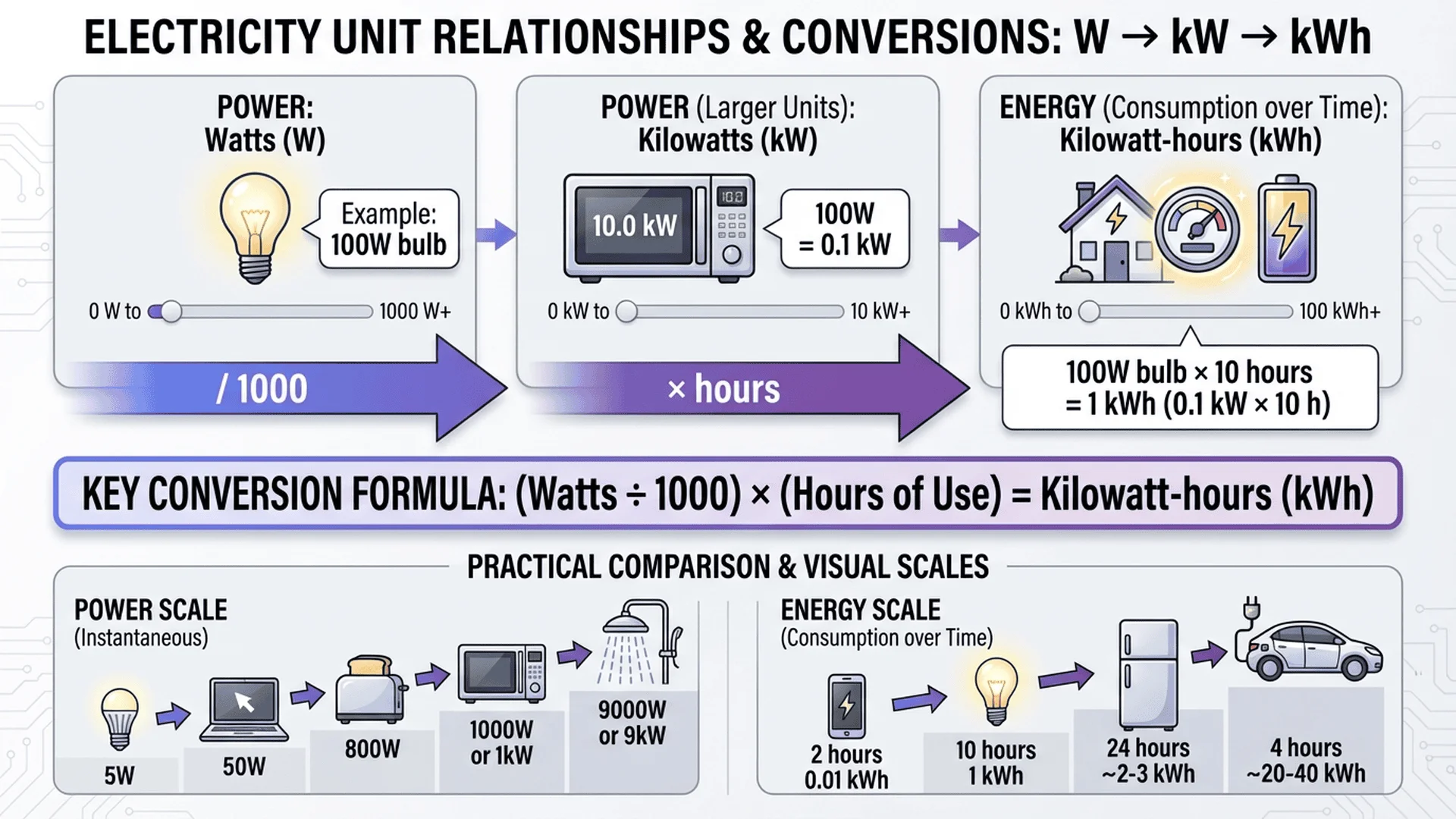
What is a Kilowatt-Hour (kWh)?
A kilowatt-hour (kWh) measures total energy consumption over time. It's the standard unit on your electricity bill.
Breaking Down kWh
Kilowatt (kW):
- 1 kilowatt = 1,000 watts
- Measures POWER (rate of energy use)
Hour (h):
- Time duration
Kilowatt-hour (kWh):
- Energy = Power × Time
- 1 kWh = 1,000 watts used for 1 hour
- 1 kWh = 100 watts used for 10 hours
- 1 kWh = 10 watts used for 100 hours
Critical Insight: kWh measures TOTAL ENERGY (amount), while kW measures POWER (rate). A 1,000W heater uses 1 kW of POWER and consumes 1 kWh of ENERGY per hour.
Real-World kWh Examples
| Appliance | Power (Watts) | Runtime | Energy (kWh) | Cost @ $0.12/kWh |
|---|---|---|---|---|
| LED bulb (10W) | 10 W | 100 hours | 1 kWh | $0.12 |
| Laptop (50W) | 50 W | 20 hours | 1 kWh | $0.12 |
| TV (100W) | 100 W | 10 hours | 1 kWh | $0.12 |
| Microwave (1000W) | 1,000 W | 1 hour | 1 kWh | $0.12 |
| Space heater (1500W) | 1,500 W | 40 minutes | 1 kWh | $0.12 |
| AC unit (3500W) | 3,500 W | 17 minutes | 1 kWh | $0.12 |
Key Takeaway: Different appliances reach 1 kWh at vastly different speeds. High-power appliances (AC, heaters) cost more per hour than low-power ones (LED, laptop).
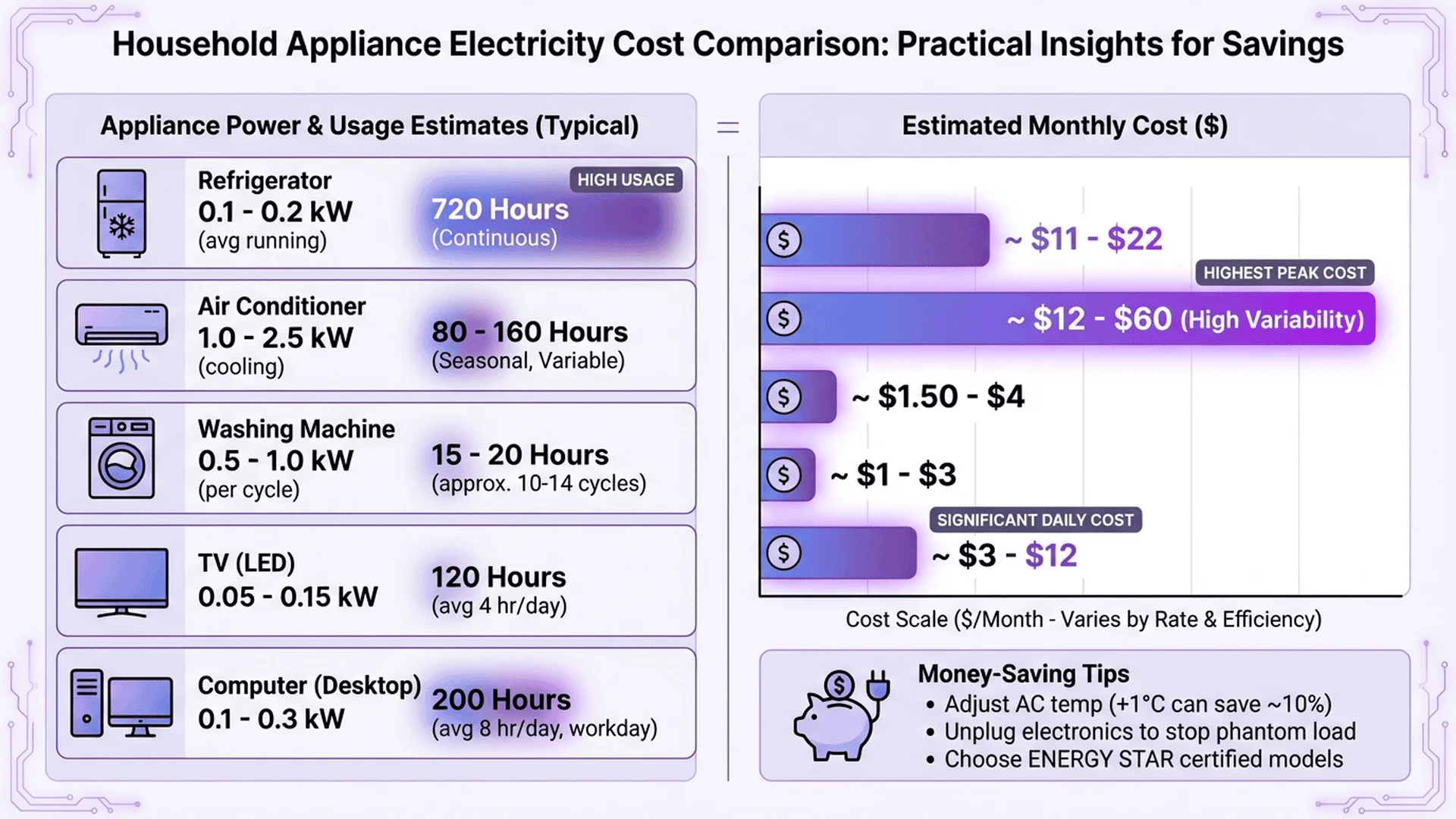
How to Convert Watts to kWh
The fundamental formula for calculating electricity consumption.
Basic Conversion Formula
kWh = (Watts × Hours) ÷ 1,000

Example 1: 100W bulb for 10 hours
kWh = (100 × 10) ÷ 1,000 = 1 kWh

Example 2: 1,500W heater for 8 hours
kWh = (1,500 × 8) ÷ 1,000 = 12 kWh
Alternative Formula (Using Kilowatts)
kWh = kW × Hours

Example: 3.5 kW AC for 6 hours
kWh = 3.5 × 6 = 21 kWh
Step-by-Step Calculation Guide
Step 1: Find appliance wattage
- Check nameplate/label on appliance
- Look in user manual
- Use wattage meter for actual consumption
Step 2: Estimate daily usage hours
- How long does it run per day?
- Consider standby power (always on)
Step 3: Calculate daily kWh
Daily kWh = (Watts × Hours/day) ÷ 1,000
Step 4: Calculate monthly kWh
Monthly kWh = Daily kWh × 30 days
Step 5: Calculate cost
Cost = Monthly kWh × Rate ($/kWh)
Real Calculation Example: Refrigerator
Appliance: Modern refrigerator
Rated power: 150 watts (while compressor runs)
Duty cycle: 33% (runs 8 hours/day, off 16 hours)

Daily kWh = (150 × 8) ÷ 1,000 = 1.2 kWh
Monthly kWh = 1.2 × 30 = 36 kWh
Monthly cost = 36 × $0.12 = $4.32

Annual cost = $4.32 × 12 = $51.84
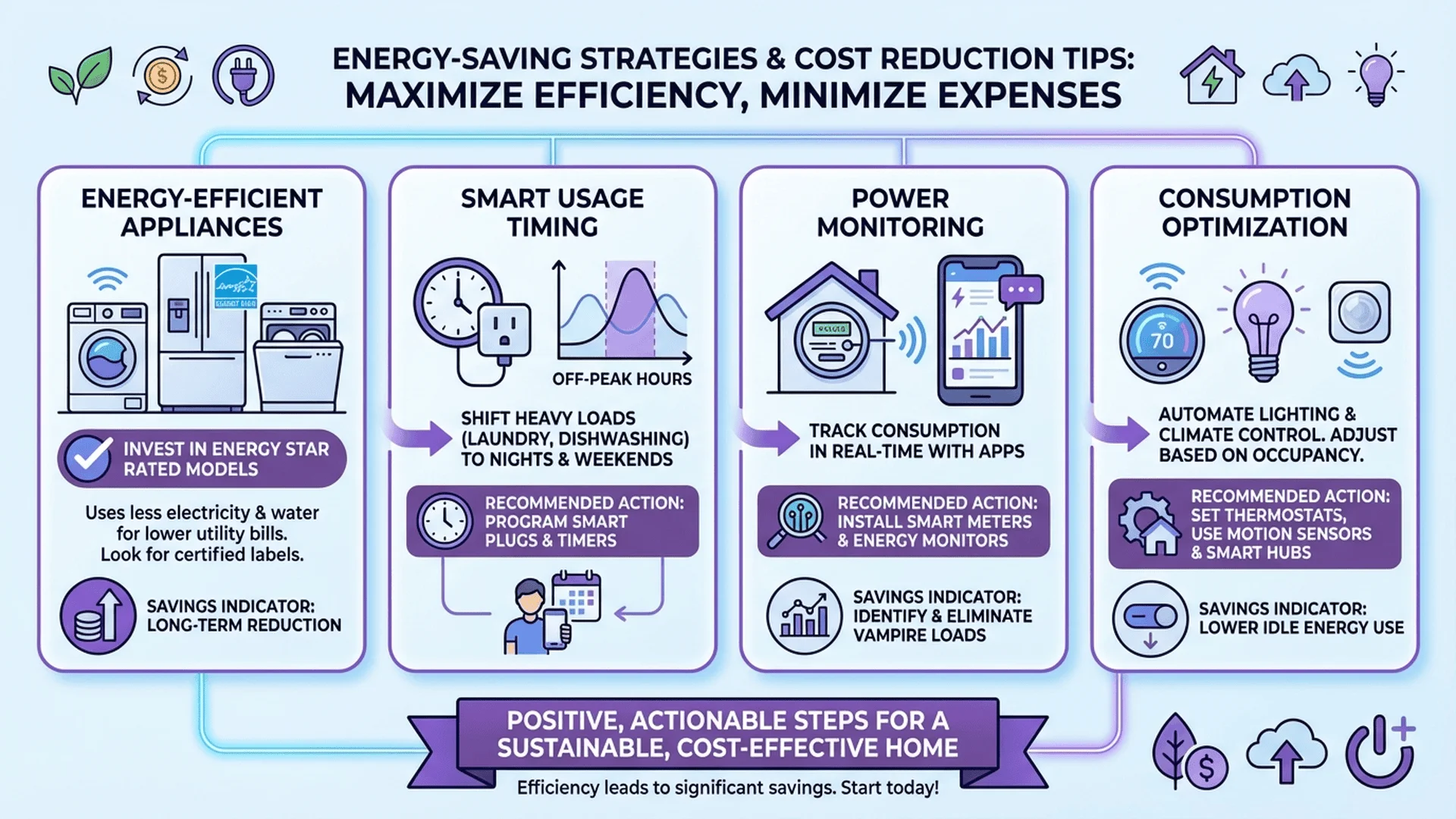
Electricity Cost Calculator
Calculate exactly how much each appliance costs to run.
Cost Calculation Formula
Cost = kWh × Rate ($/kWh)

Total Cost = (Watts × Hours × Rate) ÷ 1,000

Example: 1,500W heater, 8 hours/day, $0.12/kWh
Daily cost = (1,500 × 8 × 0.12) ÷ 1,000 = $1.44
Monthly cost = $1.44 × 30 = $43.20
Common Appliance Costs (US Average $0.12/kWh)
| Appliance | Power (W) | Daily Hours | Daily kWh | Daily Cost | Monthly Cost |
|---|---|---|---|---|---|
| LED bulb (10W) | 10 | 6 | 0.06 | $0.01 | $0.22 |
| Laptop | 50 | 8 | 0.4 | $0.05 | $1.44 |
| Desktop PC | 300 | 8 | 2.4 | $0.29 | $8.64 |
| TV (LED) | 100 | 5 | 0.5 | $0.06 | $1.80 |
| Refrigerator | 150 | 8 (duty) | 1.2 | $0.14 | $4.32 |
| Dishwasher | 1,800 | 1 | 1.8 | $0.22 | $6.48 |
| Washing machine | 500 | 1 | 0.5 | $0.06 | $1.80 |
| Dryer (electric) | 3,000 | 1 | 3.0 | $0.36 | $10.80 |
| Window AC | 1,000 | 8 | 8.0 | $0.96 | $28.80 |
| Central AC | 3,500 | 8 | 28.0 | $3.36 | $100.80 |
| Space heater | 1,500 | 8 | 12.0 | $1.44 | $43.20 |
| Water heater (electric) | 4,500 | 3 | 13.5 | $1.62 | $48.60 |
| Oven | 2,400 | 1 | 2.4 | $0.29 | $8.64 |
Shocking Reality: Central AC can cost $100+ per month in summer! Water heater adds $50/month year-round. These two alone often comprise 40-50% of total bill.
Understanding Your Electricity Bill
Decode your utility bill to find hidden costs and optimization opportunities.
Typical Bill Components
1. Energy Charge (kWh × Rate)
Base rate: $0.08 - $0.15 per kWh (varies by region)
Example: 1,000 kWh × $0.12 = $120
2. Delivery/Distribution Charge
Fixed fee: $5 - $20 per month
Variable: $0.02 - $0.05 per kWh
Covers infrastructure and grid maintenance
3. Time-of-Use Pricing (Optional)
Peak hours (2-8 PM): $0.20 - $0.40 per kWh
Off-peak (9 PM - 1 PM): $0.06 - $0.10 per kWh
Super off-peak (1-6 AM): $0.03 - $0.06 per kWh

Savings strategy: Run dishwasher, laundry, EV charging at night
4. Demand Charge (Commercial)
Based on peak kW usage in 15-minute window
Example: $15 per kW of peak demand
Avoid running all equipment simultaneously
5. Taxes and Fees
Sales tax: 5-10%
Renewable energy surcharge: $0.01 - $0.03 per kWh
Public benefits charge: $0.005 - $0.02 per kWh
Real Bill Example
Monthly Usage: 850 kWh

Energy charge: 850 × $0.11 = $93.50
Delivery charge: $15.00 (fixed) + (850 × $0.03) = $40.50
Subtotal: $134.00
Taxes (7%): $9.38
Total: $143.38

Effective rate: $143.38 ÷ 850 kWh = $0.169/kWh (16.9¢)
Critical Insight: Your "rate" isn't just the energy charge! Including delivery and taxes, effective rate is often 30-50% higher. Always calculate total bill ÷ kWh used for true cost.
State-by-State Electricity Rates (2024 US Average)
Rates vary dramatically by location. Here's what you pay.
Electricity Rates by State
| State | Rate ($/kWh) | Rank | State | Rate ($/kWh) | Rank |
|---|---|---|---|---|---|
| Hawaii | $0.32 | 1 (highest) | Louisiana | $0.09 | 50 (lowest) |
| Alaska | $0.23 | 2 | Washington | $0.10 | 49 |
| Connecticut | $0.22 | 3 | Arkansas | $0.10 | 48 |
| Massachusetts | $0.22 | 4 | Idaho | $0.10 | 47 |
| California | $0.21 | 5 | North Dakota | $0.10 | 46 |
| New York | $0.19 | 6 | Oklahoma | $0.10 | 45 |
| New Jersey | $0.17 | 7 | Utah | $0.10 | 44 |
| Vermont | $0.17 | 8 | Nebraska | $0.11 | 43 |
| Rhode Island | $0.17 | 9 | Wyoming | $0.11 | 42 |
| New Hampshire | $0.17 | 10 | Texas | $0.11 | 41 |
US National Average: $0.12 per kWh (varies $0.09 to $0.32)
Cost Impact Example:
Running 1,500W space heater 8 hours/day = 12 kWh/day = 360 kWh/month
- Louisiana ($0.09): 360 × $0.09 = $32.40/month
- Hawaii ($0.32): 360 × $0.32 = $115.20/month
- Difference: $82.80/month for same usage!
Regional Patterns:
- Lowest rates: Southern/Midwest states (cheap coal, natural gas, hydro)
- Highest rates: Hawaii (imported oil), Northeast (delivery costs), California (renewable mandates)
Solar Panel kWh Calculator
Determine how much electricity your solar system produces and saves.
Solar Production Formula
Daily kWh = System Size (kW) × Peak Sun Hours × System Efficiency

System Size: Total panel wattage in kilowatts
Peak Sun Hours: Daily average (varies by location)
System Efficiency: 0.75 - 0.85 (typical)
Example Calculation: California Home
System: 6 kW (20 panels × 300W each)
Location: Los Angeles (5.5 peak sun hours/day)
System efficiency: 80% (inverter, temperature, dirt losses)

Daily production = 6 kW × 5.5 hours × 0.80 = 26.4 kWh/day
Monthly production = 26.4 × 30 = 792 kWh/month
Annual production = 26.4 × 365 = 9,636 kWh/year

At $0.21/kWh (CA rate):
Annual savings = 9,636 × $0.21 = $2,024
Peak Sun Hours by Region
| Location | Peak Sun Hours/Day | Annual kWh per kW |
|---|---|---|
| Phoenix, AZ | 7.0 | 2,044 |
| Los Angeles, CA | 5.5 | 1,606 |
| Miami, FL | 5.3 | 1,548 |
| Austin, TX | 5.3 | 1,548 |
| Denver, CO | 5.0 | 1,460 |
| New York, NY | 4.5 | 1,314 |
| Seattle, WA | 3.5 | 1,022 |
| Anchorage, AK | 2.5 | 730 |
System Sizing Rule of Thumb:
Required system size (kW) = Monthly usage (kWh) ÷ (Peak sun hours × 30 × 0.80)

Example: 900 kWh/month usage in Los Angeles (5.5 peak hours)
System size = 900 ÷ (5.5 × 30 × 0.80) = 6.8 kW (≈23 panels)
Learn more power conversions in our Power Conversion Guide.
Electric Vehicle (EV) Charging Costs
Calculate how much it costs to charge your EV compared to gasoline.
EV Charging Formula
Charging cost = Battery capacity (kWh) × Electricity rate ($/kWh) × Charging efficiency

Charging efficiency: 85-95% (some energy lost as heat)
Popular EVs: Charging Costs
| Vehicle | Battery (kWh) | Range (mi) | Full Charge Cost @ $0.12/kWh | Cost per Mile |
|---|---|---|---|---|
| Tesla Model 3 SR+ | 50 | 263 | $6.00 | $0.023 |
| Tesla Model 3 LR | 75 | 358 | $9.00 | $0.025 |
| Chevy Bolt | 65 | 259 | $7.80 | $0.030 |
| Nissan Leaf | 40 | 149 | $4.80 | $0.032 |
| Ford Mustang Mach-E | 88 | 305 | $10.56 | $0.035 |
| Tesla Model S | 100 | 405 | $12.00 | $0.030 |
| Rivian R1T | 135 | 314 | $16.20 | $0.052 |
Compare to Gasoline:
Gas car: 30 MPG, $3.50/gallon
Cost per mile = $3.50 ÷ 30 = $0.117 per mile

EV: Tesla Model 3 (263 miles, $6 charge)
Cost per mile = $6 ÷ 263 = $0.023 per mile

EV savings: $0.117 - $0.023 = $0.094 per mile saved

For 12,000 miles/year:
Annual savings = 12,000 × $0.094 = $1,128
10-year savings = $11,280 (before gas price increases!)
Charging Speed and Cost
| Charging Level | Power | Time (0-80%) | Cost for 50 kWh | Notes |
|---|---|---|---|---|
| Level 1 (120V) | 1.4 kW | 36 hours | $6.00 @ home | Standard outlet |
| Level 2 (240V) | 7-11 kW | 6-8 hours | $6.00 @ home | Home/work charger |
| DC Fast (50 kW) | 50 kW | 1 hour | $10-15 | Public charging |
| Tesla Supercharger | 150 kW | 20 min | $12-20 | Tesla network |
| Ultra-fast (350 kW) | 350 kW | 15 min | $15-25 | New installations |
Pro Tip: Charge at home overnight with Time-of-Use pricing. Super off-peak rates (1-6 AM) can be as low as $0.03/kWh, reducing Model 3 full charge to just $1.50!
How to Reduce Your Electricity Bill
Practical strategies to cut consumption and save money immediately.
Top 10 Energy Saving Actions
1. Upgrade to LED Bulbs (Easiest)
Old: 60W incandescent × 20 bulbs × 5 hours/day = 6 kWh/day
New: 9W LED × 20 bulbs × 5 hours/day = 0.9 kWh/day
Daily savings: 5.1 kWh × $0.12 = $0.61
Annual savings: $223
Payback: LEDs cost $2 each, save $11/year per bulb → 2-month payback
2. Adjust Thermostat (Biggest Impact)
AC: Raise from 72°F to 76°F (saves 10-15%)
Average AC cost: $100/month
Savings: $10-15/month, $120-180/year

Heating: Lower from 72°F to 68°F (saves 10%)
Average heating cost: $150/month
Savings: $15/month, $90/year (winter only)
3. Air Seal and Insulate
Typical savings: 15-25% on heating/cooling
Annual HVAC cost: $1,500
Savings: $225-375/year
Cost: $500-1,500 DIY, $2,000-4,000 professional
Payback: 2-10 years
4. Upgrade to Efficient Appliances
Old refrigerator (2000): 1,400 kWh/year
New Energy Star: 400 kWh/year
Savings: 1,000 kWh × $0.12 = $120/year

Old AC (SEER 10): 4,000 kWh/summer
New AC (SEER 16): 2,500 kWh/summer
Savings: 1,500 kWh × $0.12 = $180/year
5. Use Smart Power Strips
Phantom load (always-on devices): 5-10% of bill
Average bill: $120/month
Phantom waste: $6-12/month = $72-144/year
Smart strips cost: $15-25 each
Payback: 2-4 months
6. Wash Clothes in Cold Water
Hot water washing: 4.5 kWh per load (90% is heating water)
Cold water washing: 0.3 kWh per load
Savings per load: 4.2 kWh × $0.12 = $0.50

6 loads/week: $0.50 × 6 × 52 = $156/year saved
7. Air Dry Dishes and Clothes
Dishwasher heat dry: 1 kWh per load
Air dry: 0 kWh (turn off heat dry option)
Savings: $0.12 per load → $62/year (daily use)

Electric dryer: 3 kWh per load
Line drying: Free
Savings: $0.36 per load → $187/year (10 loads/week)
8. Install Programmable Thermostat
Savings: 10-15% on heating/cooling
Annual HVAC: $1,500
Savings: $150-225/year
Cost: $40-150 (DIY install)
Payback: 3-10 months
9. Maintain HVAC System
Dirty filter increases consumption: 15%
Clean filter monthly: $0 cost
Savings: $150 × 0.15 = $22.50/year

Annual professional maintenance: $100-150
Efficiency improvement: 5-10%
Savings: $75-150/year (breaks even or saves)
10. Switch to Time-of-Use Pricing
Standard rate: $0.12/kWh all day
Time-of-use: $0.20 peak (2-8 PM), $0.06 off-peak (9 PM-1 PM)

Strategy: Shift 50% of usage to off-peak (timers, charging overnight)
Average household: 900 kWh/month
Standard cost: 900 × $0.12 = $108

TOU cost: (450 × $0.20) + (450 × $0.06) = $90 + $27 = $117

Wait, that's MORE! You need to shift >60% to off-peak:
Optimal: (350 × $0.20) + (550 × $0.06) = $70 + $33 = $103
Savings: $5/month, $60/year (modest, but grows with more shifting)
Common kWh Conversion Mistakes
Mistake 1: Confusing kW with kWh (75% of Errors!)
Wrong: "My AC uses 3.5 kWh per hour."
Right: "My AC uses 3.5 kW of POWER, consuming 3.5 kWh of ENERGY per hour."
Key Distinction:
- kW (kilowatt): Power = RATE of energy use
- kWh (kilowatt-hour): Energy = TOTAL amount used
Mistake 2: Ignoring Duty Cycle
Wrong: "My 150W fridge uses 150W × 24 hours = 3.6 kWh/day."
Right: "My fridge compressor runs 30-40% of the time: 150W × 8 hours (duty) = 1.2 kWh/day."
Duty Cycle Appliances:
- Refrigerator: 30-40% (8-10 hours actual runtime per day)
- Freezer: 40-50%
- AC: 50-70% (cycles on/off based on thermostat)
- Water heater: 15-30% (heats only when temperature drops)
Mistake 3: Using Nameplate Rating Instead of Actual Usage
Problem: Nameplate shows MAXIMUM power, not typical consumption.
Example: Microwave
- Nameplate: 1,200W (maximum)
- Actual consumption: 1,500W (includes inefficiency)
- Magnetron efficiency: 60-70%
Solution: Use a wattage meter ($15-30) to measure real consumption. Many appliances use 10-30% more than rated power.
Mistake 4: Forgetting Vampire/Phantom Loads
Problem: Devices consume power even when "off."
Common Vampire Loads:
- Cable box: 15-45W (always on) = 11-32 kWh/month = $1.32-3.84
- Game console (standby): 10-15W = 7-11 kWh/month = $0.84-1.32
- Laptop charger (plugged in): 5W = 3.6 kWh/month = $0.43
- Microwave (clock): 3W = 2.2 kWh/month = $0.26
Total Impact: 5-10% of average household bill ($60-120/year waste)
Using Our Unit Converter Tool
Calculate electricity costs instantly with our Unit Converter.
kWh Calculator Features:
✓ Watts to kWh conversion
✓ Built-in cost calculator (enter your rate)
✓ Time period converter (hour/day/month/year)
✓ Appliance comparison tool
✓ Solar production calculator
✓ EV charging cost estimator
✓ 100% free, works offline
{cta: {
title: "Calculate Your Electricity Costs",
description: "Free kWh converter and cost calculator. Find out exactly what each appliance costs to run and how to save money.",
primary_button: {
text: "Open kWh Calculator",
url: "/tools/unit-converter",
priority: "⭐⭐⭐"
},
secondary_buttons: [
{
text: "View All Conversion Tools",
url: "/categories/conversion.html",
priority: "⭐⭐"
}
]
}}
Related Conversion Guides
Explore our complete conversion toolkit:
- Unit Converter Complete Guide - All conversion types in one place
- Power Conversion Guide - Watts to horsepower and kW
- Energy Conversion Guide - Joules, calories, BTU conversions with detailed food and electricity energy comparisons
- Unit Conversion Tables - Quick reference charts
- Best Unit Converter Apps - Mobile tools review
Need Technical Documentation? Check our Unit Converter Implementation guide for developers.
Conclusion: Master kWh and Save Money
Understanding kilowatt-hours empowers you to:
- Control costs: Know exactly what each appliance costs per month
- Identify waste: Find energy hogs and eliminate unnecessary usage
- Make smart upgrades: Calculate ROI on efficient appliances
- Size solar systems: Determine how many panels you need
- Compare EV costs: See real savings vs gasoline
- Optimize billing: Choose best rate plan for your usage pattern
Key Takeaways:
1. kWh = (Watts × Hours) ÷ 1,000 - fundamental formula
2. Cost = kWh × Rate - multiply your usage by local rate
3. HVAC dominates bills - AC, heating, water heater = 60-70% of usage
4. Efficiency pays off fast - LED bulbs pay back in 2 months
5. Time-of-use saves money - shift usage to off-peak when possible
Quick Mental Math:
- 1 kW for 1 hour = 1 kWh (by definition)
- 100W for 10 hours ≈ 1 kWh (easy estimate)
- 1,000W (1kW) appliance = $0.12/hour @ $0.12/kWh (quick cost check)
Action Steps:
1. Find your electricity rate on your bill ($/kWh)
2. Calculate cost of your biggest appliances
3. Implement top 3 energy-saving strategies
4. Monitor usage monthly to track savings
Use our Unit Converter tool for instant kWh calculations, or bookmark this guide for formulas and detailed appliance costs!
Curious about other conversions? Check our complete unit conversion guide covering 32+ conversion types!
Frequently Asked Questions
Q: What is a kWh in electricity?
A: A kilowatt-hour (kWh) is 1,000 watts of power used for 1 hour. For example, a 100W light bulb running for 10 hours uses 1 kWh. It's the standard unit for measuring electricity consumption on your utility bill.
Q: How do I calculate kWh from watts?
A: Multiply watts by hours, then divide by 1,000: kWh = (Watts × Hours) ÷ 1,000. Example: 1,500W heater running 8 hours = (1,500 × 8) ÷ 1,000 = 12 kWh.
Q: How much does 1 kWh of electricity cost?
A: US average is $0.12 per kWh (2024), but varies by state from $0.08 to $0.35+. Check your electricity bill for your exact rate. Hawaii is highest ($0.32), Louisiana lowest ($0.09).
Q: What uses the most electricity in a home?
A: Top consumers: HVAC (46%), water heater (14%), washer/dryer (13%), lighting (9%), refrigerator (6%). A central AC can use 3-5 kWh per hour, costing $3-5 daily in summer.
Q: How many kWh does the average home use per month?
A: US average is 877 kWh/month (2023 data). This varies widely: apartments 500-700 kWh, houses 800-1,200 kWh, large homes 1,500-2,500+ kWh. Climate and square footage are biggest factors.
Q: Is it cheaper to run appliances at night?
A: If you have Time-of-Use (TOU) pricing, yes! Off-peak rates (9 PM-1 PM) are often 50-70% cheaper than peak (2-8 PM). Standard flat-rate pricing has no time difference. Check your utility plan.
Q: How much does it cost to charge an electric car?
A: Tesla Model 3 (50 kWh battery, 263 miles range): $6 full charge @ $0.12/kWh = $0.023 per mile. Compare to 30 MPG gas car @ $3.50/gallon = $0.117 per mile. EV saves $0.094 per mile = $1,128/year for 12,000 miles.
Q: Can solar panels eliminate my electric bill?
A: Possibly! If system produces ≥ your consumption, net metering can zero out bill (you may still pay connection fees $10-30/month). Average 6 kW system in sunny state produces 800-1,000 kWh/month, enough for typical home.
Q: What's the difference between kW and kWh?
A: kW measures POWER (rate), kWh measures ENERGY (total amount). Analogy: kW is speedometer reading (mph), kWh is odometer reading (total miles). Your bill charges for kWh (energy consumed), not kW (power rate).