功率單位換算指南
Power Conversion Guide: Watts to Horsepower, kW to HP Made Easy
Power conversions are everywhere—from car engines to household appliances. Whether you're comparing vehicle specs, calculating solar panel output, or sizing an electric motor, understanding power units saves you time and prevents costly mistakes.
This guide covers watts to horsepower, kilowatts to HP, BTU/hr conversions, and everything in between. You'll learn the formulas, avoid common pitfalls, and get real-world examples you can use immediately.
Need to convert right now? Our Unit Converter tool handles all power conversions instantly with guaranteed accuracy.

Understanding Power Units
Power measures how fast energy is transferred or converted. Think of it like water flow—power is the RATE (gallons per minute), while energy is the TOTAL amount (gallons).
Common Power Units:
- Watts (W): SI standard unit. Named after James Watt.
- Kilowatts (kW): 1,000 watts. Used for larger appliances and engines.
- Horsepower (HP): Traditional mechanical unit. 1 HP = 745.7 watts.
- Metric Horsepower (PS): European standard. 1 PS = 735.5 watts.
- BTU/hr: British Thermal Units per hour. Common in HVAC systems.
Key Insight: Power ≠ Energy! A 1000W heater uses 1 kWh (kilowatt-hour) of energy if run for 1 hour. Learn more about energy conversions in our Energy Conversion Guide.

Watts to Horsepower: The Complete Formula
The most common power conversion, especially for motors and engines.
Standard Conversion Formula
Horsepower (HP) = Watts (W) ÷ 745.7

Watts (W) = Horsepower (HP) × 745.7
Why 745.7?
James Watt defined 1 horsepower as the power needed to lift 550 pounds one foot in one second. This equals exactly 745.699872 watts, rounded to 745.7 for practical use.
Quick Conversion Examples
| Watts | Horsepower | Common Application |
|---|---|---|
| 746 W | 1 HP | Small electric motor |
| 1,500 W | 2.01 HP | Vacuum cleaner |
| 5,600 W | 7.5 HP | Table saw motor |
| 11,200 W | 15 HP | Lawn tractor engine |
| 75,000 W | 100.6 HP | Compact car engine |
| 373,000 W | 500 HP | Sports car engine |
Real-World Application: A typical circular saw rated at 1,800W produces about 2.4 HP. That's why power tool specs often use both units—watts are more precise, while horsepower is more familiar. To see how this power translates into energy consumption and electricity costs, discover our Energy Conversion Guide, which explains the relationship between power and energy in practical household and industrial applications.
Pro Tip: Motor manufacturers sometimes use "peak horsepower" for marketing. Always check the continuous rated power for accurate performance comparisons.
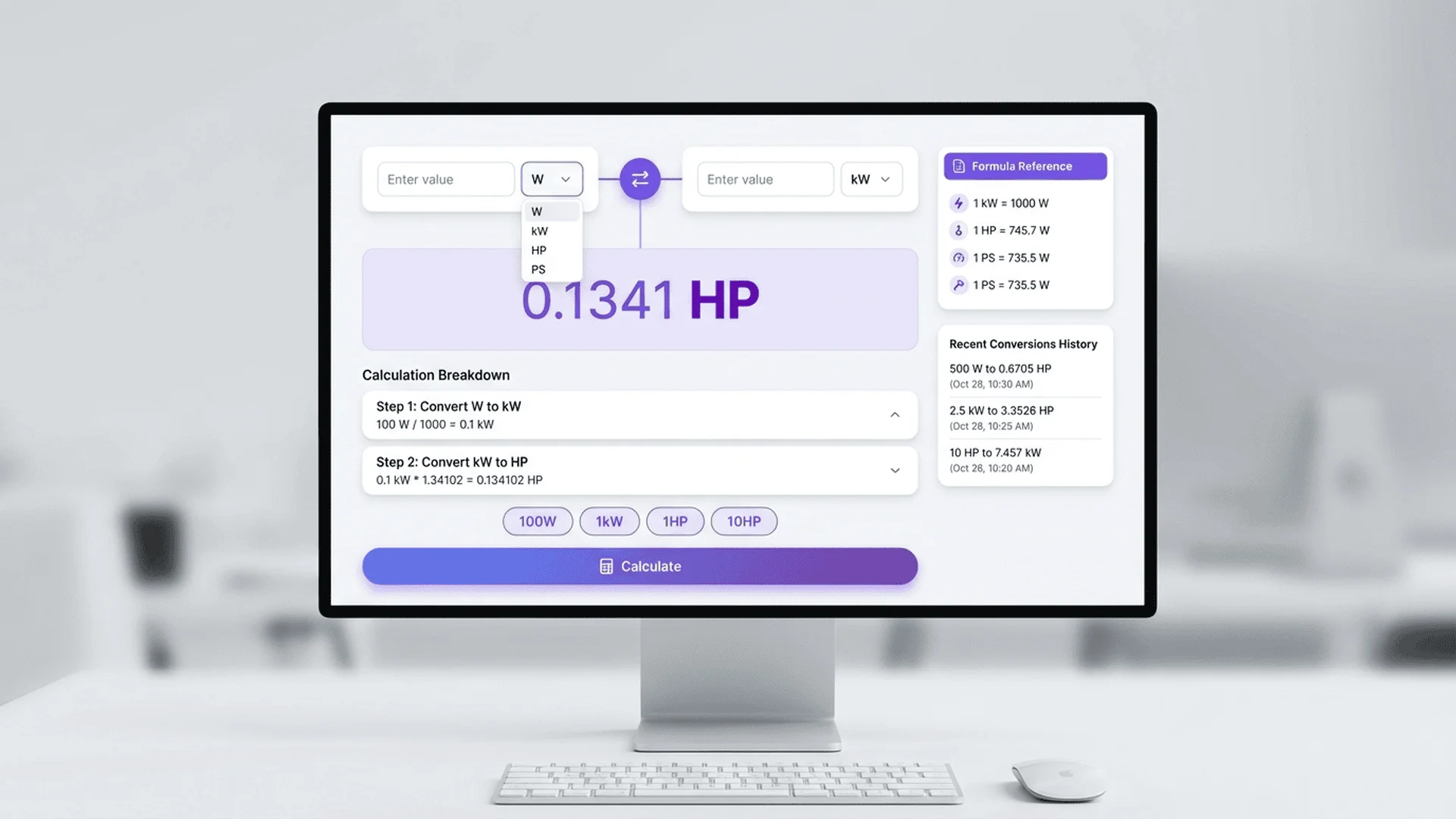
Kilowatts to Horsepower (kW to HP)
Electric vehicles and modern motors use kilowatts instead of horsepower. Here's how to convert.
Conversion Formula
Horsepower (HP) = Kilowatts (kW) × 1.341

Kilowatts (kW) = Horsepower (HP) ÷ 1.341
Why 1.341?
Since 1 HP = 745.7W, and 1 kW = 1000W, we get: 1000W ÷ 745.7W = 1.341 HP per kW.
Electric Vehicle Conversions
| Kilowatts | Horsepower | Vehicle Example |
|---|---|---|
| 50 kW | 67 HP | Nissan Leaf (base) |
| 75 kW | 101 HP | Chevy Bolt |
| 150 kW | 201 HP | Tesla Model 3 SR+ |
| 225 kW | 302 HP | Tesla Model 3 LR |
| 375 kW | 503 HP | Tesla Model S Plaid |
| 750 kW | 1,006 HP | Rimac Nevera |
Common Mistake: Don't confuse kilowatts (power) with kilowatt-hours (energy). A 150 kW motor produces 150 kW of POWER, but a 75 kWh battery stores 75 kWh of ENERGY. Check our kWh Converter Guide for electricity calculations.
Industrial Motor Sizing
When selecting electric motors for machinery:
- Determine Required Power: Calculate load requirements in watts or HP
- Apply Safety Factor: Add 15-25% for startup surge and efficiency
- Convert to Motor Rating: Match to standard motor sizes (0.5 HP, 1 HP, 2 HP, etc.)
Example Calculation:
- Pump requires 3.5 HP continuous
- Add 20% safety factor: 3.5 × 1.20 = 4.2 HP
- Select next standard size: 5 HP motor (3.73 kW)
Horsepower to Watts: Reverse Conversions
Converting from horsepower to watts is just as important, especially when dealing with older equipment specifications.
Standard Mechanical Horsepower
Watts = HP × 745.7
Examples:
- 5 HP motor = 5 × 745.7 = 3,729 W (3.73 kW)
- 250 HP engine = 250 × 745.7 = 186,425 W (186.4 kW)
- 0.5 HP blower = 0.5 × 745.7 = 373 W
Metric Horsepower (PS) Conversions
European specifications use PS (Pferdestärke) or CV (Chevaux-vapeur).
Watts = PS × 735.5
Comparison:
| Rating | Mechanical HP | Metric PS | Watts |
|--------|--------------|-----------|-------|
| Small motor | 1 HP | 1.01 PS | 746 W |
| Sedan engine | 150 HP | 152 PS | 111,900 W |
| Sports car | 400 HP | 406 PS | 298,300 W |
Critical Distinction: A car rated at 200 PS produces only 197.1 HP. Always clarify which horsepower standard is used when comparing specs!
BTU/hr to Watts Conversion
Heating and cooling systems use BTU/hr (British Thermal Units per hour). Here's how to convert to watts.
Conversion Formula
Watts = BTU/hr × 0.293071

BTU/hr = Watts × 3.41214
HVAC System Examples
| BTU/hr | Watts | Horsepower | Typical Use |
|---|---|---|---|
| 5,000 | 1,465 W | 1.96 HP | Small window AC |
| 10,000 | 2,931 W | 3.93 HP | Bedroom AC |
| 18,000 | 5,275 W | 7.07 HP | Large room AC |
| 24,000 | 7,033 W | 9.43 HP | 2-ton central AC |
| 36,000 | 10,550 W | 14.15 HP | 3-ton central AC |
| 60,000 | 17,584 W | 23.58 HP | Furnace output |
Heating vs Cooling: Air conditioners use watts of ELECTRICAL power to move BTU/hr of THERMAL energy. A 10,000 BTU/hr AC might only consume 1,000W of electricity due to efficiency (coefficient of performance).
Energy Cost Calculation:
- 10,000 BTU/hr AC = 2,931W electrical input
- Run 8 hours/day = 23.4 kWh per day
- At $0.12/kWh = $2.81 per day operating cost
Learn more about electricity costs in our kWh Converter Explained guide.
Power Conversion for Solar Panels
Solar panel ratings use watts, but system sizing requires understanding power variations.
Solar Panel Ratings Explained
Peak Watts (Wp): Maximum power under ideal conditions (1000 W/m² sunlight, 25°C cell temperature).
System Power = Panel Wattage × Number of Panels × System Efficiency
Real-World Solar Calculations
Example System:
- 20 panels × 400W each = 8,000W (8 kW) peak power
- Average 5 hours peak sun/day = 40 kWh per day
- Monthly production = 1,200 kWh
Efficiency Factors:
- Inverter efficiency: 95-98%
- Temperature losses: 10-15%
- Shading/dirt: 5-10%
- Net system efficiency: 75-85%
System Sizing Formula:
Required Panel Wattage = Daily Energy Need (kWh) ÷ Peak Sun Hours ÷ System Efficiency

Example: 30 kWh/day ÷ 5 hours ÷ 0.80 = 7,500W (7.5 kW) system needed
Appliance Power Consumption Guide
Understanding appliance power helps estimate electricity costs and size backup generators.
Common Household Appliances
| Appliance | Typical Power | Horsepower Equivalent |
|---|---|---|
| LED bulb | 10-15 W | 0.013-0.020 HP |
| Laptop | 50-100 W | 0.067-0.134 HP |
| Desktop PC | 200-500 W | 0.268-0.671 HP |
| Refrigerator | 100-800 W | 0.134-1.073 HP |
| Microwave | 600-1,200 W | 0.805-1.609 HP |
| Hair dryer | 1,200-1,875 W | 1.609-2.515 HP |
| Washing machine | 500-1,500 W | 0.671-2.012 HP |
| Electric oven | 2,000-5,000 W | 2.682-6.705 HP |
| Central AC | 3,000-5,000 W | 4.023-6.705 HP |
| Electric dryer | 3,000-5,000 W | 4.023-6.705 HP |
Startup Surge: Motors and compressors draw 2-3× rated power during startup. A 1 HP (746W) motor might pull 2,000W for 1-2 seconds when starting.
Generator Sizing
To size a backup generator:
- List Essential Appliances: Refrigerator, lights, furnace blower
- Add Running Watts: Total continuous power needed
- Add Startup Surge: Highest motor surge + other running loads
- Apply Safety Factor: Add 20% for efficiency and future loads
Example:
- Refrigerator: 800W running, 2,400W surge
- Furnace: 600W running, 1,800W surge
- Lights: 200W
- Total Running: 1,600W
- Peak Surge: 2,400W + 600W + 200W = 3,200W
- Generator Size: 4,000W (4 kW) minimum, 5,000W (5 kW) recommended
Engine Power Ratings Explained
Vehicle engines show power in HP or kW, but the numbers need context.
Brake Horsepower (BHP) vs Wheel Horsepower (WHP)
- Brake Horsepower (BHP): Power at the engine flywheel (manufacturer specs)
- Wheel Horsepower (WHP): Power delivered to wheels after drivetrain losses
- Typical Loss: 15-25% depending on drivetrain type
Wheel HP = Brake HP × Drivetrain Efficiency

Front-wheel drive: 85-90% efficient (10-15% loss)
Rear-wheel drive: 80-85% efficient (15-20% loss)
All-wheel drive: 75-80% efficient (20-25% loss)
Example:
- Engine: 300 BHP
- Drivetrain: RWD (18% loss)
- Wheel Power: 300 × 0.82 = 246 WHP
Power-to-Weight Ratio
Performance depends on power AND weight:
Power-to-Weight Ratio = Horsepower ÷ Weight (lbs)
Comparison:
| Vehicle Type | HP | Weight (lbs) | HP/lb | Performance |
|-------------|-----|--------------|-------|-------------|
| Economy sedan | 150 HP | 3,000 lbs | 0.050 | Slow |
| Sports sedan | 300 HP | 3,500 lbs | 0.086 | Quick |
| Sports car | 450 HP | 3,200 lbs | 0.141 | Fast |
| Supercar | 700 HP | 3,000 lbs | 0.233 | Very fast |
| Motorcycle | 180 HP | 400 lbs | 0.450 | Extremely fast |
Better Metric: HP per TON (2,000 lbs) is easier to calculate. A 300 HP car weighing 3,000 lbs has 200 HP/ton.
Common Power Conversion Mistakes
Mistake 1: Confusing Power with Energy (70% of Errors)
Wrong: "My 1500W heater uses 1500W per hour."
Right: "My 1500W heater uses 1.5 kWh of energy per hour."
Power is RATE (watts), energy is TOTAL (watt-hours). Learn the difference in our Energy Conversion Guide.
Mistake 2: Using Wrong Horsepower Standard
Problem: Comparing European PS to American HP directly.
Example:
- Volkswagen Golf: 147 PS = 145 HP (not 147 HP)
- BMW M3: 510 PS = 503 HP (not 510 HP)
Solution: Always convert to watts first, then to your target unit.
Mistake 3: Ignoring Efficiency Losses
Problem: Assuming rated power equals delivered power.
Reality:
- Electric motors: 80-95% efficient
- Gasoline engines: 20-30% efficient (thermal to mechanical)
- Inverters: 90-98% efficient
Example: A 2000W gas generator might only deliver 1600W of usable AC power after engine efficiency and inverter losses.
Mistake 4: Forgetting Startup Surge
Problem: Sizing generator based only on running wattage.
Example:
- 1 HP (746W) air compressor runs at 746W
- Startup surge: 2,238W (3× rated power)
- Small generator can't handle surge → trips breaker
Solution: Always size for PEAK surge power, not just continuous power.
Power Conversion Formula Reference
Quick Reference Table
| From | To | Multiply By | Divide By |
|---|---|---|---|
| Watts | Horsepower | 0.00134 | 745.7 |
| Horsepower | Watts | 745.7 | - |
| Kilowatts | Horsepower | 1.341 | - |
| Horsepower | Kilowatts | - | 1.341 |
| Watts | Metric HP (PS) | - | 735.5 |
| Metric HP (PS) | Watts | 735.5 | - |
| BTU/hr | Watts | 0.293071 | - |
| Watts | BTU/hr | 3.41214 | - |
Exact Conversion Factors (for Engineering)
1 HP (mechanical) = 745.699872 W (exactly)
1 HP (metric/PS) = 735.49875 W (exactly)
1 HP (electrical) = 746 W (exactly)
1 BTU/hr = 0.29307107 W (exactly)
1 kW = 1.34102209 HP (exactly)
When to Use Exact Values:
- Engineering calculations
- Equipment specifications
- Safety-critical applications
- Regulatory compliance
When Rounded Values Are Fine:
- Rough estimates
- Quick mental math
- General comparisons
- Non-critical applications
Using Our Unit Converter Tool
Skip the manual math! Our Unit Converter handles all power conversions instantly.
Features:
✓ Watts, kilowatts, horsepower (all types)
✓ BTU/hr and metric units
✓ Instant bidirectional conversion
✓ Mobile-friendly interface
✓ 100% free, no registration needed
{cta: {
title: "Convert Power Units Instantly",
description: "Free online converter for watts, horsepower, kW, BTU/hr, and more. No installation required.",
primary_button: {
text: "Open Power Converter",
url: "/tools/unit-converter",
priority: "⭐⭐⭐"
},
secondary_buttons: [
{
text: "View All Conversion Tools",
url: "/categories/conversion.html",
priority: "⭐⭐"
}
]
}}
Related Conversion Guides
Explore our complete conversion toolkit:
- Unit Converter Complete Guide - All conversion types in one place
- Energy Conversion Guide - Joules, calories, kWh conversions
- kWh Converter Explained - Electricity cost calculations
- Weight Conversion Guide - Kg to lbs, grams to ounces
- Temperature Conversion Guide - Celsius to Fahrenheit formulas
Need Technical Documentation? Check our Unit Converter Implementation guide for developers.
Conclusion: Master Power Conversions
Power conversions are essential for:
- Automotive: Comparing engine specs across regions
- Electrical: Sizing motors and generators correctly
- HVAC: Understanding cooling capacity vs power consumption
- Solar: Calculating system size and energy production
- Appliances: Estimating electricity costs accurately
Key Takeaways:
1. 1 HP = 745.7 watts (mechanical horsepower standard)
2. 1 kW = 1.341 HP (common for EVs and electric motors)
3. Power ≠ Energy - power is rate, energy is total amount
4. Always account for efficiency losses (15-30% typical)
5. Startup surge matters for generators and circuit sizing
Quick Mental Math:
- Watts → HP: Divide by 750 (close enough for estimates)
- kW → HP: Multiply by 1.3 (within 3% accuracy)
- HP → kW: Divide by 1.3 (quick reverse conversion)
Use our Unit Converter tool for instant accurate conversions, or bookmark this guide for formulas and detailed explanations.
Got questions about other unit conversions? Check our complete conversion guide covering 32+ conversion types!
Frequently Asked Questions
Q: How many watts are in 1 horsepower?
A: 1 horsepower (HP) equals 745.7 watts. This is the mechanical horsepower standard used in most applications. The metric horsepower (PS) is slightly different at 735.5 watts.
Q: How do I convert kilowatts to horsepower?
A: Multiply kilowatts by 1.341 to get horsepower. For example: 75 kW × 1.341 = 100.6 HP. This is commonly used for electric motors and vehicle engines.
Q: What's the difference between power and energy?
A: Power is the RATE of energy transfer (watts, HP), while energy is the TOTAL amount transferred over time (watt-hours, kWh). Power = Energy ÷ Time. A 1000W appliance uses 1 kWh in one hour.
Q: Why do European cars use PS instead of HP?
A: PS (Pferdestärke) is metric horsepower, equal to 735.5 watts, while mechanical HP equals 745.7 watts. The difference is small (about 1.4%), but European regulations require PS for vehicle specifications.
Q: How do I size a generator for my home?
A: Add the running watts of all essential appliances, then add the highest motor startup surge plus other running loads. Apply a 20% safety factor. For example, if you need 3,200W peak, choose a 4,000-5,000W generator.
Q: Can I compare electric motor HP to gas engine HP directly?
A: Not exactly. Electric motors produce peak power instantly across all RPM, while gas engines produce peak power only at specific RPM. A 150 HP electric motor often outperforms a 150 HP gas engine in real-world driving.
Q: What's brake horsepower (BHP) vs wheel horsepower (WHP)?
A: BHP is power at the engine, WHP is power at the wheels. Drivetrain losses (transmission, differential) consume 15-25% of power. A 300 BHP engine might deliver only 240 WHP.
Q: How much does it cost to run a 1500W heater?
A: At $0.12/kWh electricity rate: 1500W = 1.5 kW. Running 8 hours costs: 1.5 kW × 8 hours × $0.12 = $1.44 per day, or about $43/month. Use our kWh converter for your specific rates.