重量單位換算指南
Weight Conversion Guide | kg to lbs, Grams to Ounces【2025 Calculator】
Introduction: Why Accurate Weight Conversion Matters
Converting between kilograms and pounds wrong? You could over-pack luggage, miscalculate medication doses, or ruin recipes. Weight conversion affects everything from fitness tracking to international shipping—and mistakes cost money.
The good news: mastering weight conversion takes just minutes with the right formulas and tools. Our free weight converter eliminates calculation errors and handles all common weight units instantly.
This complete guide covers kg to lbs, grams to ounces, stones to kg, and every weight conversion you'll ever need—with real-world examples from fitness, cooking, and travel.
Understanding Weight Units: Metric vs Imperial
Weight measurement uses two competing systems that divide the world. Understanding both is essential for international communication, travel, and commerce.
The Metric System (SI Units)
Primary Units:
- Gram (g): Base unit, defined by mass of 1 cm³ of water
- Kilogram (kg): 1000 grams, standard for body weight, luggage, shipping
- Milligram (mg): 0.001 grams, used for medications, precious metals
- Metric ton (t): 1000 kilograms, used for vehicles, cargo
Where it's used: Everywhere except USA, Liberia, Myanmar (195+ countries)
Advantages:
- Decimal-based (easy conversions: 1 kg = 1000 g)
- Scientific standard worldwide
- Consistent across all measurement types
The Imperial System
Primary Units:
- Ounce (oz): 1/16 of a pound, used for food portions, postal rates
- Pound (lb): Base unit, abbreviated from Latin "libra"
- Stone (st): 14 pounds, used in UK/Ireland for body weight
- Ton (US): 2000 pounds, used for heavy cargo
Where it's used: USA primarily, UK partially (body weight in stones)
Disadvantages:
- Non-decimal (16 oz = 1 lb, 14 lbs = 1 stone)
- Inconsistent with other measurement types
- Confusing for international users
Why We Need Both Systems
Even though most of the world uses metric, you'll encounter imperial weights in:
- USA: All consumer products, body weight scales, recipes
- UK: Body weight (stones), some food packaging
- Aviation: Aircraft weight worldwide (pounds)
- Fitness: USA gym equipment (lbs), international competitions (kg)
Our Unit Converter Complete Guide explains the history and practical differences between measurement systems.
Kilograms to Pounds: The Most Common Conversion
Converting kg to lbs is the single most frequent weight conversion. You'll use it for luggage limits, fitness tracking, and international shopping.
The Exact Conversion Formula
Kilograms to Pounds:
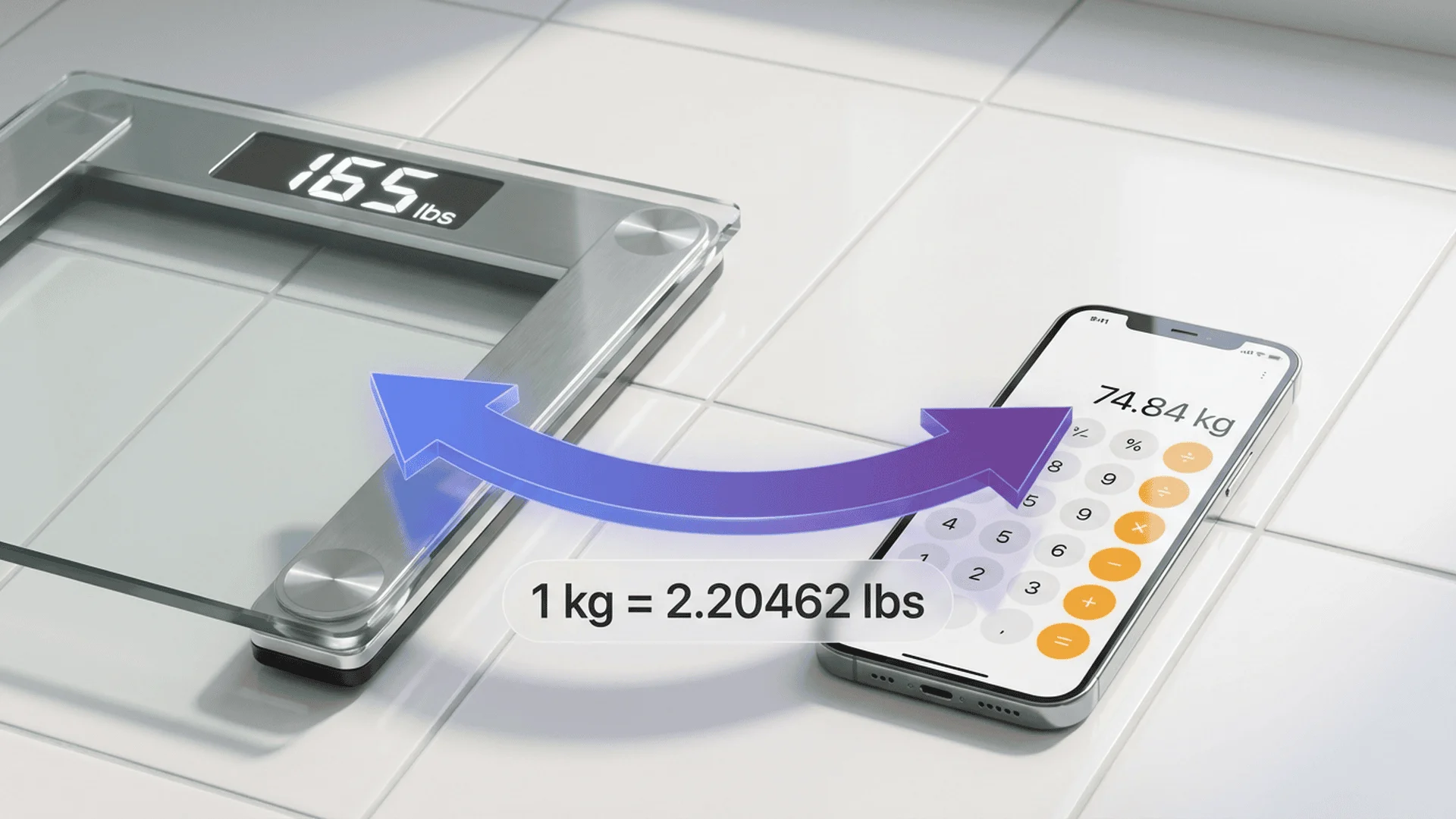
1 kg = 2.20462 lbs
Formula: pounds = kilograms × 2.20462
Example Calculations:
- 50 kg = 50 × 2.20462 = 110.23 lbs
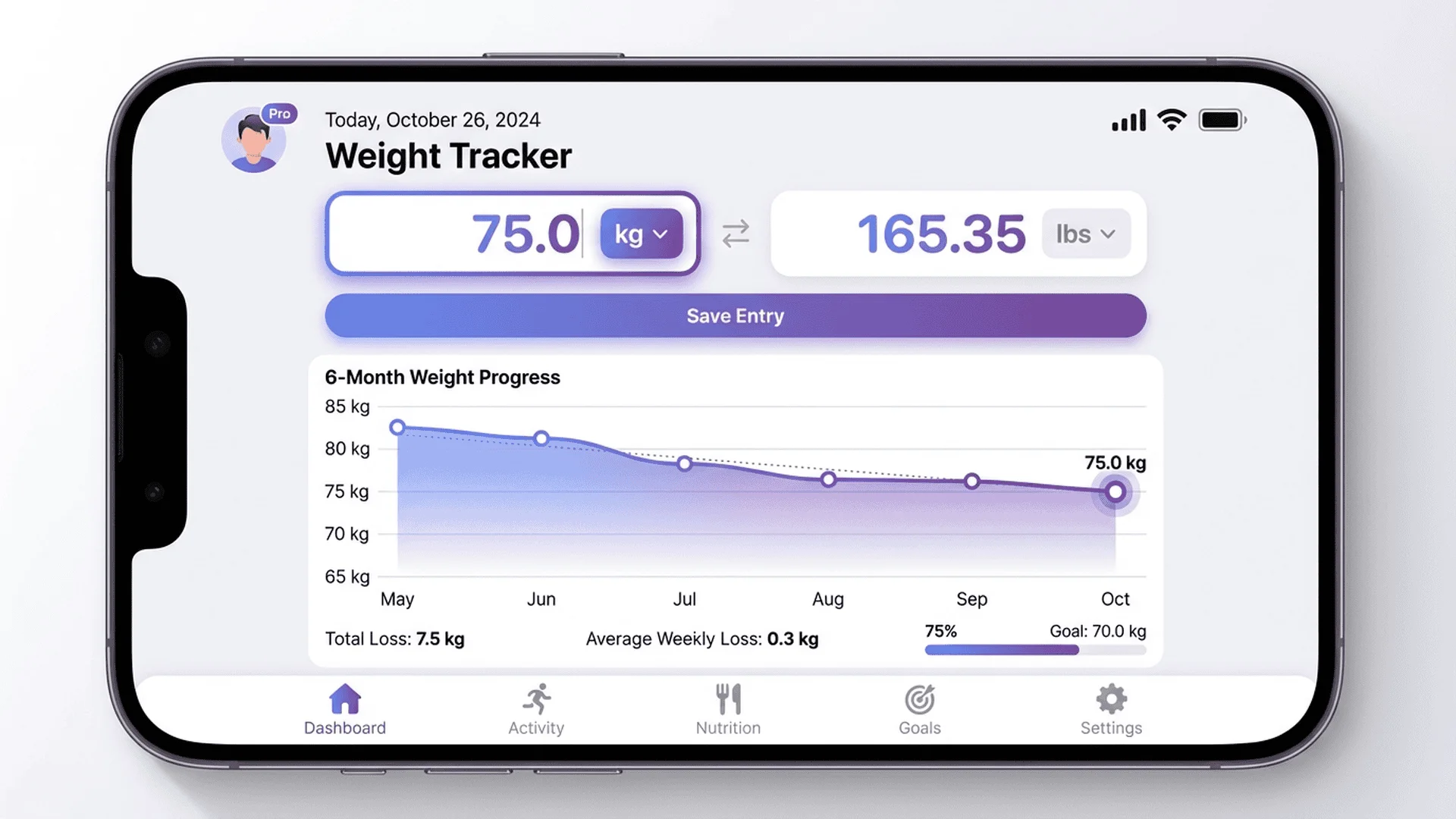
- 75 kg = 75 × 2.20462 = 165.35 lbs
- 90 kg = 90 × 2.20462 = 198.42 lbs
Why 2.20462, Not 2.2?
The simplified "2.2" conversion factor causes errors:
- Using 2.2: 75 kg × 2.2 = 165 lbs (error: -0.35 lbs)
- Using 2.20462: 75 kg × 2.20462 = 165.35 lbs ✅
For personal fitness tracking, 2.2 is "close enough." For commercial shipping or medical applications, use full precision.
Quick Mental Math Trick
Fast approximation: Double the kg number, then add 10%
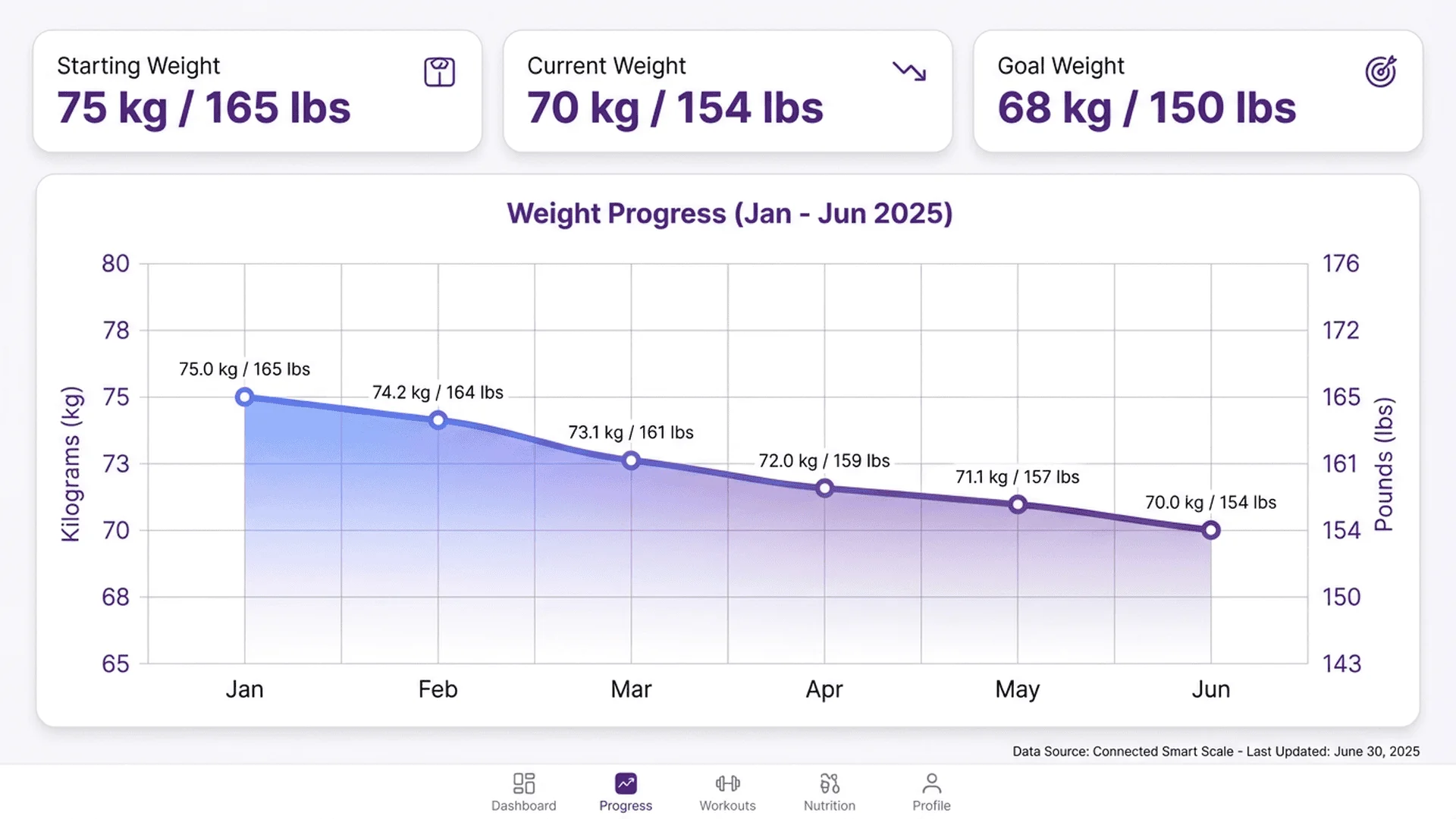
- 70 kg → 70 × 2 = 140 → 140 + 14 = 154 lbs (actual: 154.32)
- 60 kg → 60 × 2 = 120 → 120 + 12 = 132 lbs (actual: 132.28)
Accuracy: Within 0.5% for weights under 100 kg.
Comprehensive kg to lbs Conversion Table
| Kilograms | Pounds | Common Use Case |
|---|---|---|
| 1 kg | 2.20 lbs | Small package |
| 5 kg | 11.02 lbs | Newborn baby |
| 10 kg | 22.05 lbs | Toddler weight |
| 20 kg | 44.09 lbs | Luggage limit (some airlines) |
| 23 kg | 50.71 lbs | Standard checked bag |
| 50 kg | 110.23 lbs | Small adult |
| 68 kg | 149.91 lbs | Average adult (global) |
| 70 kg | 154.32 lbs | Fitness goal weight |
| 75 kg | 165.35 lbs | Common adult weight |
| 90 kg | 198.42 lbs | Larger adult |
| 100 kg | 220.46 lbs | Major milestone |
Real-World kg to lbs Applications
Fitness Tracking:
You're 78 kg and want to track progress using a US fitness app:
- 78 kg × 2.20462 = 171.96 lbs
- Log this weight for accurate tracking
Luggage Limits:
Your suitcase weighs 24 kg. Is it over the 50 lb limit?
- 24 kg × 2.20462 = 52.91 lbs
- Yes, you're 2.91 lbs over—remove items!
Baby Weight:
European hospital reports baby born at 3.4 kg:
- 3.4 kg × 2.20462 = 7.50 lbs
- That's a healthy birth weight (7 lbs 8 oz)
E-commerce Shopping:
Buying 5 kg dumbbells from Europe. How heavy in pounds?
- 5 kg × 2.20462 = 11.02 lbs
- That's light weight for most exercises
Sports Performance:
Olympic weightlifting uses kg. A 150 kg clean and jerk is:
- 150 kg × 2.20462 = 330.69 lbs
- Elite-level performance!
Try our Unit Converter for instant kg to lbs calculations with copy-paste results.
Pounds to Kilograms: The Reverse Conversion
Converting lbs to kg is essential when traveling internationally, using metric gym equipment, or understanding medical weight recommendations.
The Exact Reverse Formula
Pounds to Kilograms:
1 lb = 0.453592 kg
Formula: kilograms = pounds × 0.453592
Example Calculations:
- 150 lbs = 150 × 0.453592 = 68.04 kg
- 180 lbs = 180 × 0.453592 = 81.65 kg
- 200 lbs = 200 × 0.453592 = 90.72 kg
Mental Math Shortcut
Fast approximation: Divide pounds by 2, then subtract 10%
- 150 lbs → 150 ÷ 2 = 75 → 75 - 7.5 = 67.5 kg (actual: 68.04)
- 200 lbs → 200 ÷ 2 = 100 → 100 - 10 = 90 kg (actual: 90.72)
Pounds to kg Conversion Table
| Pounds | Kilograms | Common Use Case |
|---|---|---|
| 1 lb | 0.45 kg | Small item |
| 10 lbs | 4.54 kg | Bag of flour |
| 50 lbs | 22.68 kg | Checked luggage |
| 100 lbs | 45.36 kg | Medium adult |
| 120 lbs | 54.43 kg | Small frame adult |
| 150 lbs | 68.04 kg | Average adult |
| 180 lbs | 81.65 kg | Larger adult |
| 200 lbs | 90.72 kg | Common milestone |
| 250 lbs | 113.40 kg | Heavy adult |
| 300 lbs | 136.08 kg | Medical concern |
Practical lbs to kg Examples
International Travel:
Your airline allows 50 lbs checked bags. You have a 23 kg suitcase:
- 23 kg × 2.20462 = 50.71 lbs
- Just barely over limit!
Medical Dosing:
Doctor prescribes medication at 5 mg per kg. You weigh 165 lbs:
- 165 lbs × 0.453592 = 74.84 kg
- Dose = 74.84 × 5 = 374.2 mg
Gym Equipment:
European gym has 80 kg barbell. What's that in lbs?
- 80 kg × 2.20462 = 176.37 lbs
- Heavy lifting!
Dietary Planning:
Nutrition plan says 2 grams protein per kg body weight. You're 175 lbs:
- 175 lbs × 0.453592 = 79.38 kg
- Protein needed = 79.38 × 2 = 158.76 g per day
Newborn Weight:
US baby born at 8 lbs 4 oz (8.25 lbs):
- 8.25 lbs × 0.453592 = 3.74 kg
- Slightly above average
Grams to Ounces: Kitchen and Postal Conversions
Grams and ounces appear everywhere in cooking, baking, and small package shipping. These smaller units require more precision.
Grams to Ounces Formula
Exact Conversion:
1 g = 0.035274 oz
Formula: ounces = grams × 0.035274
Common Conversions:
- 100 g = 100 × 0.035274 = 3.53 oz
- 250 g = 250 × 0.035274 = 8.82 oz
- 500 g = 500 × 0.035274 = 17.64 oz
Ounces to Grams Formula
Reverse Conversion:
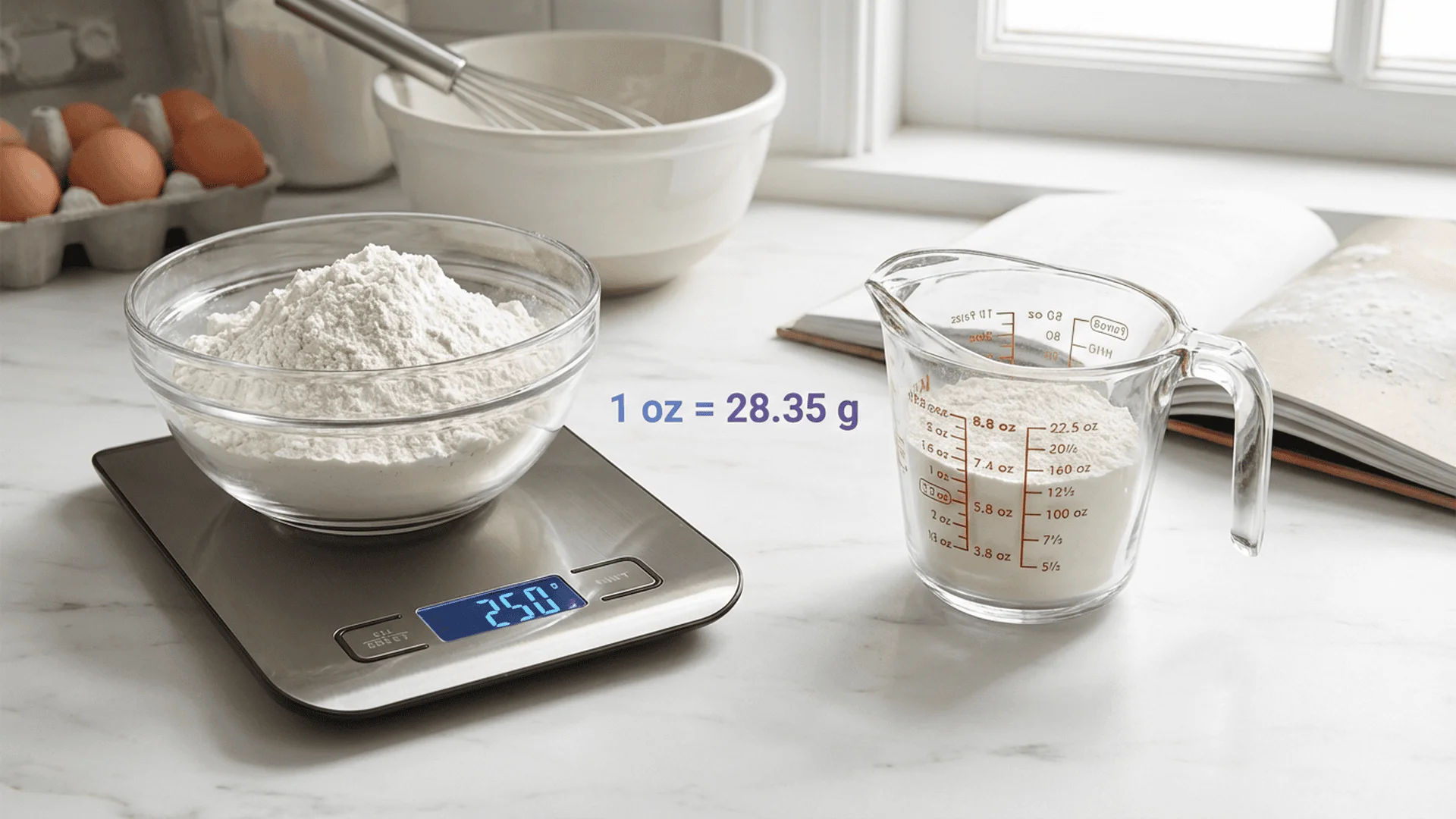
1 oz = 28.3495 g
Formula: grams = ounces × 28.3495
Common Conversions:
- 1 oz = 28.35 g
- 4 oz = 4 × 28.3495 = 113.40 g
- 8 oz = 8 × 28.3495 = 226.80 g
- 16 oz (1 lb) = 16 × 28.3495 = 453.59 g
Detailed Grams to Ounces Table
| Grams | Ounces | Kitchen Equivalent |
|---|---|---|
| 5 g | 0.18 oz | 1 teaspoon salt |
| 15 g | 0.53 oz | 1 tablespoon sugar |
| 25 g | 0.88 oz | 2 tablespoons butter |
| 50 g | 1.76 oz | ¼ cup flour |
| 100 g | 3.53 oz | ½ cup sugar |
| 125 g | 4.41 oz | ½ cup + 1 tablespoon |
| 150 g | 5.29 oz | ⅔ cup |
| 200 g | 7.05 oz | ¾ cup + 2 tablespoons |
| 250 g | 8.82 oz | 1 cup |
| 500 g | 17.64 oz | 2 cups |
Cooking and Baking Applications
Recipe Conversion:
French recipe calls for 200g flour. Your measuring cup shows ounces:
- 200 g × 0.035274 = 7.05 oz (approximately ¾ cup + 2 tablespoons)
Postal Rates:
Mailing a 150g package. Postal service uses ounces:
- 150 g × 0.035274 = 5.29 oz
- Stamp rate applies to "under 6 oz"
Precious Metals:
Buying 31.1g gold bar (1 troy ounce):
- 31.1 g × 0.035274 = 1.10 oz (regular ounces)
- Note: Troy ounce (31.1g) ≠ Regular ounce (28.35g)
Nutrition Labels:
European chocolate bar: 100g. US equivalent:
- 100 g × 0.035274 = 3.53 oz
- Standard US chocolate bar is 1.55 oz (smaller!)
For kitchen-specific conversions with cup/tablespoon equivalents, see our Cooking Unit Converter Guide.
Stone to Kilograms: UK Body Weight Conversion
The stone (st) is unique to UK and Ireland for measuring body weight. Understanding stone conversions helps interpret UK health data and fitness discussions.
Stone Conversion Formulas
Stone to Kilograms:
1 stone = 6.35029 kg
Formula: kilograms = stones × 6.35029
Stone to Pounds:
1 stone = 14 pounds (exact)
Formula: pounds = stones × 14
Stone and Pounds Combined:
When written as "11 st 7 lbs":
- Convert stones: 11 × 14 = 154 lbs
- Add remaining pounds: 154 + 7 = 161 lbs
- Or in kg: 161 × 0.453592 = 73.03 kg
Stone Conversion Table
| Stone | Pounds | Kilograms | Body Weight Category |
|---|---|---|---|
| 8 st | 112 lbs | 50.80 kg | Underweight (adult) |
| 9 st | 126 lbs | 57.15 kg | Small frame |
| 10 st | 140 lbs | 63.50 kg | Average (women) |
| 11 st | 154 lbs | 69.85 kg | Average (men) |
| 12 st | 168 lbs | 76.20 kg | Healthy weight |
| 13 st | 182 lbs | 82.55 kg | Larger frame |
| 14 st | 196 lbs | 88.90 kg | Heavy weight |
| 15 st | 210 lbs | 95.25 kg | Very heavy |
| 16 st | 224 lbs | 101.60 kg | Obesity threshold |
| 20 st | 280 lbs | 127.01 kg | Severe obesity |
Real-World Stone Conversions
UK Health Records:
Patient weighs 12 stone 6 pounds. What's that in kg?
- 12 st = 12 × 14 = 168 lbs
- Add 6 lbs = 174 lbs total
- Convert: 174 × 0.453592 = 78.92 kg
Fitness Goals:
UK person wants to lose "2 stone" (common goal):
- 2 st × 6.35029 = 12.70 kg
- Or in pounds: 2 × 14 = 28 lbs
Boxing Weight Classes:
UK boxer fights at 11 st 4 lbs (light heavyweight):
- 11 × 14 + 4 = 158 lbs
- In kg: 158 × 0.453592 = 71.67 kg
Why Stones Are Confusing
Mixed Units:
"11 st 7 lbs" combines two units, unlike pure metric (75 kg) or pure imperial (167 lbs)
Non-Decimal:
14 pounds per stone makes mental math difficult
Limited Use:
Only UK/Ireland use stones; rest of world uses kg or lbs exclusively
Modern Trend:
Younger UK generations increasingly use kg instead of stones
Metric Tons and US Tons: Heavy Weight Conversions
For vehicles, cargo, and industrial applications, tons (metric and US) measure extremely heavy weights.
Understanding Different "Tons"
Metric Ton (tonne):
- 1 metric ton = 1000 kg = 2204.62 lbs
- Symbol: t or MT
- Used worldwide for shipping, vehicles, cargo
US Ton (short ton):
- 1 US ton = 2000 lbs = 907.185 kg
- Symbol: ton or T
- Used in USA for cargo, trucks
UK Ton (long ton):
- 1 UK ton = 2240 lbs = 1016.05 kg
- Rarely used today
Ton Conversion Formulas
Metric Tons to Pounds:
1 metric ton = 2204.62 lbs
Formula: pounds = metric_tons × 2204.62
US Tons to Kilograms:
1 US ton = 907.185 kg
Formula: kilograms = US_tons × 907.185
Metric Tons to US Tons:
1 metric ton = 1.10231 US tons
Formula: US_tons = metric_tons × 1.10231
Ton Conversion Table
| Metric Tons | US Tons | Kilograms | Pounds | Example |
|---|---|---|---|---|
| 0.5 t | 0.55 T | 500 kg | 1102 lbs | Motorcycle |
| 1 t | 1.10 T | 1000 kg | 2205 lbs | Small car |
| 2 t | 2.20 T | 2000 kg | 4409 lbs | Large car |
| 5 t | 5.51 T | 5000 kg | 11023 lbs | Elephant |
| 10 t | 11.02 T | 10000 kg | 22046 lbs | Truck |
| 20 t | 22.05 T | 20000 kg | 44092 lbs | Shipping container |
| 50 t | 55.12 T | 50000 kg | 110231 lbs | Semi-truck load |
Heavy Weight Conversion Examples
Vehicle Weight:
European car specifications: 1.5 metric tons. What's that in pounds?
- 1.5 t × 2204.62 = 3306.93 lbs
Shipping Cargo:
Container holds 20 US tons. How many metric tons?
- 20 US tons ÷ 1.10231 = 18.14 metric tons
Construction Materials:
50-ton crane capacity (US tons). In metric tons?
- 50 US tons ÷ 1.10231 = 45.36 metric tons
Agricultural Yield:
Farm produces 100 metric tons wheat. In US tons?
- 100 t × 1.10231 = 110.23 US tons
Advanced Weight Conversions: Specialized Units
Beyond common weights, specialized fields use unique units requiring specific conversions.
Troy Ounces (Precious Metals)
Troy Ounce vs Regular Ounce:
- 1 troy oz = 31.1035 g (precious metals)
- 1 regular oz = 28.3495 g (everyday weight)
- Difference: 9.7% heavier
Why It Matters:
Gold, silver, platinum prices quote per troy ounce. Using regular ounces undervalues by ~10%.
Conversion Examples:
- 1 troy oz gold = 31.1035 g
- 10 troy oz silver = 311.035 g = 10.97 regular oz
Carats (Gemstones)
Carat to Grams:
1 carat = 0.2 grams (exact)
Formula: grams = carats × 0.2
Examples:
- 5 carat diamond = 5 × 0.2 = 1 gram
- 2.5 carat ruby = 2.5 × 0.2 = 0.5 grams
Not to Confuse:
- Carat (gemstone weight) = 0.2 g
- Karat (gold purity) = measurement of fineness (24K = pure)
Grains (Ammunition, Pharmacy)
Grain Conversions:
1 grain = 0.0647989 grams
1 grain = 0.00228571 ounces
Where Used:
- Bullet weight (ammunition): 115 grain, 147 grain 9mm bullets
- Historical pharmacy: aspirin tablets (5 grains)
Example:
147 grain bullet = 147 × 0.0647989 = 9.53 grams
Pennyweight (Jewelry)
Pennyweight (dwt) to Grams:
1 dwt = 1.55517 grams
20 dwt = 1 troy ounce
Used by jewelers for gold/silver pricing.
Weight Conversion Tools and Calculators
Digital tools eliminate conversion errors and save time. Here's how to choose and use weight converters effectively.
Types of Weight Converters
Online Web Converters:
- ✅ Advantages: No installation, cross-platform, always updated
- ❌ Disadvantages: Requires internet (usually)
- Best for: Quick one-time conversions
- Example: Tool Master Unit Converter
Mobile Apps:
- ✅ Advantages: Offline functionality, quick access, camera input (some)
- ❌ Disadvantages: Takes phone storage, may have ads
- Best for: Grocery shopping, gym tracking, travel
Smart Scale Integration:
- ✅ Advantages: Automatic logging, trend tracking, multiple users
- ❌ Disadvantages: Cost ($30-200), requires app setup
- Best for: Long-term fitness tracking
Excel Formulas:
- ✅ Advantages: Batch conversions, custom formulas, data analysis
- ❌ Disadvantages: Manual setup, error-prone without validation
- Best for: Business, research, large datasets
What Makes a Great Weight Converter?
Essential Features:
1. Accuracy: Full precision conversion factors (not rounded)
2. Bidirectional: Auto-converts both directions (kg→lbs and lbs→kg)
3. Real-time: Updates as you type
4. Copy function: One-click copy results
5. Mobile-friendly: Works on smartphones
Nice-to-Have Features:
- Conversion history
- Favorite conversions
- Batch conversion (multiple values)
- Decimal precision control
- Unit abbreviation recognition (kg, KG, kilo all work)
Using Our Weight Converter
Tool Master's Unit Converter provides:
- ✅ All common weight units (kg, lbs, g, oz, st, tons)
- ✅ 100% browser-based (no data transmission)
- ✅ Instant bidirectional conversion
- ✅ Works offline after first load
- ✅ Completely free, no registration
How to Use:
1. Select source unit (e.g., "Kilograms")
2. Enter value (e.g., "75")
3. Select target unit (e.g., "Pounds")
4. Result appears instantly: 165.35 lbs
5. Click "Copy" to paste anywhere
For batch conversions and Excel integration, see our Excel Unit Converter Formulas Guide.
For comparisons of different weight converter apps, read our Best Unit Converter Apps 2025 review.
Common Weight Conversion Mistakes to Avoid
Even experienced users make weight conversion errors. Understanding common pitfalls prevents costly mistakes in fitness, shipping, and medical contexts.
Mistake #1: Using 2.2 Instead of 2.20462
Wrong:
75 kg × 2.2 = 165 lbs ❌
Right:
75 kg × 2.20462 = 165.35 lbs ✅
Error: 0.35 lbs (158 grams)
When It Matters:
- Medical dosing calculations
- Competitive sports weight classes
- Commercial shipping costs
- Scientific research
Prevention: Use digital converters that store full precision, not mental math.
Mistake #2: Confusing Troy and Regular Ounces
Wrong:
10 oz gold = 10 × 28.3495 = 283.5 g ❌
Right:
10 troy oz gold = 10 × 31.1035 = 311.04 g ✅
Error: 27.54 grams (9.7% undervaluation)
When It Matters:
- Buying/selling precious metals
- Jewelry appraisal
- Investment calculations
Prevention: Always specify "troy ounces" for metals; assume regular ounces for everything else.
Mistake #3: Forgetting Stones Use Mixed Units
Wrong:
12 stone = 12 × 6.35029 = 76.20 kg ❌ (if you mean 12 st 7 lbs)
Right:
12 st 7 lbs = (12 × 14 + 7) lbs = 175 lbs = 79.38 kg ✅
Error: 3.18 kg (7 lbs) – significant!
Prevention: When you see UK weight, check if it includes extra pounds (e.g., "12 st 7").
Mistake #4: Using Metric Tons When US Tons Meant
Wrong:
5-ton truck (US) = 5 × 1000 kg = 5000 kg ❌
Right:
5-ton truck (US) = 5 × 907.185 kg = 4535.92 kg ✅
Error: 464 kg (1023 lbs) – major difference!
When It Matters:
- Vehicle weight ratings
- Bridge weight limits
- Cargo capacity
- Equipment specifications
Prevention: Check context – US specifications usually mean US tons (2000 lbs).
Mistake #5: Rounding Too Early in Multi-Step Conversions
Wrong:
150 lbs → 68 kg (rounded) → 68 × 2.20462 = 149.91 lbs ❌ (0.09 lbs lost)
Right:
150 lbs → 68.0389 kg → 68.0389 × 2.20462 = 150.00 lbs ✅
Prevention: Keep full precision until final answer, then round.
Mistake #6: Mixing Weight and Mass in Scientific Contexts
Weight vs Mass:
- Mass: Amount of matter (measured in kg, g) – constant everywhere
- Weight: Force due to gravity (measured in Newtons) – varies by location
Example:
Your mass is 70 kg on Earth and on the Moon. Your weight is 686 N on Earth but only 114 N on Moon.
Common Error:
In everyday life, we say "I weigh 70 kg" when technically we mean "my mass is 70 kg."
When It Matters:
- Physics problems
- Space science
- Engineering calculations
Prevention: In casual contexts, "weight in kg" is fine. In scientific contexts, use mass (kg) and weight (Newtons) correctly.
Weight Conversion for Fitness and Health
Tracking body weight accurately is crucial for health goals, medical treatment, and athletic performance. Here's how to handle weight conversions in fitness contexts.
Fitness Tracker Conversions
Problem:
Your gym scale shows 165 lbs, but your fitness app uses kilograms.
Solution:
- 165 lbs × 0.453592 = 74.84 kg
- Log 74.84 kg for accurate tracking
Why Precision Matters:
Small weight changes (0.5 kg / 1 lb) indicate real progress. Rounding errors can hide results.
Body Mass Index (BMI) Calculations
BMI Formula (Metric):
BMI = weight_kg / (height_m)²
BMI Formula (Imperial):
BMI = (weight_lbs / (height_in)²) × 703
Example:
Person weighs 165 lbs, height 5'8" (68 inches)
- Metric method:
- 165 lbs = 74.84 kg
- 68 inches = 1.7272 m
- BMI = 74.84 / (1.7272)² = 25.1 (slightly overweight)
- Imperial method:
- BMI = (165 / 68²) × 703 = 25.1 ✅
Protein Intake Calculations
Standard Recommendation:
1.6-2.2 grams protein per kilogram body weight (for muscle building)
Example:
180 lb person wants to calculate protein needs:
- 180 lbs × 0.453592 = 81.65 kg
- Minimum: 81.65 × 1.6 = 130.6 g protein/day
- Maximum: 81.65 × 2.2 = 179.6 g protein/day
Weight Class Conversions (Combat Sports)
UFC Weight Classes:
| Division | Pounds | Kilograms |
|----------|--------|-----------|
| Flyweight | 125 lbs | 56.7 kg |
| Bantamweight | 135 lbs | 61.2 kg |
| Featherweight | 145 lbs | 65.8 kg |
| Lightweight | 155 lbs | 70.3 kg |
| Welterweight | 170 lbs | 77.1 kg |
| Middleweight | 185 lbs | 83.9 kg |
| Light Heavyweight | 205 lbs | 93.0 kg |
| Heavyweight | 265 lbs | 120.2 kg |
Example:
Fighter weighs 156 lbs. Can he make lightweight (155 lbs)?
- Needs to lose: 156 - 155 = 1 lb = 0.45 kg
- Achievable with water weight cut
Medical Weight Conversions
Medication Dosing:
Many medications dose by mg per kg body weight.
Example:
Patient weighs 145 lbs, prescription is 5 mg/kg:
- 145 lbs × 0.453592 = 65.77 kg
- Dose = 65.77 × 5 = 328.85 mg
Pediatric Dosing:
Especially critical for children where small weight differences matter.
Example:
Child weighs 45 lbs, medication is 10 mg/kg:
- 45 lbs × 0.453592 = 20.41 kg
- Dose = 20.41 × 10 = 204.1 mg
For specialized medical unit conversions, see our Medical Unit Converter Guide.
Weight Conversion for Travel and Shipping
International travel and e-commerce require constant weight conversions. Airline baggage fees and shipping costs depend on accurate weight measurements.
Airline Baggage Limits
Standard Baggage Allowances:
| Airline Region | Checked Bag | Carry-On | Unit |
|----------------|-------------|----------|------|
| US Domestic | 50 lbs | 15-22 lbs | Pounds |
| European | 23 kg | 8-12 kg | Kilograms |
| Asian | 20-30 kg | 7-10 kg | Kilograms |
| Budget (Worldwide) | 15-20 kg | 7 kg | Kilograms |
Conversion Examples:
Example 1: US to Europe
Your suitcase weighs 48 lbs. European airline limit is 23 kg:
- 48 lbs × 0.453592 = 21.77 kg ✅ Under limit
Example 2: Europe to US
Your bag weighs 24 kg. US airline limit is 50 lbs:
- 24 kg × 2.20462 = 52.91 lbs ❌ Over limit by 2.91 lbs
- Need to remove ~3 lbs (1.4 kg) of items
Example 3: Budget Airline
RyanAir allows 20 kg checked bag. You have 46 lbs:
- 46 lbs × 0.453592 = 20.87 kg ❌ Over by 0.87 kg
- Overweight fee applies!
Excess Baggage Fees
Typical Overage Costs:
- $50-150 per bag for 1-10 kg / 2-22 lbs over limit
- Higher fees for international flights
- Some airlines charge per kg over limit
Cost Calculation:
Bag weighs 27 kg, limit is 23 kg, fee is $25/kg over:
- Overage: 27 - 23 = 4 kg
- Fee: 4 × $25 = $100 extra
Prevention: Weigh bags before airport using home scale, convert units to match airline specs.
International Package Shipping
Postal Rate Tiers:
USPS International rates jump at weight thresholds:
- 0-4 oz: $14.50
- 4-8 oz: $16.50
- 8 oz - 1 lb: $24.50
- 1-2 lbs: $31.50
Conversion Strategy:
Package weighs 220 g. Which tier?
- 220 g × 0.035274 = 7.76 oz
- Falls in 4-8 oz tier: $16.50
Example 2:
Package is 520 g:
- 520 g × 0.035274 = 18.34 oz = 1.15 lbs
- Falls in 1-2 lb tier: $31.50
E-commerce Shipping Calculations
Seller Perspective:
Listing shipping costs for international customers.
Example:
Product weighs 1.2 kg. Calculate shipping for US customers:
- US postal service uses pounds: 1.2 kg × 2.20462 = 2.65 lbs
- Shipping cost: $12.50 (under 3 lbs rate)
Buyer Perspective:
European site lists shipping as "€5 for items under 500g"
- You're buying item weighing 18 oz
- 18 oz × 28.3495 = 510.29 g ❌ Over limit
- Shipping jumps to next tier (€8)
Customs Declarations
Value Thresholds:
Many countries have import duty thresholds based on value AND weight.
Example:
USA: Items under $800 often duty-free, but must declare weight
- Package: 3.5 kg = 3.5 × 2.20462 = 7.72 lbs
- Declare as "7.72 lbs" on US customs form
Prevention: Always convert to destination country's preferred unit for customs paperwork.
Conclusion: Mastering Weight Conversion
Accurate weight conversion is a practical skill that affects daily life—from cooking recipes to tracking fitness goals to avoiding airline baggage fees.
Key Takeaways
Essential Conversions to Remember:
1. 1 kg = 2.20462 lbs (not 2.2—precision matters!)
2. 1 lb = 0.453592 kg (or divide by 2.2 for quick estimate)
3. 1 g = 0.035274 oz (critical for recipes and postal rates)
4. 1 stone = 14 lbs = 6.35 kg (UK body weight)
5. 1 metric ton = 2204.62 lbs (vehicles and cargo)
Quick Mental Math:
- kg to lbs: Double, then add 10% (75 kg → 150 + 15 = 165 lbs)
- lbs to kg: Halve, then subtract 10% (150 lbs → 75 - 7.5 = 67.5 kg)
- g to oz: Divide by 30 (approximate: 300g → 10 oz)
Common Mistakes to Avoid:
- Using 2.2 instead of 2.20462 for precision work
- Confusing troy ounces (precious metals) with regular ounces
- Mixing metric tons and US tons (9% difference)
- Rounding too early in multi-step calculations
- Forgetting UK stones use mixed units (st + lbs)
When to Use Which Tool
Mental Math:
- Quick estimates (grocery shopping, casual conversation)
- When precision isn't critical (±2% error acceptable)
- Example: "I'm about 75 kg, that's roughly 165 lbs"
Digital Converter:
- Medical dosing (100% accuracy required)
- Airline baggage (fees for small overages)
- Precious metals trading
- Scientific research
- Example: Tool Master Unit Converter
Excel Formulas:
- Batch conversions (100+ values)
- Business inventory management
- Research data analysis
- Historical tracking
- Example: See our Excel Unit Converter Formulas
Best Practices for Accuracy
Before Converting:
1. Identify source and target units clearly
2. Check for regional variations (US vs UK gallons/tons)
3. Determine required precision (medical = high, casual = low)
During Conversion:
1. Use full-precision conversion factors
2. Don't round intermediate steps
3. Double-check unit abbreviations (g vs oz, kg vs lbs)
After Converting:
1. Verify reasonableness (does 100 kg = 220 lbs make sense?)
2. Round to appropriate precision (match input precision)
3. Document conversions for critical applications
Explore More Conversion Resources
Related Guides:
- Unit Converter Complete Guide - All conversion types in one place
- Length Conversion Guide - Meters, feet, inches, miles
- Temperature Conversion Guide - Celsius, Fahrenheit, Kelvin
Specialized Converters:
- Cooking Unit Converter - Recipe measurements and portions
- Medical Unit Converter - Dosing and clinical measurements
Professional Tools:
- Excel Unit Converter Formulas - Spreadsheet templates
- Best Unit Converter Apps 2025 - Tool reviews and comparisons
Try Our Free Tool:
Tool Master Unit Converter - Convert weight, length, temperature, and 30+ other units instantly. 100% free, no registration, works offline.
Browse All Tools:
Visit our Conversion Tools Category for the complete collection of calculators and converters.
For technical implementation details, see our Unit Converter Technical Documentation.
References
- National Institute of Standards and Technology (NIST). (2024). "Weights and Measures Division: Official Conversion Factors." NIST Handbook 44.
- International Bureau of Weights and Measures (BIPM). (2024). "The International System of Units (SI)," 9th edition. Section 2.3.1: Units of Mass.
- United States Department of Agriculture (USDA). (2024). "Food Composition Databases: Weight Conversions for Nutrition Labeling."
- World Health Organization (WHO). (2024). "BMI Classification and Weight Guidelines." Global Database on Body Mass Index.
- International Air Transport Association (IATA). (2024). "Baggage Allowance Standards and Weight Limits." Passenger Services Resolution Manual.
- London Bullion Market Association (LBMA). (2024). "Precious Metals Weight Standards: Troy Ounce Specifications."