長度單位換算指南
Length Conversion Guide | Meters to Feet, km to Miles【2025 Calculator】

Introduction: Why Length Conversion Matters
Ordering 2-meter curtains for an 8-foot window? They won't fit. Flying 100 kilometers but your GPS shows miles? You'll miss your exit. Length conversion errors cause real problems—wasted money, missed deadlines, construction mistakes.
The challenge: The world uses two incompatible measurement systems. Europe, Asia, and most countries use meters. The USA uses feet and miles. Traveling, shopping online, or working internationally requires constant conversion.
This complete guide shows you how to convert meters to feet, kilometers to miles, inches to centimeters, and every length unit you'll encounter—with formulas, tables, and real-world examples from construction, travel, and sports.
Understanding Length Units: Metric vs Imperial
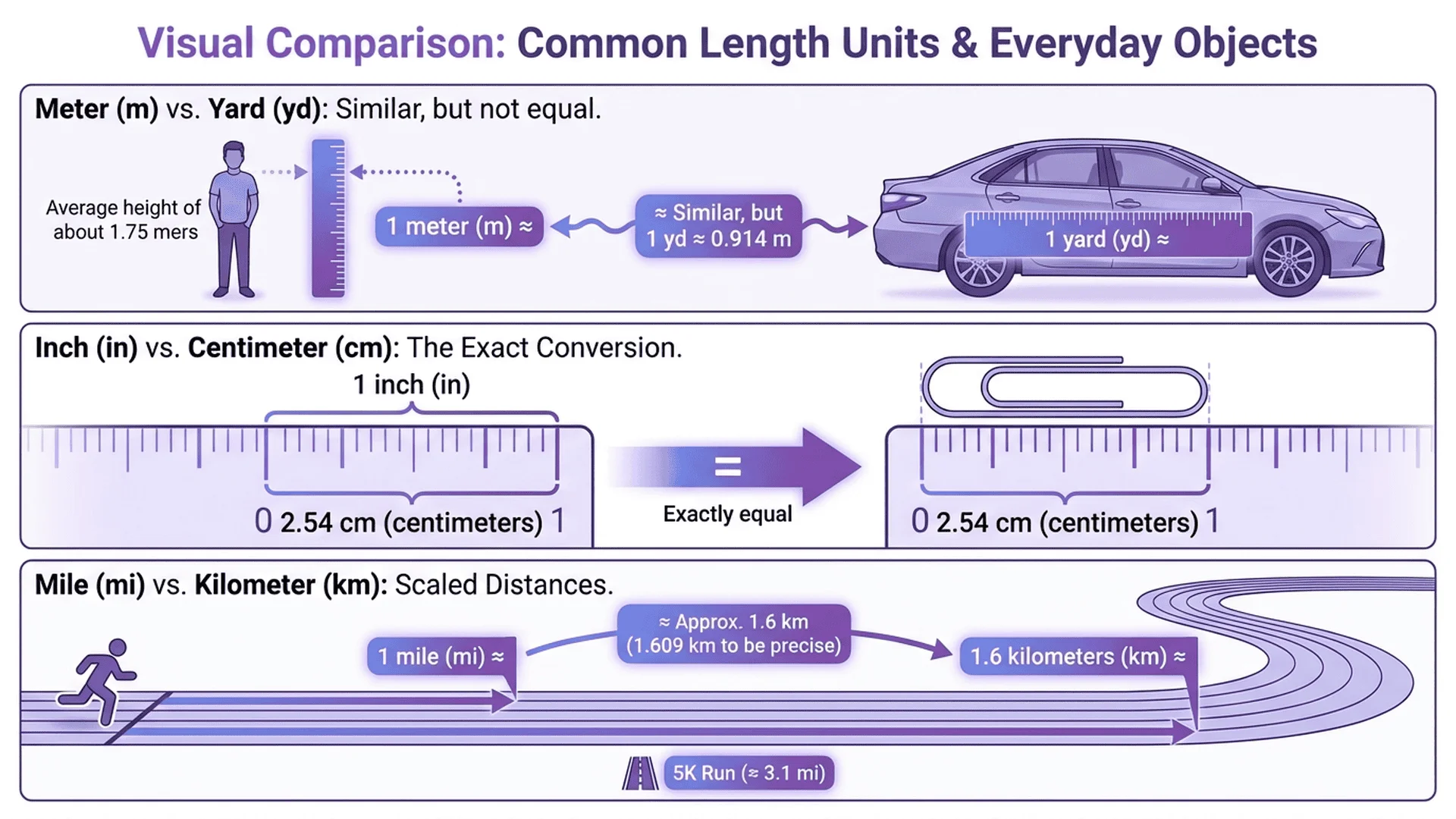
Length measurement systems divide the world. Understanding both is essential for international communication, trade, and daily life.
The Metric System (International)
Primary Units:
- Millimeter (mm): 0.001 meters, used for precision (engineering, manufacturing)
- Centimeter (cm): 0.01 meters, used for body measurements (height, waist)
- Meter (m): Base unit, defined by speed of light (1/299,792,458 second of light travel)
- Kilometer (km): 1000 meters, used for distances (roads, maps, travel)
Advantages:
- Decimal-based: 1 km = 1000 m = 100,000 cm (easy multiplication)
- Scientific standard worldwide
- Consistent prefixes (kilo, centi, milli) across all measurements
Where it's used: 195+ countries (everywhere except USA, Liberia, Myanmar)
The Imperial System (US/UK)
Primary Units:
- Inch (in): Base unit, originally based on thumb width
- Foot (ft): 12 inches, based on human foot length
- Yard (yd): 3 feet = 36 inches, roughly one pace
- Mile (mi): 5280 feet = 1760 yards, based on Roman "mille passus" (1000 paces)
Disadvantages:
- Non-decimal: 12 inches = 1 foot, 3 feet = 1 yard, 1760 yards = 1 mile (confusing!)
- Inconsistent relationships between units
- Only used in USA and partially in UK
Where it's used: USA exclusively; UK partially (road distances in miles, but many use cm/m)
Why Both Systems Persist
Historical Reasons:
- USA gained independence before metric system standardized (1790s)
- Switching costs billions (road signs, textbooks, tools, public mindset)
Practical Impact:
- Aviation: Altitude in feet worldwide (even in metric countries!)
- Maritime: Nautical miles (different from statute miles)
- Sports: Track events use meters (100m, 400m); American football uses yards
- Construction: US uses feet/inches; rest of world uses meters/cm
The Result: You MUST know both systems to function globally.
For a comprehensive comparison of all measurement systems, see our Unit Converter Complete Guide.
Meters to Feet: The Essential Conversion
Converting meters to feet is the single most common length conversion. You'll use it for room dimensions, height measurements, and construction projects.
The Exact Conversion Formula
Meters to Feet:
1 m = 3.28084 feet
Formula: feet = meters × 3.28084
Example Calculations:
- 1 m = 1 × 3.28084 = 3.28 ft
- 2 m = 2 × 3.28084 = 6.56 ft
- 10 m = 10 × 3.28084 = 32.81 ft
- 100 m = 100 × 3.28084 = 328.08 ft
Why 3.28084, Not 3.3?
The simplified "3.3" conversion factor introduces errors:
- Using 3.3: 10 m × 3.3 = 33 ft (error: +0.19 ft = 2.3 inches)
- Using 3.28084: 10 m × 3.28084 = 32.81 ft ✅
For home projects, 3.3 is "close enough." For construction or professional work, use full precision.
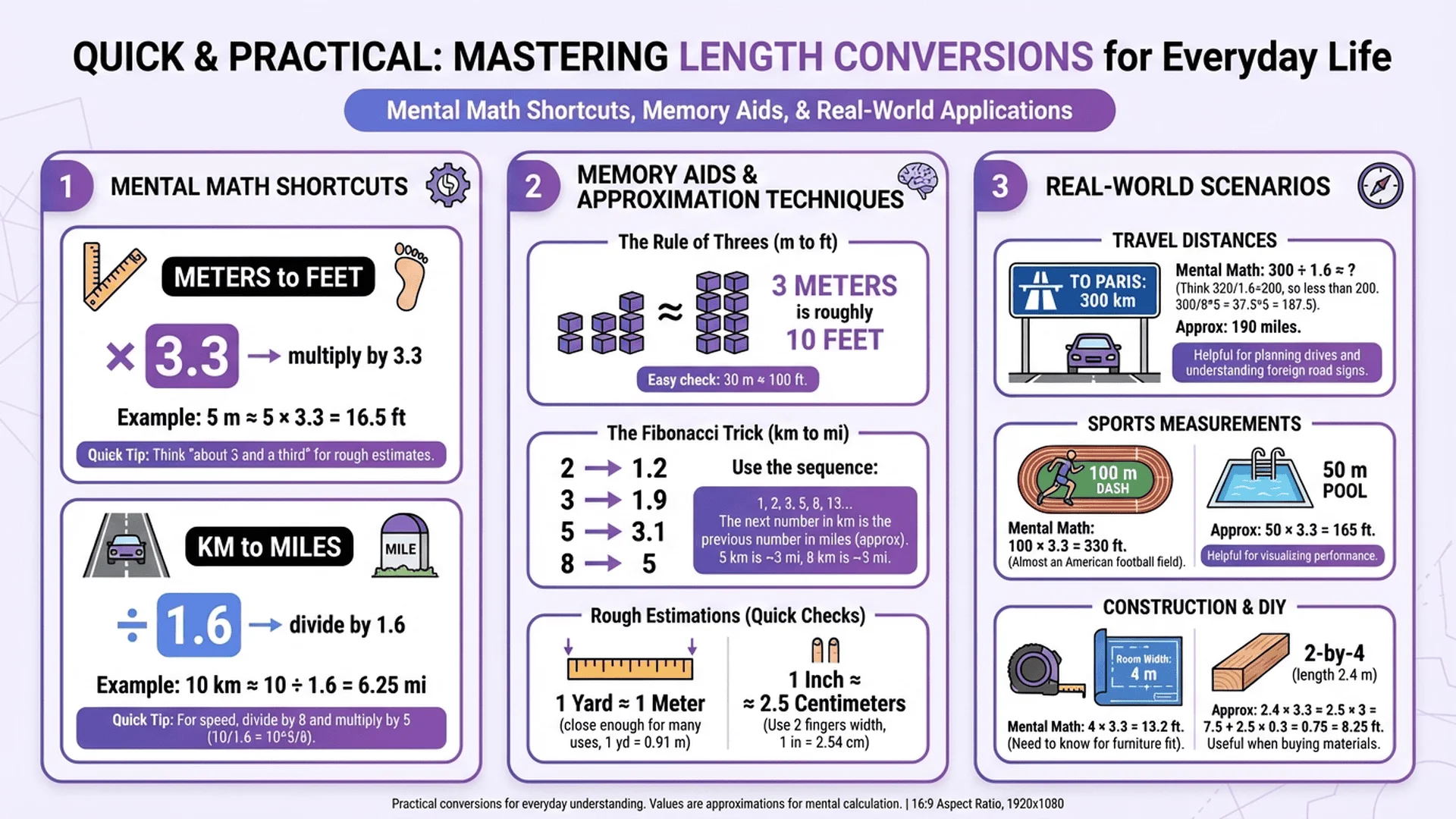
Quick Mental Math Trick
Fast approximation: Multiply meters by 3, then add 10%
- 5 m → 5 × 3 = 15 → 15 + 1.5 = 16.5 ft (actual: 16.40)
- 10 m → 10 × 3 = 30 → 30 + 3 = 33 ft (actual: 32.81)
- 20 m → 20 × 3 = 60 → 60 + 6 = 66 ft (actual: 65.62)
Accuracy: Within 1% for most practical uses.
Comprehensive Meters to Feet Table
| Meters | Feet | Feet + Inches | Common Use |
|---|---|---|---|
| 0.5 m | 1.64 ft | 1 ft 7.7 in | Door threshold |
| 1 m | 3.28 ft | 3 ft 3.4 in | Meter stick |
| 1.5 m | 4.92 ft | 4 ft 11.1 in | Average person height |
| 2 m | 6.56 ft | 6 ft 6.7 in | Doorway height |
| 2.5 m | 8.20 ft | 8 ft 2.4 in | Ceiling height |
| 3 m | 9.84 ft | 9 ft 10.1 in | Room width |
| 5 m | 16.40 ft | 16 ft 4.9 in | Room length |
| 10 m | 32.81 ft | 32 ft 9.7 in | House width |
| 25 m | 82.02 ft | 82 ft 0.3 in | Swimming pool |
| 50 m | 164.04 ft | 164 ft 0.5 in | Olympic pool |
| 100 m | 328.08 ft | 328 ft 1.0 in | Track length |
Real-World Meters to Feet Applications
Home Improvement:
European curtains are 2.5 m wide. Your window is 8 feet:
- 2.5 m × 3.28084 = 8.20 ft
- Perfect fit! (with 0.2 ft = 2.4 inches extra)
Height Conversion:
You're 1.75 m tall. What's that in feet?
- 1.75 m × 3.28084 = 5.74 ft = 5 ft 8.9 in
- Round to: 5 ft 9 in
Construction Planning:
Building a 12-meter deck. How many feet of lumber?
- 12 m × 3.28084 = 39.37 ft
- Round up to 40 ft for waste
Swimming Pool:
Olympic pool is 50 m. How long in feet?
- 50 m × 3.28084 = 164.04 ft
- That's over half a football field!
Track and Field:
100-meter dash. How far in feet?
- 100 m × 3.28084 = 328.08 ft
- Approximately 109 yards (1 yard = 3 ft)
Use our Unit Converter for instant meter-to-feet calculations with precision results.
Feet to Meters: The Reverse Conversion
Converting feet to meters is essential when traveling internationally, buying furniture online from Europe, or following metric building codes.
The Exact Reverse Formula
Feet to Meters:
1 ft = 0.3048 m (exact)
Formula: meters = feet × 0.3048
Example Calculations:
- 1 ft = 1 × 0.3048 = 0.30 m = 30 cm
- 5 ft = 5 × 0.3048 = 1.52 m
- 10 ft = 10 × 0.3048 = 3.05 m
- 100 ft = 100 × 0.3048 = 30.48 m
Mental Math Shortcut
Fast approximation: Divide feet by 3, then subtract 2%
- 10 ft → 10 ÷ 3 = 3.33 → 3.33 - 0.07 = 3.26 m (actual: 3.05)
- 20 ft → 20 ÷ 3 = 6.67 → 6.67 - 0.13 = 6.54 m (actual: 6.10)
Note: This method is less accurate than meters→feet. For precision, use calculator.
Feet to Meters Conversion Table
| Feet | Meters | Centimeters | Common Use |
|---|---|---|---|
| 1 ft | 0.30 m | 30.48 cm | Ruler length |
| 3 ft | 0.91 m | 91.44 cm | Yard (3 ft) |
| 5 ft | 1.52 m | 152.40 cm | Short person height |
| 6 ft | 1.83 m | 182.88 cm | Tall person height |
| 8 ft | 2.44 m | 243.84 cm | Ceiling height |
| 10 ft | 3.05 m | 304.80 cm | Room dimension |
| 20 ft | 6.10 m | 609.60 cm | Shipping container |
| 50 ft | 15.24 m | 1524.00 cm | House width |
| 100 ft | 30.48 m | 3048.00 cm | Lot dimension |
| 300 ft | 91.44 m | 9144.00 cm | City block |
Practical Feet to Meters Examples
International Furniture Shopping:
Buying a European sofa online. Your space is 8 feet wide:
- 8 ft × 0.3048 = 2.44 m
- Check if sofa is ≤2.44 m to fit
Building Code Compliance:
US building code: 7 ft minimum ceiling. European code uses meters:
- 7 ft × 0.3048 = 2.13 m
- Need ≥2.13 m ceiling in metric plans
Running Track:
Quarter-mile (1320 ft) in meters?
- 1320 ft × 0.3048 = 402.34 m
- That's why tracks are 400 m (slightly shorter than ¼ mile)
Swimming Pool:
Your backyard pool is 30 ft long. In meters?
- 30 ft × 0.3048 = 9.14 m
- Smaller than Olympic-size (50 m)
Height for Visa Applications:
You're 5 ft 10 in (5.833 ft) tall. European visa wants meters:
- 5.833 ft × 0.3048 = 1.78 m
- Enter as 1.78 m or 178 cm
Kilometers to Miles: Distance Conversion
Converting km to miles is crucial for travel, GPS navigation, and understanding international distances. The conversion factor is less intuitive than meters/feet.
Kilometers to Miles Formula
Exact Conversion:
1 km = 0.621371 miles
Formula: miles = kilometers × 0.621371
Example Calculations:
- 1 km = 0.62 miles
- 5 km = 5 × 0.621371 = 3.11 miles
- 10 km = 10 × 0.621371 = 6.21 miles
- 100 km = 100 × 0.621371 = 62.14 miles
Mental Math Trick for km to Miles
Fast approximation: Divide km by 1.6 (or multiply by 0.6)
- 10 km → 10 ÷ 1.6 = 6.25 miles (actual: 6.21)
- 50 km → 50 ÷ 1.6 = 31.25 miles (actual: 31.07)
- 100 km → 100 ÷ 1.6 = 62.5 miles (actual: 62.14)
Even Faster: Multiply km by 0.6, then add 10%
- 50 km → 50 × 0.6 = 30 → 30 + 3 = 33 miles (actual: 31.07, close enough!)
Kilometers to Miles Reference Table
| Kilometers | Miles | Running Event | Travel Context |
|---|---|---|---|
| 1 km | 0.62 mi | - | Walk distance |
| 5 km | 3.11 mi | 5K race | Short run |
| 10 km | 6.21 mi | 10K race | Medium run |
| 21.1 km | 13.11 mi | Half-marathon | Long run |
| 42.2 km | 26.22 mi | Marathon | Ultra distance |
| 50 km | 31.07 mi | Ultramarathon | Commute |
| 100 km | 62.14 mi | Century ride | Road trip leg |
| 160 km | 99.42 mi | ~100 miles | Highway drive |
| 500 km | 310.69 mi | Day trip | Cross-state |
| 1000 km | 621.37 mi | Long trip | Cross-country |
Real-World km to Miles Applications
GPS Navigation:
Your European GPS shows 85 km to destination. How far in miles?
- 85 km × 0.621371 = 52.82 miles
- About 1 hour drive at highway speeds
Running Races:
Training for a 5K. What's the distance in miles?
- 5 km × 0.621371 = 3.11 miles
- Marathon (42.195 km) = 26.22 miles (26.2 mi)
Fuel Efficiency:
European car gets 5L/100km. What MPG is that?
- First convert distance: 100 km = 62.14 miles
- Fuel: 5 L = 1.32 gallons
- MPG = 62.14 ÷ 1.32 = 47.08 MPG (excellent!)
Speed Limits:
European highway limit: 130 km/h. In MPH?
- 130 km/h × 0.621371 = 80.78 MPH
- Faster than most US highways (65-70 MPH)
Travel Planning:
Paris to London: 450 km. How far in miles?
- 450 km × 0.621371 = 279.62 miles
- Similar to NYC to Washington DC (225 mi)
Miles to Kilometers: The Reverse Distance Conversion
Converting miles to km is necessary when traveling from USA to other countries, or when using metric-based mapping apps.
Miles to Kilometers Formula
Exact Conversion:
1 mile = 1.60934 km
Formula: kilometers = miles × 1.60934
Example Calculations:
- 1 mile = 1.61 km
- 10 miles = 10 × 1.60934 = 16.09 km
- 50 miles = 50 × 1.60934 = 80.47 km
- 100 miles = 100 × 1.60934 = 160.93 km
Mental Math for Miles to km
Fast approximation: Multiply miles by 1.6
- 10 miles × 1.6 = 16 km (actual: 16.09)
- 50 miles × 1.6 = 80 km (actual: 80.47)
- 100 miles × 1.6 = 160 km (actual: 160.93)
Fibonacci Sequence Trick:
Adjacent Fibonacci numbers approximate miles↔km conversion!
- 3 miles ≈ 5 km (actual: 4.83 km)
- 5 miles ≈ 8 km (actual: 8.05 km)
- 8 miles ≈ 13 km (actual: 12.87 km)
- 13 miles ≈ 21 km (actual: 20.92 km)
Miles to Kilometers Table
| Miles | Kilometers | Use Case |
|---|---|---|
| 1 mi | 1.61 km | City block |
| 5 mi | 8.05 km | Local drive |
| 10 mi | 16.09 km | Commute |
| 26.2 mi | 42.16 km | Marathon |
| 50 mi | 80.47 km | Regional trip |
| 100 mi | 160.93 km | Cross-county |
| 500 mi | 804.67 km | Long drive |
| 1000 mi | 1609.34 km | Cross-country |
Practical Miles to km Examples
Road Trip Planning:
Driving 300 miles. How far in km?
- 300 miles × 1.60934 = 482.80 km
- At 120 km/h speed limit = 4 hours
Running Performance:
You ran 13.1 miles (half-marathon). In kilometers?
- 13.1 miles × 1.60934 = 21.08 km
- International race standard: 21.1 km
Speed Conversion:
US highway: 70 MPH. What's that in km/h?
- 70 MPH × 1.60934 = 112.65 km/h
- Above most European limits (110-130 km/h)
Cycling Distance:
Century ride: 100 miles. In kilometers?
- 100 miles × 1.60934 = 160.93 km
- European "metric century" is 100 km (62 miles—easier!)
For more distance conversion scenarios, see our Unit Converter Complete Guide.
Inches to Centimeters: Small-Scale Precision
Inches and centimeters are used for body measurements, screen sizes, and detailed dimensions. This conversion requires more precision than larger units.
Inches to Centimeters Formula
Exact Conversion:
1 inch = 2.54 cm (exact, by definition)
Formula: centimeters = inches × 2.54
Example Calculations:
- 1 in = 2.54 cm
- 5 in = 5 × 2.54 = 12.70 cm
- 10 in = 10 × 2.54 = 25.40 cm
- 12 in (1 ft) = 12 × 2.54 = 30.48 cm
Mental Math Shortcut
Fast approximation: Multiply inches by 2.5
- 6 inches × 2.5 = 15 cm (actual: 15.24 cm)
- 10 inches × 2.5 = 25 cm (actual: 25.40 cm)
Accuracy: Within 2% (good enough for most purposes)
Detailed Inches to cm Table
| Inches | Centimeters | Common Use |
|---|---|---|
| ¼ in | 0.64 cm | Thickness (paper, wood) |
| ½ in | 1.27 cm | Pipe diameter |
| 1 in | 2.54 cm | Thumb width |
| 2 in | 5.08 cm | Two fingers width |
| 3 in | 7.62 cm | Phone width |
| 5 in | 12.70 cm | Small screen |
| 6 in | 15.24 cm | Ruler length |
| 10 in | 25.40 cm | Tablet screen |
| 12 in | 30.48 cm | 1 foot / 30 cm ruler |
| 24 in | 60.96 cm | Monitor width |
| 32 in | 81.28 cm | TV screen |
| 55 in | 139.70 cm | Large TV |
| 65 in | 165.10 cm | Extra large TV |
Centimeters to Inches Reverse Conversion
Formula:
1 cm = 0.393701 inches
Formula: inches = centimeters ÷ 2.54 (or × 0.393701)
Example:
- 10 cm = 10 ÷ 2.54 = 3.94 inches
- 50 cm = 50 ÷ 2.54 = 19.69 inches
- 100 cm = 100 ÷ 2.54 = 39.37 inches
Real-World Inches to cm Applications
TV and Monitor Sizes:
Buying a 55-inch TV in Europe (specs show cm):
- 55 in × 2.54 = 139.70 cm diagonal
- Marketing rounds to "140 cm TV"
Clothing Measurements:
Your waist is 32 inches. European sizes use cm:
- 32 in × 2.54 = 81.28 cm
- Look for "82 cm" size pants
Screen Resolution:
Smartphone screen: 6.1 inches diagonal
- 6.1 in × 2.54 = 15.49 cm
Height Conversion:
You're 5 ft 9 in tall (69 inches). In centimeters?
- 69 in × 2.54 = 175.26 cm
- Round to 175 cm for forms
Photo Printing:
4×6 inch photo. What size in cm?
- 4 in × 2.54 = 10.16 cm
- 6 in × 2.54 = 15.24 cm
- Often listed as "10×15 cm" prints
Bicycle Frame Size:
Bike frame: 18 inches. In centimeters?
- 18 in × 2.54 = 45.72 cm
- European bikes list as "46 cm frame"
Yards and Other Uncommon Length Units
While meters, feet, and miles dominate, you'll occasionally encounter yards, nautical miles, and specialized units.
Yards: The Middle Ground
Yard Conversions:
1 yard = 3 feet = 36 inches (exact)
1 yard = 0.9144 meters (exact)
Where Yards Are Used:
- American football (100 yards field length)
- Fabric and textile (sold by yard in USA)
- Golf (distance markers)
- Swimming pools (25-yard short-course)
Example:
Football field is 100 yards. In meters?
- 100 yd × 0.9144 = 91.44 meters
- Note: Soccer field is 100-110 meters (longer!)
Nautical Miles: Maritime and Aviation
Nautical Mile:
1 nautical mile (nmi) = 1.15078 statute miles
1 nautical mile = 1.852 kilometers (exact)
Why Different?
Nautical mile is based on Earth's geometry:
- 1 nmi = 1 minute of latitude arc
- Makes navigation calculations easier on globe
Where Used:
- All maritime navigation worldwide
- Aviation (altitude in feet, distance in nautical miles)
- Military operations
Example:
Ship travels 100 nautical miles. In regular miles?
- 100 nmi × 1.15078 = 115.08 statute miles
- In km: 100 nmi × 1.852 = 185.2 km
Speed Conversion:
Knots (nautical miles per hour) to MPH:
- 1 knot = 1.15078 MPH
- 30 knots = 30 × 1.15078 = 34.52 MPH
Other Specialized Length Units
Light-Year (Astronomy):
- 1 light-year = 9.461 trillion km = 5.879 trillion miles
- Distance light travels in one year
- Used for interstellar distances
Angstrom (Physics):
- 1 Å = 10⁻¹⁰ meters = 0.1 nanometers
- Used for atomic-scale measurements
- Wavelength of light, crystal structures
Fathom (Maritime):
- 1 fathom = 6 feet = 1.8288 meters
- Used for water depth measurement
- Origin: Distance between outstretched arms
Furlong (Racing):
- 1 furlong = 220 yards = 660 feet = 201.168 meters
- Horse racing track distances
- 8 furlongs = 1 mile
Chain (Surveying):
- 1 chain = 66 feet = 20.1168 meters
- Land surveying in USA
- 80 chains = 1 mile
For comprehensive coverage of all unit types, see our Unit Converter Complete Guide.
Length Conversion for Construction and DIY
Construction requires precision—small measurement errors multiply across large projects. Here's how to handle length conversions in building contexts.
Converting Building Plans
Scenario: European Plans, US Materials
You have European building plans (all measurements in meters). Your US lumber comes in feet/inches.
Key Conversions:
- Wall height: 2.4 m = 2.4 × 3.28084 = 7.87 ft ≈ 7 ft 10 in
- Room length: 4.5 m = 4.5 × 3.28084 = 14.76 ft ≈ 14 ft 9 in
- Window width: 1.2 m = 1.2 × 3.28084 = 3.94 ft ≈ 3 ft 11 in
Material Ordering:
Standard US lumber lengths: 8 ft, 10 ft, 12 ft, 14 ft, 16 ft
- If plan calls for 3.5 m pieces:
- 3.5 m × 3.28084 = 11.48 ft
- Order 12 ft boards, cut to length
Flooring Installation
Problem:
European flooring sold per square meter. Your room is 12 ft × 15 ft.
Solution:
1. Convert dimensions to meters:
- 12 ft × 0.3048 = 3.66 m
- 15 ft × 0.3048 = 4.57 m
2. Calculate area:
- 3.66 m × 4.57 m = 16.73 m²
3. Add 10% waste:
- 16.73 × 1.1 = 18.40 m²
4. Order at least 19 m² of flooring
Plumbing and Electrical
Pipe Sizing:
US pipes use inches; international standards use millimeters.
- ½ inch pipe = 12.7 mm (call it 12 mm)
- ¾ inch pipe = 19.05 mm (call it 19 mm)
- 1 inch pipe = 25.4 mm (call it 25 mm)
Conduit Lengths:
Electrical conduit in USA: 10 ft lengths
- European projects specify 3 m lengths
- 3 m = 9.84 ft (just under 10 ft—works!)
Framing and Spacing
Stud Spacing:
- US standard: 16 inches on center (OC)
- Metric equivalent: 16 in × 2.54 = 40.64 cm ≈ 40 cm OC
Ceiling Height:
- US standard: 8 ft = 8 × 0.3048 = 2.44 m
- European standard: 2.5 m = 2.5 × 3.28084 = 8.20 ft
Measuring Tools Conversion
Tape Measures:
- Dual-scale tape measures show both inches and centimeters
- Digital laser measures can toggle between ft/in and meters
- Always verify which unit you're reading!
Common Mistake:
Reading "2.5" on tape measure:
- If scale is feet: 2.5 ft = 2 ft 6 in = 30 inches
- If scale is meters: 2.5 m = 250 cm = 98.4 inches
- Huge difference! Always check unit labels.
For specialized construction calculations, including area and volume conversions, see our Area Conversion Guide.
Length Conversion Tools and Calculators
The right conversion tool saves time and prevents errors. Here's how to choose and use length converters effectively.
Types of Length Converters
Online Web Converters:
- ✅ Advantages: No installation, always updated, cross-platform
- ✅ Bidirectional conversion (m↔ft automatically)
- ❌ Disadvantages: Requires internet (usually)
- Best for: Quick conversions, research, planning
- Example: Tool Master Unit Converter
Mobile Apps:
- ✅ Advantages: Offline mode, camera AR measurement, voice input
- ✅ Some apps overlay conversions on photos
- ❌ Disadvantages: Phone storage, potential ads/in-app purchases
- Best for: Shopping, construction sites, travel
Physical Dual-Scale Tools:
- ✅ Advantages: No battery, instant reading, very reliable
- ✅ Tape measures, rulers with both cm and inches
- ❌ Disadvantages: Limited to specific increments
- Best for: Construction, woodworking, sewing
Smartwatch/Wearable Apps:
- ✅ Advantages: Always accessible, hands-free voice conversion
- ❌ Disadvantages: Small screen, limited functionality
- Best for: Quick conversions while working
Features to Look For
Essential Features:
1. High Precision: Conversion factors to 6+ decimal places
2. Bidirectional: Auto-updates both fields
3. Multiple Units: Supports mm, cm, m, km, in, ft, yd, mi
4. Real-time Calculation: Updates as you type
5. Copy Function: One-click copy results
Advanced Features:
- Fraction support (e.g., "5 ft 7½ in")
- Compound units (e.g., "3 m 45 cm")
- Batch conversion (convert list of values)
- History log (track previous conversions)
- Custom unit definitions
Using Our Length Converter
Tool Master's Unit Converter provides:
- ✅ All common length units (mm, cm, m, km, in, ft, yd, mi)
- ✅ 100% browser-based (no data transmission)
- ✅ Instant bidirectional conversion
- ✅ Works offline after first load
- ✅ Completely free, no registration
- ✅ Mobile-responsive design
How to Use:
1. Select source unit (e.g., "Meters")
2. Enter value (e.g., "10")
3. Select target unit (e.g., "Feet")
4. Result appears instantly: 32.81 ft
5. Click "Copy" to use anywhere
For Excel-based batch conversions, see our Excel Unit Converter Formulas Guide.
For mobile app reviews, check our Best Unit Converter Apps 2025 comparison.
Common Length Conversion Mistakes to Avoid
Even experienced professionals make length conversion errors. Understanding common pitfalls prevents costly mistakes.
Mistake #1: Using 3.3 Instead of 3.28084
Wrong:
10 m × 3.3 = 33 ft ❌
Right:
10 m × 3.28084 = 32.81 ft ✅
Error: 0.19 ft = 2.3 inches
When It Matters:
- Construction framing (small errors compound)
- Athletic track design (official dimensions)
- Manufacturing tolerances
Prevention: Use digital converters with full precision, not mental approximations.
Mistake #2: Confusing Feet-Inches Notation
Wrong Interpretation:
5.5 ft = 5 ft 5 in ❌
Right Interpretation:
5.5 ft = 5 ft 6 in ✅ (0.5 ft = 6 inches)
Explanation:
- Decimal feet: 5.5 ft means 5 + (0.5 × 12) inches = 5 ft 6 in
- Architects use decimal feet (5.5 ft)
- Carpenters use fractional notation (5' 6")
Conversion:
To convert decimal feet to feet-inches:
- 5.75 ft → 0.75 × 12 = 9 inches → 5 ft 9 in
Prevention: Always clarify if measurements are decimal feet or feet-inches format.
Mistake #3: Mixing Nautical and Statute Miles
Wrong:
100 miles to km: 100 × 1.609 = 160.9 km ❌ (if nautical miles meant)
Right:
100 nautical miles to km: 100 × 1.852 = 185.2 km ✅
Error: 24.3 km (15% difference!)
When It Matters:
- Aviation navigation
- Maritime shipping
- Military coordinates
Prevention: Always specify "nautical miles" or "statute miles" explicitly.
Mistake #4: Forgetting Unit Conversions in Formulas
Wrong:
Speed = distance ÷ time
- Distance: 100 km
- Time: 1 hour 30 min
- Speed: 100 ÷ 1.5 = 66.67 km/h ✅ (This is correct)
But if you want MPH:
- 66.67 km/h = 66.67 × 0.621371 = 41.42 MPH ✅
Common Error:
Forgetting to convert BOTH distance AND speed units leads to wrong answers.
Prevention: Convert all units to same system before calculations, then convert result if needed.
Mistake #5: Rounding Too Early
Wrong:
25.4 cm → 10 in (rounded) → 10 in × 2.54 = 25.4 cm (looks OK)
BUT: 25.42 cm → 10 in (rounded) → 10 in × 2.54 = 25.4 cm ❌ (lost 0.02 cm)
Right:
Keep full precision until final answer:
- 25.42 cm ÷ 2.54 = 10.00787 in ✅
- Round final answer: 10.01 inches
Prevention: Digital calculators maintain precision automatically—don't manually round intermediate steps.
Mistake #6: Using Wrong Conversion Factor
Common Confusion:
- 1 yard = 3 feet ✅
- 1 meter = 3 feet ❌ (Wrong! 1 m = 3.28 ft)
Another Example:
- 1 mile = 5280 feet ✅
- 1 km = 1000 feet ❌ (Wrong! 1 km = 3280.84 ft)
Prevention: Memorize key conversion factors, or use trusted conversion tools. Don't guess!
Conclusion: Mastering Length Conversion for Daily Life
Length conversion is an essential skill in our globalized world. Whether you're traveling internationally, shopping online, building a deck, or tracking athletic performance, accurate conversions save time, money, and prevent errors.
Key Takeaways
Essential Conversions to Remember:
1. 1 meter = 3.28084 feet (not 3.3!)
2. 1 foot = 0.3048 meters (exactly)
3. 1 km = 0.621371 miles (divide km by 1.6 for quick estimate)
4. 1 mile = 1.60934 km (multiply miles by 1.6)
5. 1 inch = 2.54 cm (exactly, by definition)
Quick Mental Math:
- m to ft: Multiply by 3, add 10% (10 m → 30 + 3 = 33 ft)
- ft to m: Divide by 3, subtract 2% (10 ft → 3.33 - 0.07 ≈ 3.3 m)
- km to mi: Divide by 1.6 (50 km → 31.25 mi)
- mi to km: Multiply by 1.6 (50 mi → 80 km)
- in to cm: Multiply by 2.5 (10 in → 25 cm)
Common Mistakes to Avoid:
- Using rounded conversion factors for precision work
- Confusing decimal feet (5.5 ft) with feet-inches (5' 6")
- Mixing nautical miles and statute miles
- Rounding intermediate steps in multi-step conversions
- Forgetting unit conversions in speed/area/volume formulas
When to Use Which Tool
Mental Math:
- Quick estimates (grocery shopping, casual conversation)
- When precision isn't critical (±2-3% error acceptable)
- Example: "That's about 10 feet" (from 3 meters)
Digital Converter:
- Construction and building projects
- International travel planning
- Athletic performance tracking
- Scientific or engineering work
- Example: Tool Master Unit Converter
Dual-Scale Measuring Tools:
- Active construction/woodworking
- Sewing and fabric cutting
- When no electricity/internet available
- Example: Stanley dual-scale tape measure
Excel Formulas:
- Batch conversions (100+ values)
- Data analysis and reporting
- Business inventory management
- Example: See our Excel Unit Converter Formulas
Best Practices for Accuracy
Before Converting:
1. Identify source and target units clearly
2. Check for regional variations (US vs UK measurements)
3. Determine required precision level
During Conversion:
1. Use full-precision conversion factors
2. Don't round intermediate steps
3. Double-check decimal vs fractional notation (ft vs ft-in)
After Converting:
1. Verify reasonableness (does 10 m = 33 ft make sense?)
2. Round to appropriate precision (match input precision)
3. Document conversions for critical applications
Explore More Conversion Resources
Related Guides:
- Unit Converter Complete Guide - All conversion types in one place
- Weight Conversion Guide - kg, lbs, grams, ounces
- Temperature Conversion Guide - Celsius, Fahrenheit, Kelvin
Specialized Converters:
- Area Conversion Guide - m², ft², acres for real estate
- Volume Conversion Guide - Liters, gallons for cooking
Professional Tools:
- Excel Unit Converter Formulas - Batch processing templates
- Best Unit Converter Apps 2025 - Tool reviews and comparisons
Try Our Free Tool:
Tool Master Unit Converter - Convert length, weight, temperature, and 30+ other units instantly. 100% free, no registration, works offline.
Browse All Tools:
Visit our Conversion Tools Category for the complete collection of calculators and converters.
For technical implementation details, see our Unit Converter Technical Documentation.
References
- National Institute of Standards and Technology (NIST). (2024). "NIST Guide to SI Units: Length and Distance." NIST Special Publication 330.
- International Bureau of Weights and Measures (BIPM). (2024). "The International System of Units (SI)," 9th edition. Section 2.1: Units of Length.
- United States Geological Survey (USGS). (2024). "Standards for Digital Elevation Models: Conversion Factors."
- Federal Aviation Administration (FAA). (2024). "Aeronautical Information Manual: Nautical Miles and Statute Miles."
- American Society of Civil Engineers (ASCE). (2024). "Construction Measurement Standards: Metric and Imperial Conversions."
- International Association of Athletics Federations (IAAF). (2024). "Track and Field Facilities Manual: Standard Distances."