單位換算器完整指南
Unit Converter Complete Guide | Weight, Length, Temperature【2025】
Introduction: Why You Need a Reliable Unit Converter
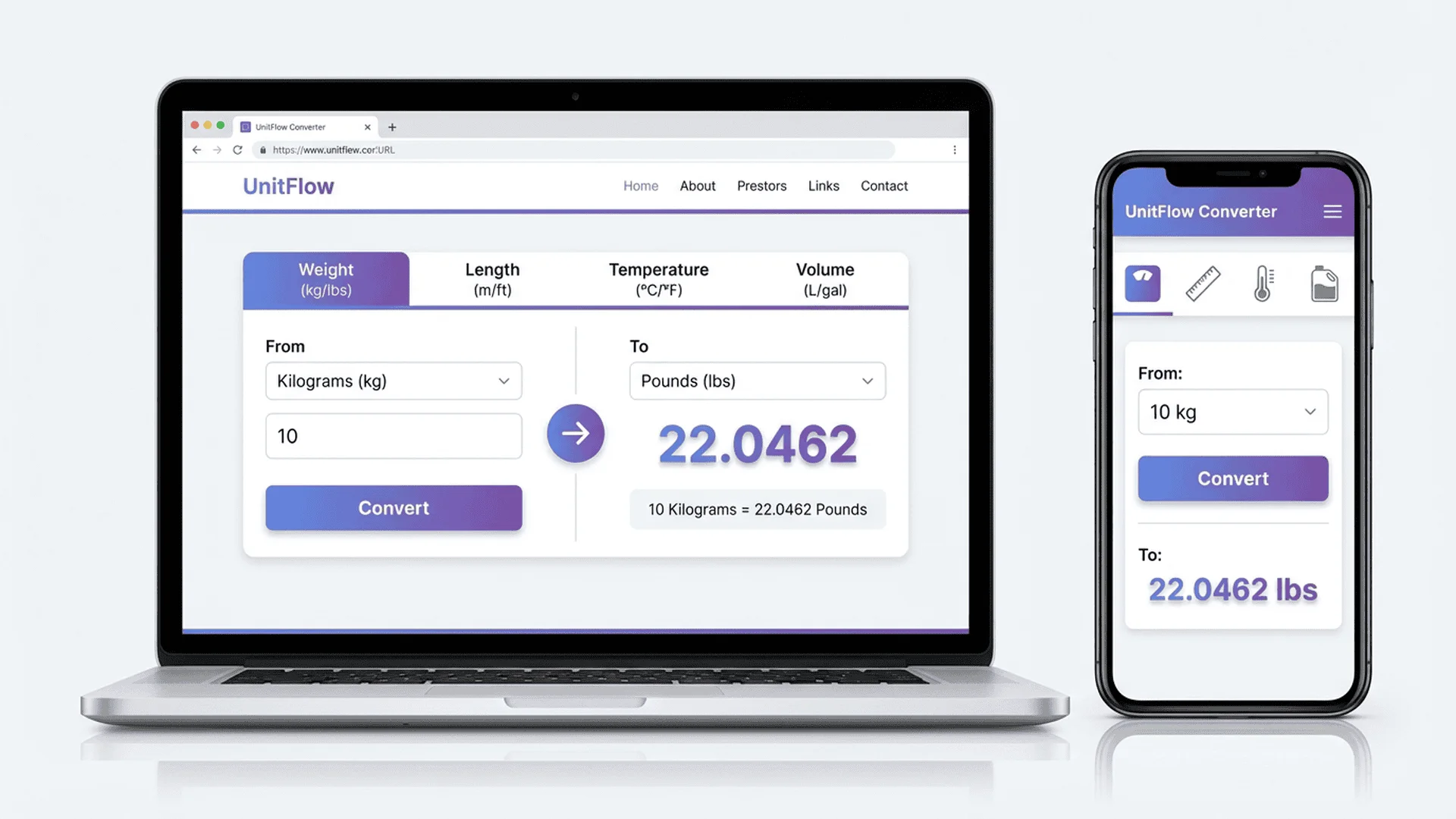
Need to convert kilograms to pounds? Celsius to Fahrenheit? You're in the right place. Our free online unit converter handles 32+ conversion types instantly—no signup, no downloads, 100% privacy-safe.
Whether you're cooking international recipes, planning construction projects, or solving physics homework, accurate unit conversion is essential. A single conversion error can ruin a recipe, cause construction mistakes, or lead to failed calculations.
This complete guide shows you how to convert units like a pro, with formulas, tables, and real-world examples across all major measurement systems.
What Is a Unit Converter? Understanding the Basics
A unit converter is a tool that translates measurements from one unit system to another. It handles conversions between metric (kilograms, meters, Celsius) and imperial systems (pounds, feet, Fahrenheit), plus many specialized units.
Why Manual Conversion Is Risky
Converting units by hand introduces errors. Common mistakes include:
- Formula confusion: Mixing up multiplication and division
- Rounding errors: Losing precision in multi-step calculations
- Conversion factor mistakes: Using 2.2 instead of 2.20462 for kg to lbs
How Digital Converters Solve This
Modern unit converters eliminate human error by:
- Storing precise conversion factors (up to 15 decimal places)
- Performing instant calculations with zero rounding mistakes
- Supporting bidirectional conversion (kg→lbs and lbs→kg automatically)
Our Unit Converter tool processes all calculations locally in your browser, ensuring your data never leaves your device.
Weight Conversion: From Kilograms to Pounds and Beyond
Weight conversion is the most common use case. Whether you're tracking fitness goals, shipping packages, or following recipes, you'll frequently need to convert between kilograms (kg), pounds (lbs), grams (g), and ounces (oz).
Essential Weight Conversion Formulas
Kilograms to Pounds:
- 1 kg = 2.20462 lbs
- Formula: pounds = kilograms × 2.20462
- Example: 75 kg = 75 × 2.20462 = 165.35 lbs
Pounds to Kilograms:
- 1 lb = 0.453592 kg
- Formula: kilograms = pounds × 0.453592
- Example: 150 lbs = 150 × 0.453592 = 68.04 kg
Grams to Ounces:
- 1 g = 0.035274 oz
- Formula: ounces = grams × 0.035274
- Example: 500 g = 500 × 0.035274 = 17.64 oz
Quick Weight Conversion Table
| Kilograms | Pounds | Grams | Ounces |
|---|---|---|---|
| 1 kg | 2.20 lbs | 1000 g | 35.27 oz |
| 5 kg | 11.02 lbs | 5000 g | 176.37 oz |
| 10 kg | 22.05 lbs | 10000 g | 352.74 oz |
| 25 kg | 55.12 lbs | 25000 g | 881.85 oz |
| 50 kg | 110.23 lbs | 50000 g | 1763.70 oz |
| 75 kg | 165.35 lbs | 75000 g | 2645.55 oz |
| 100 kg | 220.46 lbs | 100000 g | 3527.40 oz |
Real-World Weight Conversion Examples
Fitness Tracking:
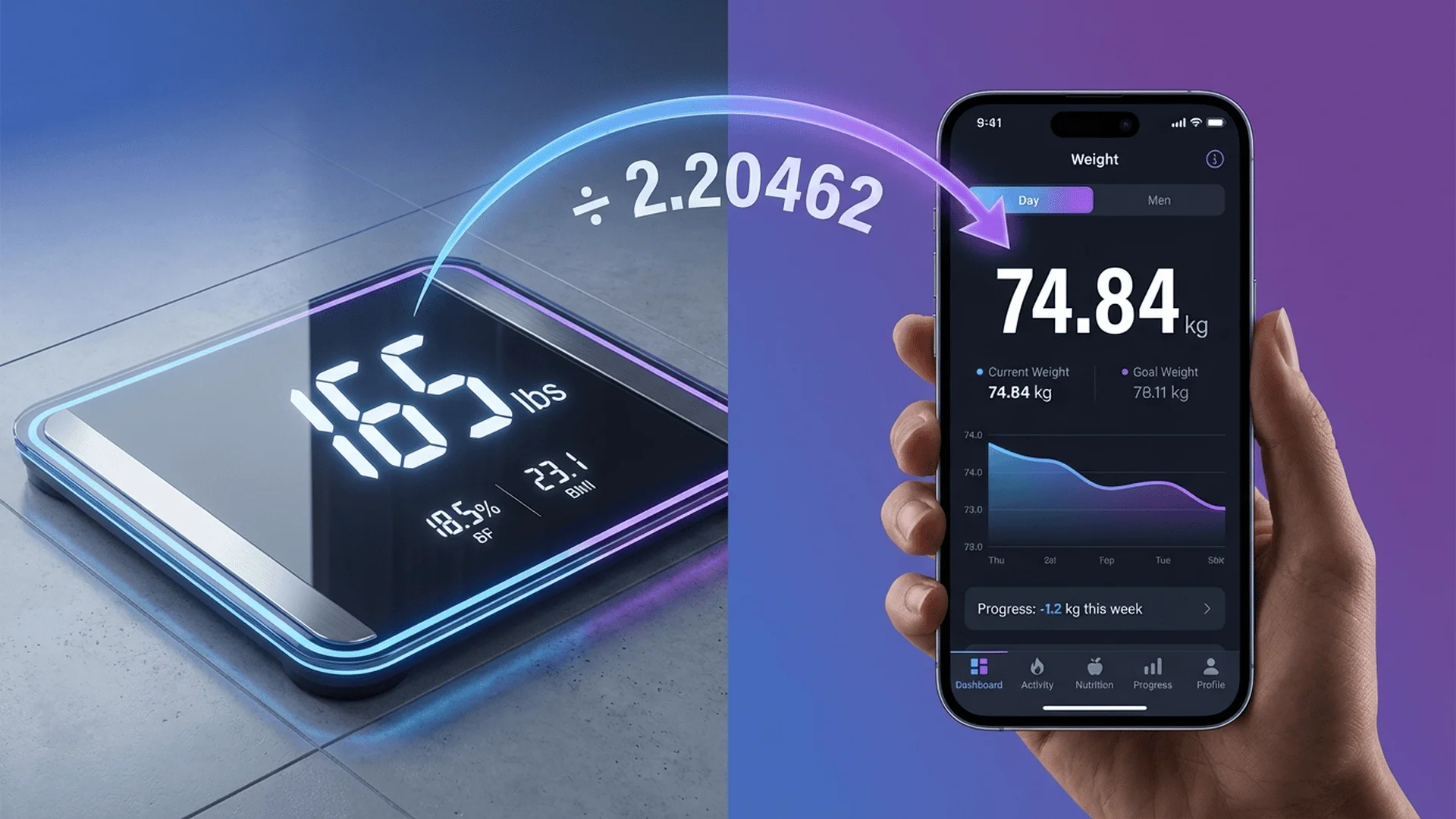
If your gym scale shows 165 lbs but your fitness app uses kg, you need to convert: 165 lbs ÷ 2.20462 = 74.84 kg.
International Shipping:
Shipping a 15 lb package to Europe? Convert to kg for customs: 15 lbs × 0.453592 = 6.80 kg.
Cooking International Recipes:
A French recipe calls for 250g flour. You need ounces: 250g × 0.035274 = 8.82 oz (roughly ½ cup).
For detailed weight conversion strategies with industry-specific examples, see our Weight Conversion Guide.
Length and Distance: Mastering Meters, Feet, and Miles
Length conversion is critical for construction, travel, and scientific calculations. The metric system (meters, centimeters, kilometers) and imperial system (feet, inches, miles) use completely different base units.
Core Length Conversion Formulas
Meters to Feet:
- 1 m = 3.28084 ft
- Formula: feet = meters × 3.28084
- Example: 10 m = 10 × 3.28084 = 32.81 ft
Feet to Meters:
- 1 ft = 0.3048 m
- Formula: meters = feet × 0.3048
- Example: 100 ft = 100 × 0.3048 = 30.48 m
Kilometers to Miles:
- 1 km = 0.621371 mi
- Formula: miles = kilometers × 0.621371
- Example: 50 km = 50 × 0.621371 = 31.07 mi
Miles to Kilometers:
- 1 mi = 1.60934 km
- Formula: kilometers = miles × 1.60934
- Example: 26.2 mi (marathon) = 26.2 × 1.60934 = 42.16 km
Length Conversion Reference Table
| Meters | Feet | Inches | Centimeters |
|---|---|---|---|
| 1 m | 3.28 ft | 39.37 in | 100 cm |
| 2 m | 6.56 ft | 78.74 in | 200 cm |
| 5 m | 16.40 ft | 196.85 in | 500 cm |
| 10 m | 32.81 ft | 393.70 in | 1000 cm |
| 50 m | 164.04 ft | 1968.50 in | 5000 cm |
| 100 m | 328.08 ft | 3937.01 in | 10000 cm |
Practical Length Conversion Scenarios
Home Improvement:
You're installing European curtains (2.5m wide) in a US home. Convert to feet: 2.5m × 3.28084 = 8.20 ft. Your window is 8 ft wide—perfect fit!
International Travel:
Your GPS shows 15 km to the hotel. How far in miles? 15 km × 0.621371 = 9.32 miles.
Sports Performance:
You ran a 5K race (5 kilometers). What's that in miles? 5 km × 0.621371 = 3.11 miles.
Construction Planning:
Building plans show a 30-foot wall. How many meters of material do you need? 30 ft × 0.3048 = 9.14 m.
Explore comprehensive length conversion techniques with construction examples in our Length Conversion Guide.
Temperature Conversion: Celsius, Fahrenheit, and Kelvin
Temperature conversion confuses many people because it's not a simple multiplication—it requires formula adjustments. Whether you're following recipes, checking weather forecasts, or conducting scientific experiments, accurate temperature conversion is essential.
Temperature Conversion Formulas Explained
Celsius to Fahrenheit:
- Formula: °F = (°C × 9/5) + 32
- Example: 25°C = (25 × 1.8) + 32 = 77°F
- Why it works: Celsius and Fahrenheit have different zero points and scale ratios
Fahrenheit to Celsius:
- Formula: °C = (°F - 32) × 5/9
- Example: 98.6°F = (98.6 - 32) × 0.5556 = 37°C (normal body temperature)
Celsius to Kelvin:
- Formula: K = °C + 273.15
- Example: 25°C = 25 + 273.15 = 298.15 K
- Note: Kelvin has no negative numbers (absolute zero is 0 K)
Fahrenheit to Kelvin:
- Formula: K = (°F - 32) × 5/9 + 273.15
- Example: 32°F (freezing point) = (32 - 32) × 5/9 + 273.15 = 273.15 K
Temperature Conversion Reference Points
| Celsius (°C) | Fahrenheit (°F) | Kelvin (K) | Description |
|---|---|---|---|
| -273.15°C | -459.67°F | 0 K | Absolute zero |
| -40°C | -40°F | 233.15 K | Unique point (C = F) |
| 0°C | 32°F | 273.15 K | Water freezes |
| 20°C | 68°F | 293.15 K | Room temperature |
| 37°C | 98.6°F | 310.15 K | Human body temp |
| 100°C | 212°F | 373.15 K | Water boils |
| 180°C | 356°F | 453.15 K | Baking temperature |
Why Temperature Conversion Matters
International Cooking:
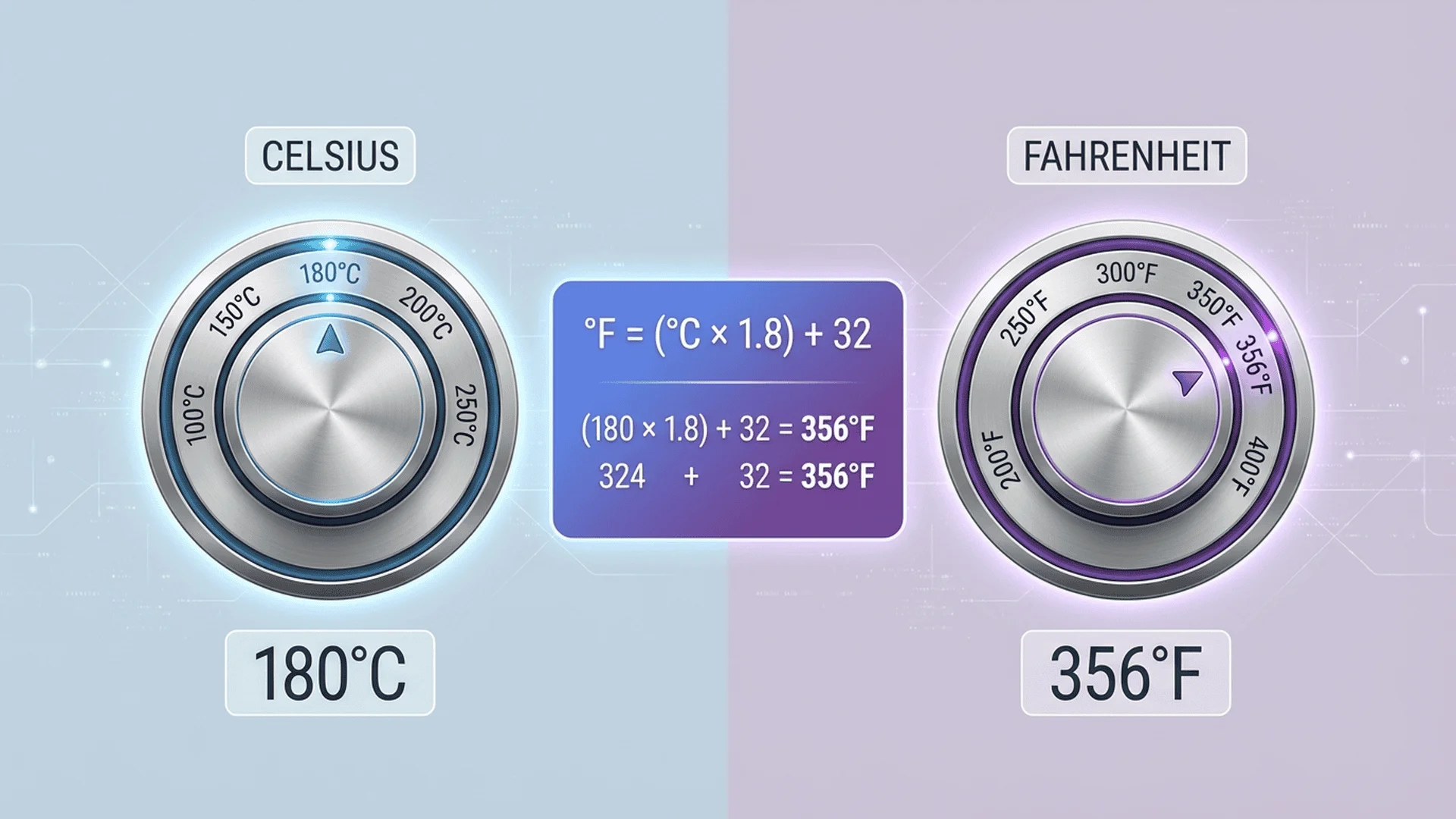
A European recipe calls for baking at 180°C. Your oven shows Fahrenheit. Convert: (180 × 1.8) + 32 = 356°F. Without this conversion, you'd overbake or underbake.
Weather Forecasting:
You're traveling to Europe where weather reports show 25°C. Is that warm or cool? Convert: (25 × 1.8) + 32 = 77°F—perfect weather!
Scientific Research:
Chemistry experiments often use Kelvin. If your lab thermometer shows 25°C, that's 298.15 K for your calculations.
Medical Applications:
A European hospital reports a patient's temperature as 39°C. Is this a fever? Convert: (39 × 1.8) + 32 = 102.2°F—yes, that's a significant fever.
For medical professionals and scientists, our Temperature Conversion Guide provides specialized conversion tables and clinical reference points.
Area Conversion: Square Meters, Acres, and Square Feet
Area conversion is crucial for real estate, land surveying, and home improvement projects. Unlike linear measurements, area calculations involve squared units, which multiplies the conversion complexity.
Understanding Area Conversion Basics
When converting area, remember that conversion factors are squared. For example:
- 1 meter = 3.28084 feet (linear)
- 1 square meter = 10.764 square feet (area = 3.28084²)
Essential Area Conversion Formulas
Square Meters to Square Feet:
- 1 m² = 10.764 ft²
- Formula: square_feet = square_meters × 10.764
- Example: 50 m² apartment = 50 × 10.764 = 538.2 ft²
Square Feet to Square Meters:
- 1 ft² = 0.092903 m²
- Formula: square_meters = square_feet × 0.092903
- Example: 1000 ft² = 1000 × 0.092903 = 92.90 m²
Acres to Square Meters:
- 1 acre = 4046.86 m²
- Formula: square_meters = acres × 4046.86
- Example: 2.5 acres = 2.5 × 4046.86 = 10,117.15 m²
Hectares to Acres:
- 1 hectare = 2.47105 acres
- Formula: acres = hectares × 2.47105
- Example: 10 hectares = 10 × 2.47105 = 24.71 acres
Area Conversion Comparison Table
| Square Meters | Square Feet | Acres | Hectares |
|---|---|---|---|
| 1 m² | 10.76 ft² | 0.000247 ac | 0.0001 ha |
| 10 m² | 107.64 ft² | 0.00247 ac | 0.001 ha |
| 100 m² | 1076.39 ft² | 0.0247 ac | 0.01 ha |
| 1000 m² | 10763.91 ft² | 0.247 ac | 0.1 ha |
| 4046.86 m² | 43560 ft² | 1 ac | 0.405 ha |
| 10000 m² | 107639.10 ft² | 2.47 ac | 1 ha |
Real-World Area Conversion Examples
Real Estate Listings:
You see a European apartment listed as 85 m². How big is that? 85 m² × 10.764 = 914.94 ft²—approximately a 1-bedroom apartment.
Land Purchase:
Buying 5 acres of land. What's that in hectares for international paperwork? 5 acres ÷ 2.47105 = 2.02 hectares.
Flooring Projects:
Your room is 12 ft × 15 ft = 180 ft². How many square meters of flooring do you need? 180 ft² × 0.092903 = 16.72 m².
Agricultural Planning:
Your farm is 50 hectares. How many acres is that? 50 hectares × 2.47105 = 123.55 acres.
Dive deeper into area calculations for construction and real estate with our Area Conversion Complete Guide.
Volume Conversion: Liters, Gallons, and Cubic Units
Volume conversion is essential for cooking, fuel efficiency calculations, and scientific measurements. The relationship between liters (metric) and gallons (imperial) causes frequent confusion.
Key Volume Conversion Formulas
Liters to Gallons (US):
- 1 L = 0.264172 gal (US)
- Formula: gallons = liters × 0.264172
- Example: 20 L = 20 × 0.264172 = 5.28 gal
Gallons (US) to Liters:
- 1 gal (US) = 3.78541 L
- Formula: liters = gallons × 3.78541
- Example: 10 gal = 10 × 3.78541 = 37.85 L
Milliliters to Fluid Ounces:
- 1 mL = 0.033814 fl oz
- Formula: fluid_ounces = milliliters × 0.033814
- Example: 500 mL = 500 × 0.033814 = 16.91 fl oz
Cubic Meters to Cubic Feet:
- 1 m³ = 35.3147 ft³
- Formula: cubic_feet = cubic_meters × 35.3147
- Example: 5 m³ = 5 × 35.3147 = 176.57 ft³
Volume Conversion Quick Reference
| Liters | Gallons (US) | Milliliters | Fluid Ounces |
|---|---|---|---|
| 1 L | 0.26 gal | 1000 mL | 33.81 fl oz |
| 3.785 L | 1 gal | 3785 mL | 128 fl oz |
| 5 L | 1.32 gal | 5000 mL | 169.07 fl oz |
| 10 L | 2.64 gal | 10000 mL | 338.14 fl oz |
| 20 L | 5.28 gal | 20000 mL | 676.28 fl oz |
| 50 L | 13.21 gal | 50000 mL | 1690.70 fl oz |
Practical Volume Conversion Use Cases
Fuel Efficiency:
Your European car gets 6 L/100km. What's that in MPG? This requires two conversions:
- 6 L = 6 × 0.264172 = 1.585 gal
- 100 km = 100 × 0.621371 = 62.14 miles
- MPG = 62.14 miles ÷ 1.585 gal = 39.21 MPG
Cooking Recipes:
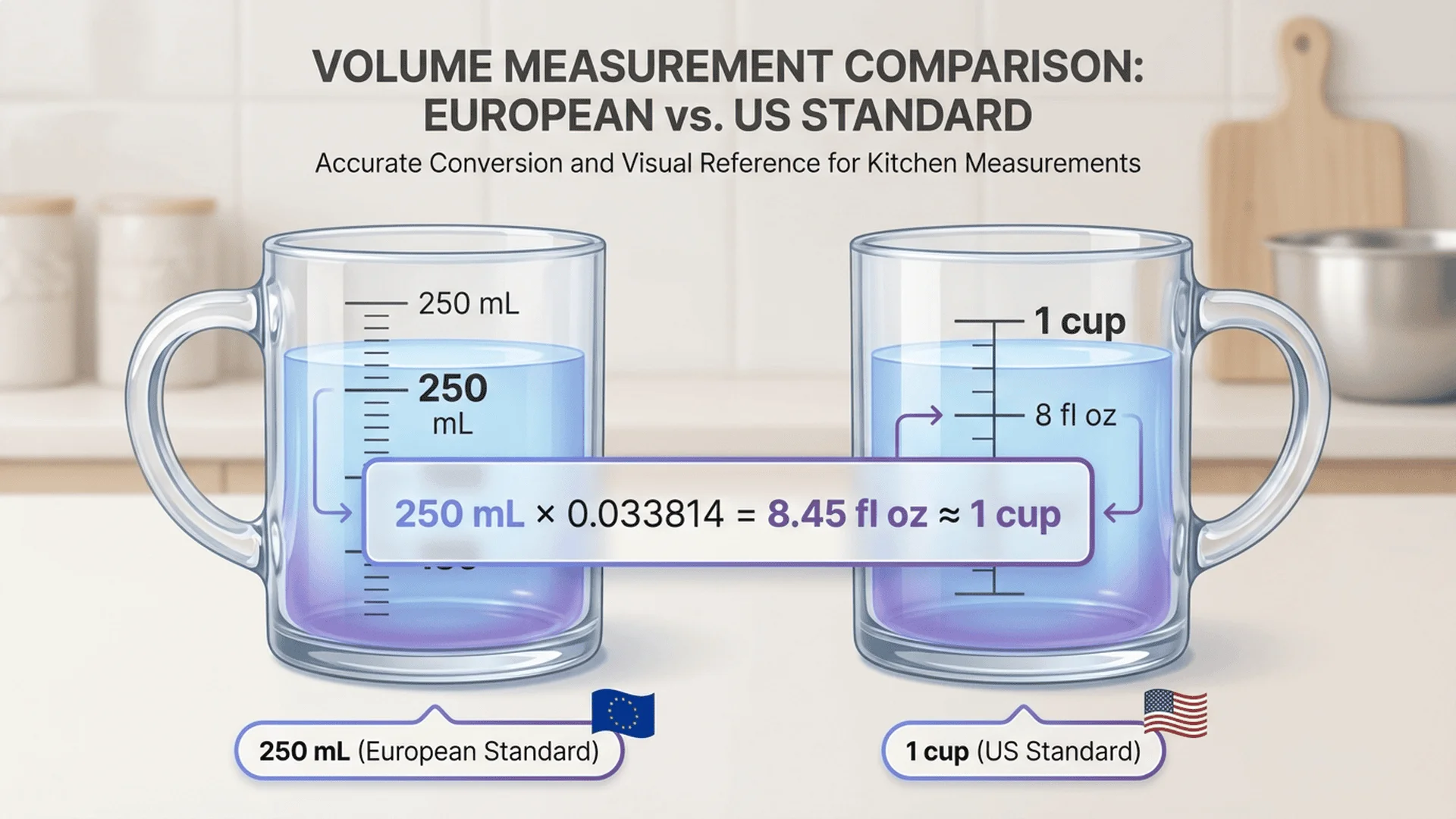
A British recipe calls for 250 mL of milk. You need cups: 250 mL × 0.033814 = 8.45 fl oz ≈ 1 cup (8 fl oz).
Aquarium Setup:
You're buying a 50-gallon aquarium. How many liters is that? 50 gal × 3.78541 = 189.27 L.
Medication Dosing:
A prescription says 15 mL. How many tablespoons? 15 mL × 0.033814 = 0.507 fl oz = 1 tablespoon (0.5 fl oz).
For kitchen-specific volume conversions with cooking measurements, check our Cooking Unit Converter Guide and detailed Volume Conversion Guide.
Pressure Conversion: PSI, Bar, and Pascal Explained
Pressure conversion is critical for automotive maintenance, HVAC systems, and scientific applications. Understanding pressure units prevents equipment damage and ensures safety.
Common Pressure Units and Conversions
PSI to Bar:
- 1 PSI = 0.0689476 bar
- Formula: bar = PSI × 0.0689476
- Example: 35 PSI (tire pressure) = 35 × 0.0689476 = 2.41 bar
Bar to PSI:
- 1 bar = 14.5038 PSI
- Formula: PSI = bar × 14.5038
- Example: 2.5 bar = 2.5 × 14.5038 = 36.26 PSI
Pascal to PSI:
- 1 Pa = 0.000145038 PSI
- Formula: PSI = Pascal × 0.000145038
- Example: 100,000 Pa = 100,000 × 0.000145038 = 14.50 PSI
Atmospheres to PSI:
- 1 atm = 14.6959 PSI
- Formula: PSI = atmospheres × 14.6959
- Example: 2 atm = 2 × 14.6959 = 29.39 PSI
Pressure Conversion Table
| PSI | Bar | Pascal | Atmospheres |
|---|---|---|---|
| 1 PSI | 0.069 bar | 6895 Pa | 0.068 atm |
| 14.5 PSI | 1 bar | 100000 Pa | 0.987 atm |
| 14.7 PSI | 1.013 bar | 101325 Pa | 1 atm |
| 30 PSI | 2.07 bar | 206843 Pa | 2.04 atm |
| 50 PSI | 3.45 bar | 344738 Pa | 3.40 atm |
| 100 PSI | 6.89 bar | 689476 Pa | 6.80 atm |
Why Pressure Conversion Matters
Tire Pressure:
Your European car manual says 2.2 bar. Your gauge shows PSI. Convert: 2.2 bar × 14.5038 = 31.91 PSI.
Scuba Diving:
Tank pressure is 3000 PSI. That's 3000 × 0.0689476 = 206.84 bar—important for dive planning.
Industrial Equipment:
Hydraulic systems require 3000 PSI. In pascals: 3000 PSI × 6894.76 = 20,684,280 Pa = 20.68 MPa.
Weather Monitoring:
Atmospheric pressure is 1013 mbar (millibars). In PSI: 1013 mbar × 0.0145038 = 14.69 PSI.
Engineers and technicians can find detailed pressure conversion tables in our Pressure Conversion Complete Guide.
Power and Energy: Watts, Horsepower, and Joules
Power and energy conversions are essential for understanding electricity bills, engine performance, and scientific calculations. These units measure different things—power is energy over time.
Power Conversion Formulas
Watts to Horsepower:
- 1 W = 0.00134102 HP
- Formula: horsepower = watts × 0.00134102
- Example: 5000 W = 5000 × 0.00134102 = 6.71 HP
Horsepower to Watts:
- 1 HP = 745.7 W
- Formula: watts = horsepower × 745.7
- Example: 150 HP car engine = 150 × 745.7 = 111,855 W = 111.86 kW
Kilowatts to Horsepower:
- 1 kW = 1.34102 HP
- Formula: horsepower = kilowatts × 1.34102
- Example: 75 kW = 75 × 1.34102 = 100.58 HP
Energy Conversion Formulas
Joules to Calories:
- 1 J = 0.239006 cal
- Formula: calories = joules × 0.239006
- Example: 1000 J = 1000 × 0.239006 = 239.01 cal
Kilowatt-hours to Joules:
- 1 kWh = 3,600,000 J
- Formula: joules = kWh × 3,600,000
- Example: 1.5 kWh = 1.5 × 3,600,000 = 5,400,000 J
BTU to Kilowatt-hours:
- 1 BTU = 0.000293071 kWh
- Formula: kWh = BTU × 0.000293071
- Example: 10,000 BTU air conditioner = 10,000 × 0.000293071 = 2.93 kWh
Power and Energy Reference Table
| Watts | Horsepower | Kilowatts | Joules/second |
|---|---|---|---|
| 100 W | 0.13 HP | 0.1 kW | 100 J/s |
| 746 W | 1 HP | 0.746 kW | 746 J/s |
| 1000 W | 1.34 HP | 1 kW | 1000 J/s |
| 5000 W | 6.71 HP | 5 kW | 5000 J/s |
| 75000 W | 100.58 HP | 75 kW | 75000 J/s |
Real-World Power and Energy Applications
Electric Vehicle Performance:
A Tesla Model 3 has 283 HP. In kilowatts: 283 HP ÷ 1.34102 = 211.02 kW.
Home Appliances:
Your microwave uses 1200 W. Running for 5 minutes uses: 1200 W × (5/60) hours = 0.1 kWh of electricity.
Electricity Bills:
You used 450 kWh this month. At $0.12/kWh: 450 × $0.12 = $54.00 electricity cost.
HVAC Efficiency:
Your 12,000 BTU air conditioner uses: 12,000 × 0.000293071 = 3.52 kWh per hour of operation.
For detailed electricity consumption calculations and cost analysis, see our Power Conversion Complete Guide and Energy Conversion Guide.
Understanding kilowatt-hour conversions helps reduce electricity bills—learn more in our kWh Converter Explained.
Best Unit Converter Tools and Apps for 2025
Choosing the right unit converter depends on your needs. Here's how different tools compare for accuracy, speed, and features.
Desktop vs Mobile Converters
Desktop Web Converters:
- ✅ Advantages: Full keyboard input, large displays, copy-paste functionality
- ❌ Disadvantages: Requires internet (usually), not portable
- Best for: Office work, research, detailed calculations
Mobile Apps:
- ✅ Advantages: Offline functionality, quick access, voice input
- ❌ Disadvantages: Small screen, typing errors, limited display
- Best for: On-the-go conversions, shopping, cooking
Browser-Based Tools (like ours):
- ✅ Advantages: No installation, 100% privacy (local processing), works offline after first load
- ❌ Disadvantages: Requires initial internet connection
- Best for: Security-conscious users, quick conversions
What Makes a Great Unit Converter?
Essential Features:
1. Accuracy: Conversion factors with 6+ decimal places
2. Speed: Instant results (< 0.1 seconds)
3. Privacy: Local processing (no data transmission)
4. Coverage: 20+ conversion categories
5. Mobile-friendly: Responsive design
Nice-to-Have Features:
- Conversion history
- Favorites/bookmarks
- Dark mode
- Keyboard shortcuts
- Batch conversion
Our Unit Converter Advantages
Tool Master's Unit Converter offers:
- ✅ 32+ conversion types covering all common measurements
- ✅ 100% local processing (your data never leaves your device)
- ✅ No registration, no ads, completely free
- ✅ Works offline after first load
- ✅ Mobile-responsive design
- ✅ Instant calculation with real-time updates
- ✅ Copy results with one click
For a comprehensive comparison of different converter tools, including accuracy tests and feature breakdowns, read our Best Unit Converter Apps 2025.
Excel Unit Conversion: Formulas and Functions
Excel is powerful for batch conversions and record-keeping. Learning Excel conversion formulas saves time when processing large datasets.
Basic Excel Conversion Formulas
Temperature Conversion in Excel:
// Celsius to Fahrenheit
=A2*9/5+32

// Fahrenheit to Celsius
=(A2-32)*5/9

// Celsius to Kelvin
=A2+273.15
Weight Conversion in Excel:
// Kilograms to Pounds
=A2*2.20462

// Pounds to Kilograms
=A2*0.453592

// Grams to Ounces
=A2*0.035274
Length Conversion in Excel:
// Meters to Feet
=A2*3.28084

// Feet to Meters
=A2*0.3048

// Kilometers to Miles
=A2*0.621371

// Miles to Kilometers
=A2*1.60934
Excel CONVERT Function
Excel has a built-in CONVERT() function:
Syntax:
=CONVERT(value, "from_unit", "to_unit")
Examples:
// Weight conversion
=CONVERT(100, "kg", "lbm")    // Returns 220.46 lbs
=CONVERT(5, "lbm", "kg")       // Returns 2.27 kg

// Length conversion
=CONVERT(10, "m", "ft")        // Returns 32.81 feet
=CONVERT(100, "mi", "km")      // Returns 160.93 km

// Temperature conversion
=CONVERT(25, "C", "F")         // Returns 77°F
=CONVERT(98.6, "F", "C")       // Returns 37°C

// Volume conversion
=CONVERT(5, "gal", "l")        // Returns 18.93 liters
Batch Conversion in Excel
Creating a Conversion Table:
- Create column headers: Original Value, Unit, Converted Value
- Enter conversion formula in B2:
=A2*2.20462(for kg to lbs) - Drag formula down to apply to entire column
- Copy column B → Paste Special → Values to keep only results
Dynamic Unit Selection:
Use IF statements for multiple unit options:
=IF(B2="kg to lbs", A2*2.20462,
   IF(B2="lbs to kg", A2*0.453592,
      IF(B2="m to ft", A2*3.28084, "Invalid")))
Limitations of Excel Conversions
Drawbacks:
- Requires manual formula entry (error-prone)
- Limited to units supported by CONVERT function
- No validation (garbage in, garbage out)
- Harder to verify accuracy
When to Use Excel:
- Batch processing 100+ conversions
- Integration with existing spreadsheets
- Record-keeping and historical tracking
- Complex multi-step calculations
For comprehensive Excel conversion formulas with downloadable templates, see our Unit Conversion Tables & Charts.
Common Unit Conversion Mistakes and How to Avoid Them
Even experienced users make conversion errors. Understanding common pitfalls prevents costly mistakes.
Mistake #1: Confusing Temperature Formulas
Wrong:
Converting 30°C to Fahrenheit: 30 × 1.8 = 54°F ❌
Right:
30°C to Fahrenheit: (30 × 1.8) + 32 = 86°F ✅
Why it happens: Temperature conversion requires adding/subtracting offset, not just multiplication.
Prevention: Always use complete formula: °F = (°C × 1.8) + 32, never skip the +32.
Mistake #2: Using Rounded Conversion Factors
Wrong:
Converting 100 kg to lbs: 100 × 2.2 = 220 lbs ❌
Right:
100 kg to lbs: 100 × 2.20462 = 220.462 lbs ✅
Why it happens: Using simplified conversion factors (2.2 instead of 2.20462) introduces rounding errors.
Prevention: Use full precision conversion factors, especially for scientific or commercial calculations.
Mistake #3: Confusing US and UK Gallons
Different Values:
- 1 US gallon = 3.78541 liters
- 1 UK (Imperial) gallon = 4.54609 liters
- Difference: 20% (significant!)
Wrong:
Using US gallon conversion for UK recipe: 5 UK gallons × 3.78541 = 18.93 L ❌
Right:
5 UK gallons × 4.54609 = 22.73 L ✅
Prevention: Always specify US or UK gallons. When in doubt, use liters (international standard).
Mistake #4: Forgetting Area is Squared
Wrong:
Converting 10 m² to ft²: 10 × 3.28084 = 32.81 ft² ❌
Right:
10 m² to ft²: 10 × 10.764 = 107.64 ft² ✅
Why it happens: Area uses squared conversion factor (3.28084² = 10.764), not linear factor.
Prevention: Remember: linear units → multiply by factor. Area units → multiply by factor².
Mistake #5: Mixing Metric and Imperial Mid-Calculation
Wrong:
Calculating BMI with mixed units:
- Weight: 150 lbs
- Height: 1.75 m
- BMI = 150 / (1.75²) = 49.0 ❌ (Incorrect! Used lbs with m)
Right:
Convert first, then calculate:
- 150 lbs = 68.04 kg
- BMI = 68.04 / (1.75²) = 22.2 ✅
Prevention: Always convert to one system before doing calculations. Never mix metric and imperial in formulas.
Mistake #6: Ignoring Significant Figures
Wrong:
Converting 5 kg to lbs with excessive precision: 5 kg = 11.023113109244 lbs ❌
Right:
5 kg = 11.02 lbs ✅ (match original precision)
Why it happens: Calculators show many decimal places, but original measurement may not be that precise.
Prevention: Match output precision to input precision. If input has 2 significant figures, output should too.
Mistake #7: Using Wrong Pressure Units
Wrong:
Inflating tires to 32 kPa (thinking it's PSI) ❌
Right:
32 PSI = 220.6 kPa ✅
Why it happens: kPa (kilopascals) and PSI look similar but differ by factor of 6.89.
Prevention: Always verify unit labels. Double-check automotive specifications (usually PSI in US, bar in Europe).
How to Verify Your Conversions
- Use two different converters: Compare results from our Unit Converter with another trusted source
- Reverse the conversion: Convert back to original—should match starting value
- Check reasonableness: Does 100 kg = 220 lbs seem reasonable? (Yes, an adult human weight)
- Use reference points: Water freezes at 0°C/32°F, boils at 100°C/212°F
Conclusion: Mastering Unit Conversion for Daily Life
Unit conversion is an essential life skill. Whether you're cooking international recipes, tracking fitness goals, planning construction projects, or understanding scientific data, accurate conversions save time, money, and prevent errors.
Key Takeaways
Remember These Essentials:
1. Temperature needs formulas: °F = (°C × 1.8) + 32, not just multiplication
2. Area uses squared factors: 1 m² = 10.764 ft², not 3.28 ft²
3. Precision matters: Use full conversion factors (2.20462, not 2.2)
4. Verify results: Always double-check critical conversions
5. Use reliable tools: Digital converters eliminate human error
Next Steps for Conversion Mastery
For Everyday Users:
- Bookmark our Unit Converter tool for instant access
- Practice common conversions (kg↔lbs, °C↔°F, km↔miles) until they become second nature
- Keep reference tables handy for cooking, travel, and shopping
For Professionals:
- Learn Excel conversion formulas for batch processing
- Create custom conversion tables for your industry
- Implement data validation to catch conversion errors
For Developers:
- Integrate conversion APIs into your applications
- Review our Unit Converter Technical Documentation for implementation details
- Explore open-source conversion libraries
Universal Conversion Tips
Before Converting:
- Identify source and target units clearly
- Verify which measurement system (metric vs imperial)
- Check for regional variations (US vs UK gallons)
During Conversion:
- Use full-precision conversion factors
- Apply formulas correctly (especially temperature)
- Keep units consistent throughout calculations
After Converting:
- Verify reasonableness of result
- Round to appropriate precision
- Document conversions for future reference
Why Choose Tool Master's Unit Converter?
Our free online unit converter provides:
- ✅ 100% Privacy: All calculations happen in your browser—no data transmission
- ✅ Complete Coverage: 32+ conversion types from weight to energy
- ✅ Instant Results: Real-time conversion as you type
- ✅ Always Free: No registration, no ads, no hidden fees
- ✅ Mobile-Friendly: Works perfectly on smartphones and tablets
- ✅ Offline-Ready: Functions without internet after first load
Explore More Conversion Resources
Detailed Guides:
- Weight Conversion Guide - kg, lbs, g, oz with fitness examples
- Length Conversion Guide - m, ft, in, km, mi with construction cases
- Temperature Conversion Guide - °C, °F, K with scientific applications
Specialized Converters:
- Area Conversion Guide - m², ft², acres for real estate
- Volume Conversion Guide - L, gal, mL for cooking and automotive
- Pressure Conversion Guide - PSI, bar, Pa for engineering
Professional Tools:
- Unit Conversion Tables - Batch processing templates
- Unit Converter for Physics - Scientific units and constants
- Cooking Unit Converter - Clinical measurements and dosing
Practical Applications:
- Cooking Unit Converter - Recipe conversions made easy
- Best Unit Converter Apps 2025 - Tool comparisons and reviews
Browse All Conversion Tools:
Visit our Conversion Tools Category for the complete collection of calculators and converters.
References
- National Institute of Standards and Technology (NIST). (2024). "Guide for the Use of the International System of Units (SI)." NIST Special Publication 811.
- International Bureau of Weights and Measures (BIPM). (2024). "The International System of Units (SI)," 9th edition.
- American Society for Testing and Materials (ASTM). (2024). "Standard Practice for Use of the International System of Units (SI)." ASTM E380-24.
- United States Metric Association. (2024). "Metric Conversion Factors."
- National Aeronautics and Space Administration (NASA). (1999). "Mars Climate Orbiter Mishap Investigation Board Phase I Report." (Case study on unit conversion errors)
- International Organization for Standardization (ISO). (2024). "ISO 80000 - Quantities and Units."