壓力單位換算指南
Pressure Converter | PSI to Bar, Pascal Calculator【2025】
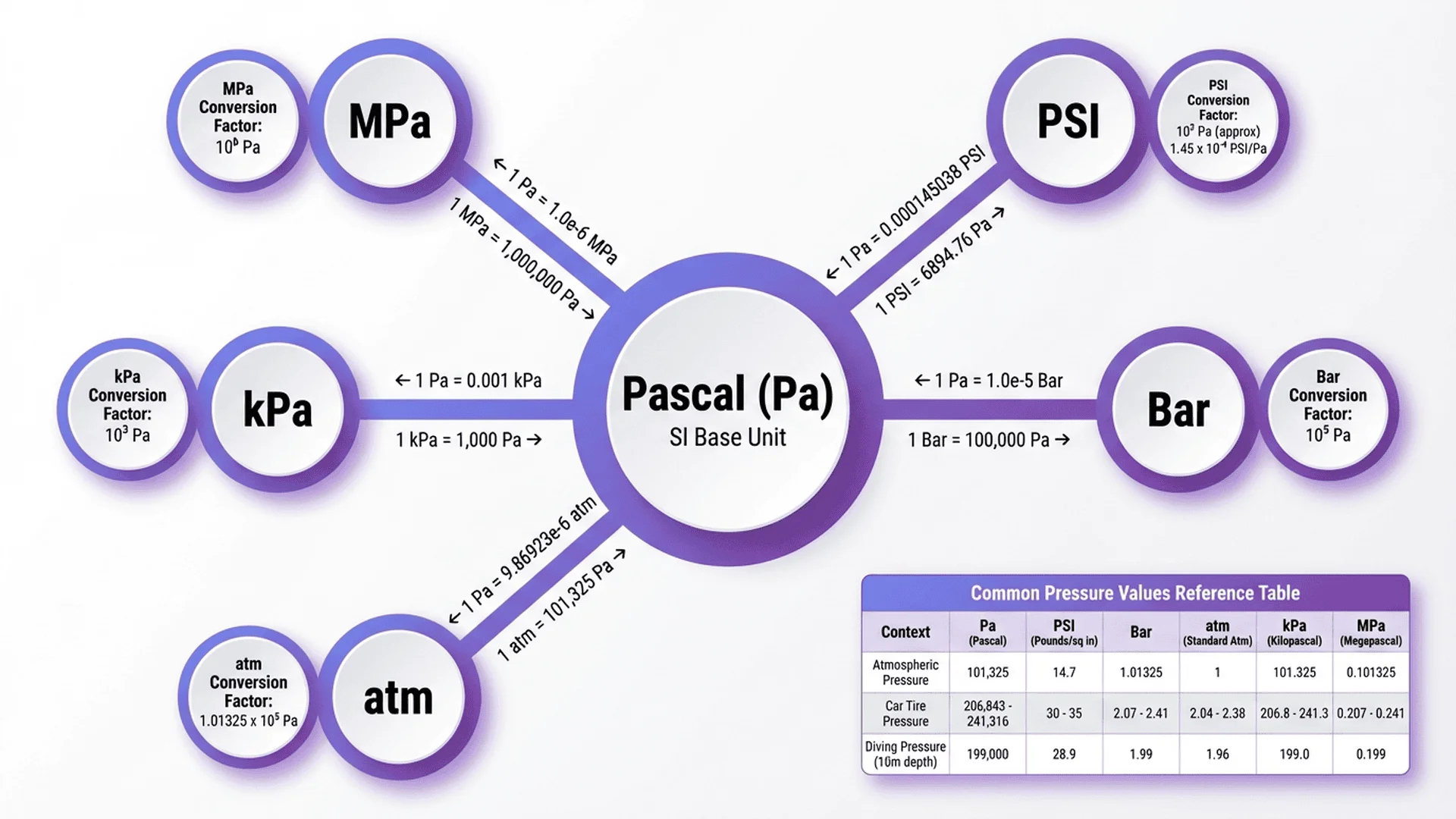
Introduction: Why Pressure Conversion Matters
Your tire pressure gauge shows 32 PSI. European manual says 2.2 bar. Are your tires properly inflated? Yes—they're equivalent! Pressure conversion errors can damage equipment, waste energy, and compromise safety.
Pressure measurement uses multiple incompatible units: PSI (pounds per square inch), bar, Pascal, atmospheres, and more. Each industry prefers different standards, making conversions essential for automotive maintenance, HVAC systems, scuba diving, and industrial applications.
This complete guide shows you how to convert PSI to bar, Pascal to PSI, and all pressure units—with formulas, reference tables, and real-world examples from tires, weather, and engineering.
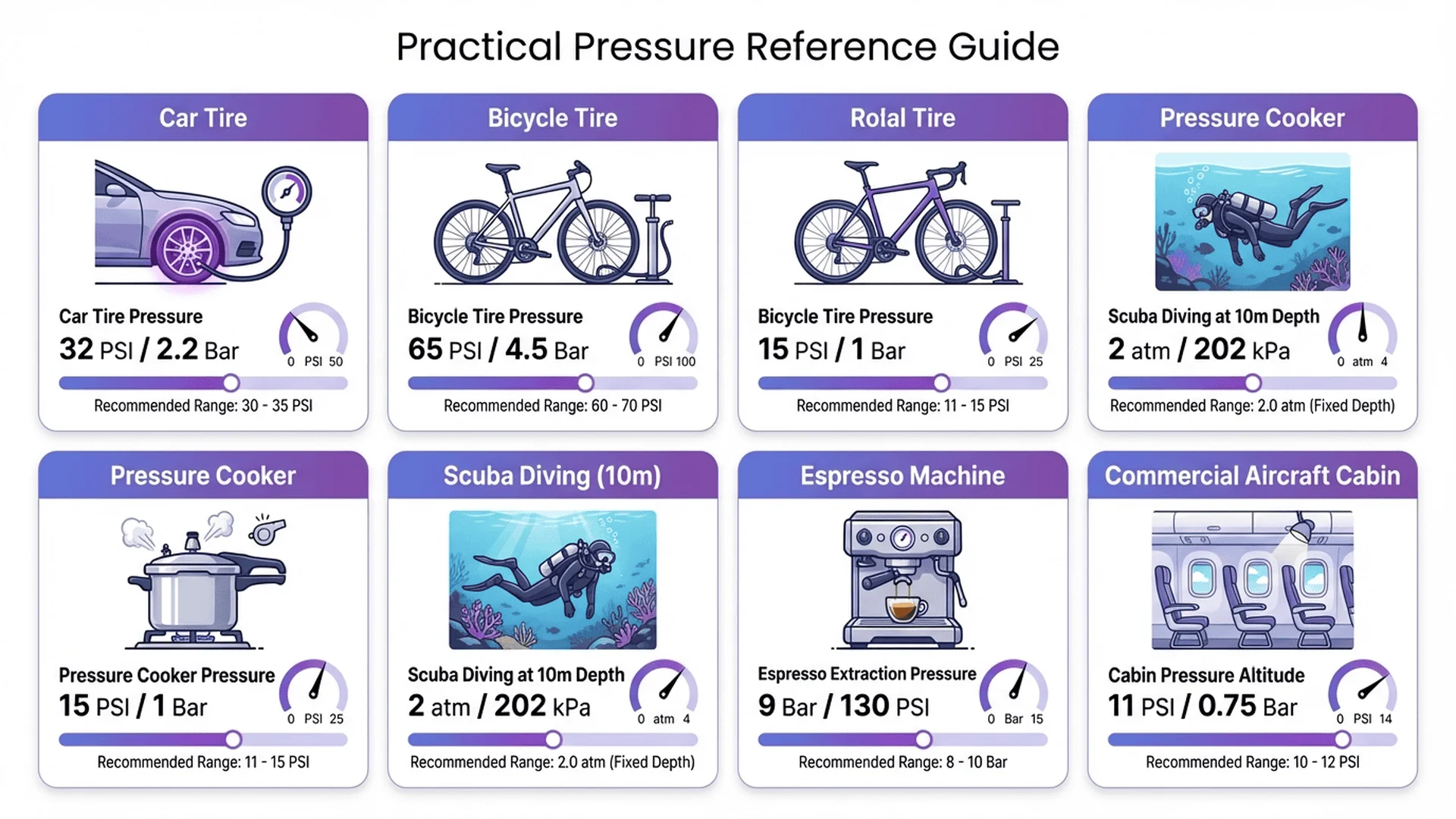
Understanding Pressure Units: PSI, Bar, Pascal, and More
Pressure measures force per unit area. Multiple measurement systems exist because different industries developed their own standards before international coordination.
What Is Pressure?
Definition:
Pressure = Force ÷ Area
Example:
- Force: 100 pounds pushing down
- Area: 1 square inch
- Pressure: 100 pounds / 1 in² = 100 PSI
Key Insight:
Same force over larger area = lower pressure
- 100 lbs over 2 in² = 50 PSI
- 100 lbs over 10 in² = 10 PSI
Common Pressure Units Explained
PSI (Pounds per Square Inch):
- Definition: Force in pounds over one square inch
- Where used: USA automotive, industrial, HVAC
- Typical range: Tire pressure (30-35 PSI), air compressor (90-150 PSI)
- Symbol: PSI or psi
Bar:
- Definition: 100,000 Pascals (metric standard)
- Where used: Europe, automotive, industrial worldwide
- Typical range: Tire pressure (2.0-2.5 bar), hydraulics (100-300 bar)
- Symbol: bar
- Relation to atmosphere: 1 bar ≈ 1 atmosphere (sea level air pressure)
Pascal (Pa):
- Definition: SI unit, 1 Newton per square meter
- Where used: Scientific research, engineering calculations
- Typical range: Often expressed as kPa (kilopascals) or MPa (megapascals)
- Symbol: Pa, kPa, MPa
- Scale: 1 kPa = 1,000 Pa, 1 MPa = 1,000,000 Pa
Atmosphere (atm):
- Definition: Average atmospheric pressure at sea level
- Where used: Scuba diving, chemistry, high-pressure systems
- Typical range: Scuba tanks (200-300 atm), chemistry (1-10 atm)
- Symbol: atm
- Standard value: 1 atm = 101,325 Pa = 14.696 PSI = 1.01325 bar
Kilopascal (kPa):
- Definition: 1,000 Pascals
- Where used: Canadian automotive, weather forecasting, tire pressure
- Typical range: Tire pressure (200-250 kPa), weather (95-105 kPa)
- Symbol: kPa
Millibar (mbar):
- Definition: 1/1000 of a bar = 100 Pascals
- Where used: Weather forecasting, meteorology
- Typical range: Atmospheric pressure (980-1050 mbar)
- Symbol: mbar
- Note: 1 mbar = 1 hPa (hectopascal)
Why Multiple Pressure Units Exist
Historical Reasons:
- PSI: Developed in USA with imperial system
- Bar: Created as metric alternative (easy round number)
- Pascal: SI standard (Newton/m²)
- Atmosphere: Based on natural air pressure
Industry Preferences:
- Automotive (US): PSI
- Automotive (Europe): Bar
- Scientific: Pascal (Pa, kPa, MPa)
- Weather: Millibar (mbar) or hectopascal (hPa)
- Diving: Atmospheres (atm) or bar
- Industrial: Depends on region (PSI in US, bar in Europe)
For comprehensive unit understanding, see our Unit Converter Complete Guide.
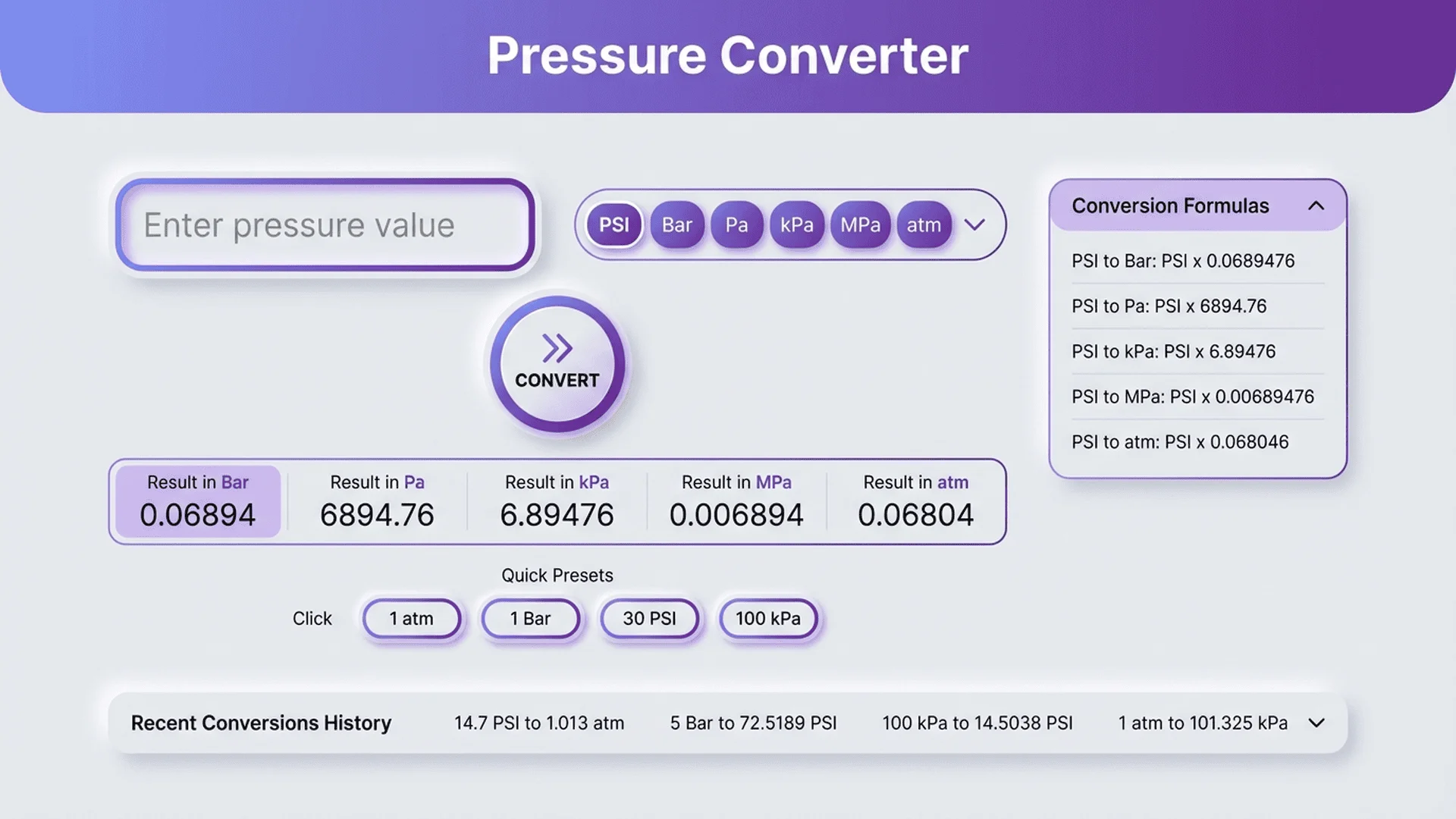
PSI to Bar: The Essential Automotive Conversion
Converting PSI to bar is crucial for international tire pressure standards, imported vehicles, and understanding European equipment specifications.
The Exact Conversion Formula
PSI to Bar:
1 PSI = 0.0689476 bar
Formula: bar = PSI × 0.0689476
Simplified (rounded):
1 PSI ≈ 0.069 bar
Divide PSI by 14.5 to get bar
Example Calculations:
- 30 PSI = 30 × 0.0689476 = 2.07 bar
- 32 PSI = 32 × 0.0689476 = 2.21 bar
- 35 PSI = 35 × 0.0689476 = 2.41 bar
- 40 PSI = 40 × 0.0689476 = 2.76 bar
Quick Mental Math Method
Approximation: Divide PSI by 14.5
Examples:
- 30 PSI ÷ 14.5 = 2.07 bar ✅ (exact!)
- 35 PSI ÷ 14.5 = 2.41 bar ✅
- 40 PSI ÷ 14.5 = 2.76 bar ✅
Why 14.5?
Because 1 bar = 14.5038 PSI (rounded to 14.5 for mental math)
PSI to Bar Reference Table
| PSI | Bar | Common Use |
|---|---|---|
| 10 PSI | 0.69 bar | Low-pressure gauge |
| 15 PSI | 1.03 bar | Bicycle tire (road bike) |
| 20 PSI | 1.38 bar | Bicycle tire (mountain bike) |
| 25 PSI | 1.72 bar | Low car tire pressure |
| 28 PSI | 1.93 bar | Minimum car tire |
| 30 PSI | 2.07 bar | Standard car tire |
| 32 PSI | 2.21 bar | Common car tire |
| 35 PSI | 2.41 bar | Recommended car tire |
| 40 PSI | 2.76 bar | Higher pressure tire |
| 50 PSI | 3.45 bar | Light truck tire |
| 60 PSI | 4.14 bar | Heavy truck tire |
| 80 PSI | 5.52 bar | Commercial truck |
| 90 PSI | 6.21 bar | Air compressor |
| 100 PSI | 6.89 bar | Industrial air tool |
| 150 PSI | 10.34 bar | High-pressure system |
Real-World PSI to Bar Applications
Tire Pressure Adjustment:
US car manual: "Inflate to 32 PSI"
European gauge shows bar:
- 32 PSI × 0.0689476 = 2.21 bar
- Set tires to 2.2 bar
Imported Vehicle:
German car door sticker: "2.5 bar front, 2.3 bar rear"
Your gauge shows PSI:
- Front: 2.5 bar ÷ 0.0689476 = 36.3 PSI
- Rear: 2.3 bar ÷ 0.0689476 = 33.4 PSI
Air Compressor Setting:
Tool requires 6 bar. Compressor displays PSI:
- 6 bar ÷ 0.0689476 = 87.0 PSI
- Set compressor to 87 PSI
Bicycle Tire:
Road bike tire: "Max 120 PSI / 8.3 bar"
- Verify: 120 PSI × 0.0689476 = 8.27 bar ✅
Use our Unit Converter for instant PSI to bar calculations.
Bar to PSI: The Reverse Conversion
Converting bar to PSI is necessary when using US-market pressure gauges with European equipment specifications.
The Reverse Formula
Bar to PSI:
1 bar = 14.5038 PSI
Formula: PSI = bar × 14.5038
Simplified:
Multiply bar by 14.5
Common Conversions:
- 1 bar = 14.50 PSI
- 2 bar = 2 × 14.5038 = 29.01 PSI
- 2.5 bar = 2.5 × 14.5038 = 36.26 PSI
- 3 bar = 3 × 14.5038 = 43.51 PSI
- 5 bar = 5 × 14.5038 = 72.52 PSI
- 10 bar = 10 × 14.5038 = 145.04 PSI
Mental Math Shortcut
Approximation: Multiply bar by 15 (slightly high, but close)
Examples:
- 2 bar × 15 = 30 PSI (actual: 29.01, within 3%)
- 2.5 bar × 15 = 37.5 PSI (actual: 36.26, close enough!)
- 3 bar × 15 = 45 PSI (actual: 43.51)
Better Accuracy: Multiply by 14.5
- 2.5 bar × 14.5 = 36.25 PSI (actual: 36.26) ✅
Bar to PSI Conversion Table
| Bar | PSI | Application |
|---|---|---|
| 0.5 bar | 7.25 PSI | Low pressure |
| 1.0 bar | 14.50 PSI | Atmospheric pressure |
| 1.5 bar | 21.76 PSI | Bicycle tire (casual) |
| 2.0 bar | 29.01 PSI | Car tire (low) |
| 2.2 bar | 31.91 PSI | Car tire (standard) |
| 2.5 bar | 36.26 PSI | Car tire (recommended) |
| 3.0 bar | 43.51 PSI | Car tire (high) |
| 4.0 bar | 58.02 PSI | Light truck |
| 5.0 bar | 72.52 PSI | Truck tire |
| 6.0 bar | 87.02 PSI | Air compressor |
| 8.0 bar | 116.03 PSI | High-pressure air |
| 10.0 bar | 145.04 PSI | Industrial system |
Practical Bar to PSI Examples
European Car in USA:
BMW door sticker: 2.3 bar. US gauge shows PSI:
- 2.3 bar × 14.5038 = 33.36 PSI
- Inflate to 33-34 PSI
Scuba Tank Pressure:
Tank rated 200 bar. Gauge shows PSI:
- 200 bar × 14.5038 = 2,900.76 PSI
- Tank holds ~2,900 PSI
Pressure Washer:
European model: 150 bar output. What's that in PSI?
- 150 bar × 14.5038 = 2,175.57 PSI
- Very high pressure!
Espresso Machine:
Optimal extraction: 9 bar. Your gauge shows PSI:
- 9 bar × 14.5038 = 130.53 PSI
- Aim for 130 PSI extraction pressure
Pascal to PSI: Scientific Pressure Conversion
Pascal (Pa) is the SI standard for pressure. Converting to PSI helps understand scientific specifications in practical terms.
Pascal Conversion Formulas
Pascal to PSI:
1 Pa = 0.000145038 PSI
1 kPa = 0.145038 PSI
Formula: PSI = Pa × 0.000145038
PSI to Pascal:
1 PSI = 6,894.76 Pa = 6.89476 kPa
Formula: Pa = PSI × 6894.76
Common Conversions:
- 100,000 Pa (100 kPa) = 100 × 0.145038 = 14.50 PSI = 1 bar
- 200,000 Pa (200 kPa) = 29.01 PSI = 2 bar
- 250,000 Pa (250 kPa) = 36.26 PSI = 2.5 bar
Kilopascal (kPa) to PSI Table
| kPa | PSI | Bar | Use |
|---|---|---|---|
| 50 kPa | 7.25 PSI | 0.5 bar | Low pressure |
| 100 kPa | 14.50 PSI | 1.0 bar | Atmospheric |
| 150 kPa | 21.76 PSI | 1.5 bar | Bicycle tire |
| 200 kPa | 29.01 PSI | 2.0 bar | Car tire (low) |
| 220 kPa | 31.91 PSI | 2.2 bar | Car tire |
| 250 kPa | 36.26 PSI | 2.5 bar | Car tire (high) |
| 300 kPa | 43.51 PSI | 3.0 bar | Truck tire |
| 500 kPa | 72.52 PSI | 5.0 bar | High pressure |
| 1000 kPa | 145.04 PSI | 10.0 bar | Very high |
Real-World Pascal Conversions
Tire Pressure (Canadian Standard):
Canadian tire label: 240 kPa. What's that in PSI?
- 240 kPa × 0.145038 = 34.81 PSI
- Set tires to 35 PSI
Weather Pressure:
Barometric pressure: 101.3 kPa (standard atmosphere)
- 101.3 kPa × 0.145038 = 14.69 PSI
- Sea level atmospheric pressure
Hydraulic System:
System operates at 20 MPa (megapascals). In PSI?
- 20 MPa = 20,000 kPa
- 20,000 × 0.145038 = 2,900.76 PSI
- Extremely high pressure!
Vacuum Measurement:
Vacuum pump: -90 kPa (90 kPa below atmospheric)
- Absolute pressure: 101.3 - 90 = 11.3 kPa
- In PSI: 11.3 × 0.145038 = 1.64 PSI
- Strong vacuum
Atmosphere (atm) and Other Pressure Units
Atmospheres and specialized units serve specific industries. Understanding these conversions helps with scuba diving, chemistry, and high-pressure systems.
Atmosphere (atm) Conversions
Atmosphere to Other Units:
1 atm = 14.696 PSI
1 atm = 1.01325 bar
1 atm = 101,325 Pa (101.325 kPa)
1 atm = 1013.25 mbar
Common Conversions:
- 2 atm = 29.39 PSI = 2.03 bar
- 5 atm = 73.48 PSI = 5.07 bar
- 10 atm = 146.96 PSI = 10.13 bar
- 200 atm = 2,939.2 PSI = 202.65 bar (scuba tank)
Atmosphere Conversion Table
| Atmospheres | PSI | Bar | kPa | Use |
|---|---|---|---|---|
| 0.5 atm | 7.35 PSI | 0.51 bar | 50.7 kPa | Partial vacuum |
| 1 atm | 14.70 PSI | 1.01 bar | 101.3 kPa | Sea level |
| 2 atm | 29.39 PSI | 2.03 bar | 202.7 kPa | Scuba 10m depth |
| 3 atm | 44.09 PSI | 3.04 bar | 304.0 kPa | Scuba 20m depth |
| 5 atm | 73.48 PSI | 5.07 bar | 506.6 kPa | Watch water resistance |
| 10 atm | 146.96 PSI | 10.13 bar | 1013 kPa | Scuba 90m depth |
| 200 atm | 2939 PSI | 202.7 bar | 20265 kPa | Scuba tank full |
| 300 atm | 4409 PSI | 304.0 bar | 30398 kPa | High-pressure tank |
Scuba Diving Pressure Applications
Depth and Pressure:
Every 10 meters (33 feet) underwater adds 1 atmosphere:
- Surface: 1 atm
- 10m depth: 2 atm (1 atm water + 1 atm air)
- 20m depth: 3 atm
- 30m depth: 4 atm
Tank Pressure:
Scuba tank filled to 200 bar:
- In PSI: 200 × 14.5038 = 2,901 PSI
- In atmospheres: 200 ÷ 1.01325 = 197.4 atm
Air Consumption:
Breathing rate at 20m (3 atm):
- Surface consumption: 15 liters/minute at 1 atm
- At 20m (3 atm): 15 × 3 = 45 liters/minute
- Tank depletes 3× faster!
Specialized Pressure Units
Torr (mmHg):
- 1 Torr = 1 mm of mercury
- 1 atm = 760 Torr
- Used in: Vacuum systems, medical (blood pressure)
- Conversion: 1 Torr = 0.01934 PSI
Inches of Mercury (inHg):
- 1 atm = 29.92 inHg
- Used in: Weather (US), aviation altimeters
- Conversion: 1 inHg = 0.491 PSI
Inches of Water (inH₂O):
- 1 PSI = 27.68 inH₂O
- Used in: HVAC, low-pressure gas systems
- Conversion: 1 inH₂O = 0.0361 PSI
Bar Gauge (barg) vs Bar Absolute (bara):
- Gauge pressure: Relative to atmospheric (0 barg = 1 bara)
- Absolute pressure: Relative to perfect vacuum
- Tire pressure "2.2 bar" means 2.2 barg (gauge)
- Actual absolute pressure: 2.2 + 1.01 = 3.21 bara
For physics-specific pressure calculations, see our Unit Converter for Physics Guide.
Tire Pressure: Complete Conversion Guide
Tire pressure is the most common everyday use of pressure conversions. Getting it right improves safety, fuel economy, and tire lifespan.
Recommended Tire Pressure Ranges
Passenger Cars:
- Standard: 30-35 PSI (2.1-2.4 bar / 207-241 kPa)
- Performance: 32-36 PSI (2.2-2.5 bar / 221-248 kPa)
- Eco (fuel efficiency): 35-38 PSI (2.4-2.6 bar / 241-262 kPa)
SUVs and Light Trucks:
- Standard: 33-38 PSI (2.3-2.6 bar / 228-262 kPa)
- Towing/Loading: 40-45 PSI (2.8-3.1 bar / 276-310 kPa)
Motorcycles:
- Front: 28-32 PSI (1.9-2.2 bar / 193-221 kPa)
- Rear: 32-36 PSI (2.2-2.5 bar / 221-248 kPa)
- Sport/Racing: 30-34 PSI (2.1-2.3 bar / 207-234 kPa)
Bicycles:
- Road bike: 80-130 PSI (5.5-9.0 bar / 552-896 kPa)
- Mountain bike: 25-35 PSI (1.7-2.4 bar / 172-241 kPa)
- Hybrid: 50-70 PSI (3.4-4.8 bar / 345-483 kPa)
Tire Pressure Conversion Table (Common Ranges)
| PSI | Bar | kPa | Vehicle Type |
|---|---|---|---|
| 25 PSI | 1.72 bar | 172 kPa | Underinflated car |
| 28 PSI | 1.93 bar | 193 kPa | Minimum safe (car) |
| 30 PSI | 2.07 bar | 207 kPa | Low-normal (car) |
| 32 PSI | 2.21 bar | 221 kPa | Standard (car) |
| 33 PSI | 2.28 bar | 228 kPa | Common (car) |
| 35 PSI | 2.41 bar | 241 kPa | Recommended (car) |
| 36 PSI | 2.48 bar | 248 kPa | High-normal (car) |
| 38 PSI | 2.62 bar | 262 kPa | Eco/efficiency |
| 40 PSI | 2.76 bar | 276 kPa | Truck/SUV |
| 42 PSI | 2.90 bar | 290 kPa | Loaded truck |
| 44 PSI | 3.03 bar | 303 kPa | Max car tire |
| 50 PSI | 3.45 bar | 345 kPa | Light truck |
Effects of Incorrect Tire Pressure
Underinflated (Below Recommended):
- ❌ Increased fuel consumption (+3% per 1 PSI under)
- ❌ Faster tire wear (edges wear faster)
- ❌ Poor handling and longer braking distance
- ❌ Increased heat buildup (blowout risk)
- ❌ Lower load capacity
Example:
Recommended: 35 PSI, Actual: 28 PSI (7 PSI under)
- Fuel penalty: ~21% more consumption
- Tire lifespan reduced by 25%
Overinflated (Above Recommended):
- ❌ Harsh ride quality
- ❌ Center tread wears faster
- ❌ Reduced traction (less contact patch)
- ❌ Increased impact damage risk (potholes)
Example:
Recommended: 35 PSI, Actual: 44 PSI (9 PSI over)
- Center tread wears 2× faster
- Reduced grip in wet conditions
Optimal Inflation Benefits:
- ✅ Best fuel economy
- ✅ Even tire wear (maximize lifespan)
- ✅ Optimal handling and braking
- ✅ Comfortable ride
- ✅ Proper load capacity
Tire Pressure Adjustment Tips
Temperature Effects:
Tire pressure changes ~1 PSI per 10°F (5.5°C) temperature change
Example:
- Set tires to 35 PSI at 70°F (21°C)
- Temperature drops to 30°F (-1°C)
- Change: 40°F drop = 4 PSI loss
- New pressure: 35 - 4 = 31 PSI (check and adjust!)
When to Check:
- Check when tires are COLD (before driving)
- After driving, pressure increases 2-4 PSI (heat expansion)
- Wait 3 hours after driving for accurate reading
Seasonal Adjustments:
- Winter: Add 3-5 PSI to compensate for cold
- Summer: May need to reduce slightly if overheating
- Before long trip: Add 2-3 PSI for sustained highway speeds
Altitude Effects:
Going from sea level to mountains (6,000 ft elevation):
- Atmospheric pressure drops ~20%
- Gauge pressure increases ~3 PSI
- May need to release air at high altitude
Pressure Conversion for Weather and Barometric Pressure
Weather forecasting uses pressure measurements to predict conditions. Understanding barometric pressure conversions helps interpret weather data.
Standard Atmospheric Pressure
Sea Level Standard:
- 1 atmosphere (atm)
- 1013.25 mbar (millibars)
- 101.325 kPa (kilopascals)
- 29.92 inHg (inches of mercury)
- 14.696 PSI
- 1.01325 bar
Weather Pressure Ranges
High Pressure (Fair Weather):
- 1020-1050 mbar (30.12-31.00 inHg)
- Clear skies, stable conditions
- Cold in winter, hot in summer
Normal Pressure:
- 1000-1020 mbar (29.53-30.12 inHg)
- Variable conditions
Low Pressure (Storms):
- 980-1000 mbar (28.94-29.53 inHg)
- Clouds, precipitation likely
- Strong low: <980 mbar (hurricane/typhoon)
Barometric Pressure Conversion Table
| Mbar | inHg | kPa | Condition |
|---|---|---|---|
| 980 mbar | 28.94 inHg | 98.0 kPa | Storm |
| 990 mbar | 29.24 inHg | 99.0 kPa | Low pressure |
| 1000 mbar | 29.53 inHg | 100.0 kPa | Below normal |
| 1013 mbar | 29.92 inHg | 101.3 kPa | Standard |
| 1020 mbar | 30.12 inHg | 102.0 kPa | High pressure |
| 1030 mbar | 30.42 inHg | 103.0 kPa | Very high |
| 1040 mbar | 30.71 inHg | 104.0 kPa | Extreme high |
| 1050 mbar | 31.00 inHg | 105.0 kPa | Record high |
Weather Pressure Applications
Hurricane Strength:
Category 5 hurricane: <920 mbar core pressure
- 920 mbar = 27.17 inHg = 92.0 kPa
- Extremely dangerous
Altitude Pressure:
Pressure decreases ~1 mbar per 8 meters elevation
- Denver (1,600m): ~835 mbar
- Mt. Everest summit (8,849m): ~337 mbar (1/3 sea level!)
Pressure Tendency:
Rapid pressure drop (>3 mbar/hour) = Storm approaching
Rapid pressure rise (>3 mbar/hour) = Clearing conditions
Common Pressure Conversion Mistakes
Pressure conversions are error-prone due to multiple unit systems and gauge vs absolute pressure confusion.
Mistake #1: Confusing Gauge and Absolute Pressure
Gauge Pressure (most common):
- Relative to atmospheric pressure
- Tire gauge reads "32 PSI" = 32 PSI above atmosphere
- Actual absolute pressure: 32 + 14.7 = 46.7 PSI
Absolute Pressure:
- Relative to perfect vacuum
- Used in scientific calculations
- Symbol: PSIA (absolute) vs PSIG (gauge)
Example Error:
Tire spec: "2.2 bar"
- This means 2.2 bar GAUGE (barg)
- NOT 2.2 bar absolute
- Absolute: 2.2 + 1.013 = 3.21 bara
When It Matters:
- Scuba diving calculations (depth pressure is absolute)
- Vacuum systems (measured as negative gauge or low absolute)
- Scientific equations (always use absolute)
Mistake #2: Using Rounded Conversion Factors
Wrong:
35 PSI × 0.07 = 2.45 bar ❌
Right:
35 PSI × 0.0689476 = 2.41 bar ✅
Error: 0.04 bar (1.6% error)
When It Matters:
- High-precision industrial systems
- Calibration work
- Medical equipment
Mistake #3: Ignoring Temperature Effects
Wrong:
Set tires to 35 PSI in summer, never check in winter ❌
Right:
Check and adjust for temperature changes ✅
Example:
- Summer (90°F): Set to 35 PSI
- Winter (30°F): Drops to ~31 PSI (60°F drop = 6 PSI loss)
- Re-inflate to 35 PSI
Mistake #4: Mixing Units in Calculations
Wrong:
Pressure1 (2 bar) + Pressure2 (20 PSI) = 22 bar+PSI nonsense ❌
Right:
Convert to same unit first:
- 2 bar = 29.01 PSI
- 29.01 + 20 = 49.01 PSI total
- Or: 20 PSI = 1.38 bar → 2 + 1.38 = 3.38 bar total ✅
Mistake #5: Forgetting Pressure Is Force/Area
Wrong:
"Doubling the force doubles the pressure" (not if area changes!)
Right:
Pressure = Force ÷ Area
- Double force, same area = 2× pressure ✅
- Double force, double area = Same pressure ✅
- Double force, half area = 4× pressure ✅
Conclusion: Mastering Pressure Conversion
Pressure conversion is essential for automotive maintenance, industrial equipment, scuba diving, and understanding weather. Multiple incompatible unit systems (PSI, bar, Pascal, atmospheres) make conversions necessary for safety and equipment operation.
Key Takeaways
Essential Formulas:
1. PSI to bar: PSI × 0.0689476 (or ÷14.5)
2. Bar to PSI: bar × 14.5038 (or ×14.5)
3. kPa to PSI: kPa × 0.145038
4. PSI to kPa: PSI × 6.89476
5. Atm to PSI: atm × 14.696
Quick Reference:
- 1 bar ≈ 14.5 PSI ≈ 100 kPa ≈ 1 atm
- Tire pressure: 30-35 PSI = 2.1-2.4 bar = 207-241 kPa
- Atmospheric: 14.7 PSI = 1.01 bar = 101.3 kPa = 1 atm
Common Mistakes to Avoid:
- Confusing gauge vs absolute pressure (tire "32 PSI" is gauge)
- Using rounded conversion factors (0.07 vs 0.0689476)
- Ignoring temperature effects (±1 PSI per 10°F)
- Mixing units mid-calculation
- Forgetting pressure = force/area relationship
Critical Applications:
- Tires: Check monthly when cold, adjust for seasons
- Scuba: Every 10m depth adds 1 atm pressure
- Weather: <1000 mbar = storm, >1020 mbar = fair
- Industrial: Always verify gauge vs absolute specs
When to Use Which Tool
Mental Math:
- Quick tire pressure checks (÷14.5 or ×14.5)
- Approximate conversions (±5% acceptable)
Digital Converter:
- Precise industrial specifications
- Calibration work
- Medical equipment
- Scientific calculations
- Example: Tool Master Unit Converter
Dual-Scale Gauge:
- Tire pressure monitoring
- Automotive maintenance
- When you need real-time measurement + conversion
Explore More Conversion Resources
Related Guides:
- Unit Converter Complete Guide - All conversion types
- Volume Conversion Guide - Fluid pressure calculations
- Power Conversion Guide - Air compressor power ratings
- Energy Conversion Guide - Compressed air energy
Specialized Applications:
- Unit Converter for Physics - Scientific pressure calculations
- Weight Conversion Guide - Force and pressure relationship
Professional Tools:
- Excel Unit Converter Formulas - Batch pressure conversions
- Best Unit Converter Apps 2025 - Mobile pressure converters
Try Our Free Tool:
Tool Master Unit Converter - Convert pressure, temperature, weight, and 30+ units instantly. 100% free, no registration, works offline.
Browse All Tools:
Visit our Conversion Tools Category for complete collection.
For technical details, see our Unit Converter Technical Documentation.
References
- National Institute of Standards and Technology (NIST). (2024). "Pressure Measurement Standards and Conversion Factors." NIST Technical Note 1297.
- Society of Automotive Engineers (SAE). (2024). "Tire Pressure Monitoring Systems (TPMS) Standards." SAE J2657.
- International Organization for Standardization (ISO). (2024). "ISO 80000-4: Quantities and Units - Mechanics."
- National Oceanic and Atmospheric Administration (NOAA). (2024). "Barometric Pressure Measurement Guidelines."
- Professional Association of Diving Instructors (PADI). (2024). "Dive Tables and Pressure Calculations." PADI Open Water Manual.
- American Society of Mechanical Engineers (ASME). (2024). "Pressure Vessel Code and Standards." ASME BPVC.