能量單位換算指南
Energy Conversion Guide: Joules, Calories, kWh Made Simple
Energy conversions appear everywhere—from nutrition labels to electricity bills to physics homework. Whether you're counting food calories, calculating battery capacity, or solving thermodynamics problems, understanding energy units prevents confusion and costly mistakes.
This guide covers joules to calories, kWh to BTU, watt-hours to joules, and everything in between. You'll learn the formulas, avoid the calorie/Calorie trap, and master real-world energy calculations.
Need instant conversions? Our Unit Converter tool handles all energy units with guaranteed accuracy.
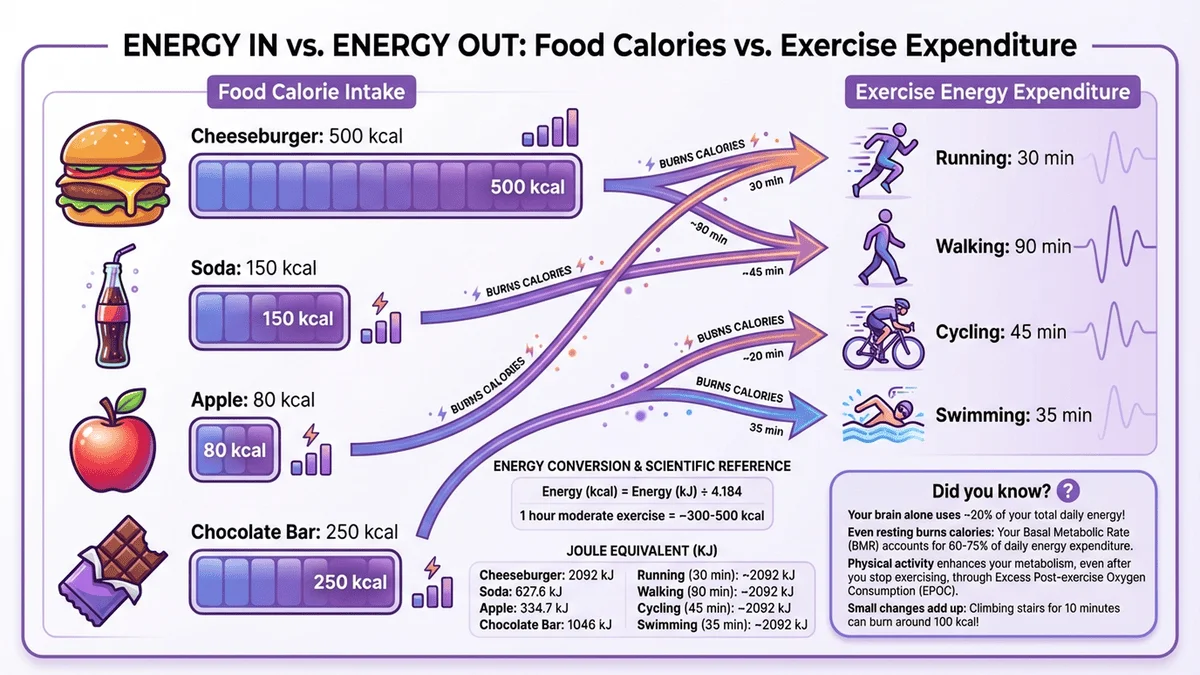
Understanding Energy Units
Energy measures the total capacity to do work or produce heat. Unlike power (which measures RATE), energy measures AMOUNT.
Think of it like money:
- Energy = Total dollars in your bank (joules, kWh, calories)
- Power = Dollars per hour you earn (watts, HP)
Common Energy Units:
- Joules (J): SI standard unit. Work done by 1 newton over 1 meter.
- Kilojoules (kJ): 1,000 joules. Common on nutrition labels outside the US.
- Calories (cal): Energy to raise 1g of water by 1°C. Small calorie.
- Calories (Cal): Dietary Calorie = 1,000 small calories = 1 kilocalorie (kcal).
- Kilowatt-hours (kWh): Electrical energy. 1 kWh = running 1 kW for 1 hour.
- BTU: British Thermal Unit. Energy to raise 1 lb of water by 1°F.
- Watt-hours (Wh): 1 watt of power for 1 hour = 3,600 joules.
Critical Distinction: Energy ≠ Power! Learn more in our Power Conversion Guide.
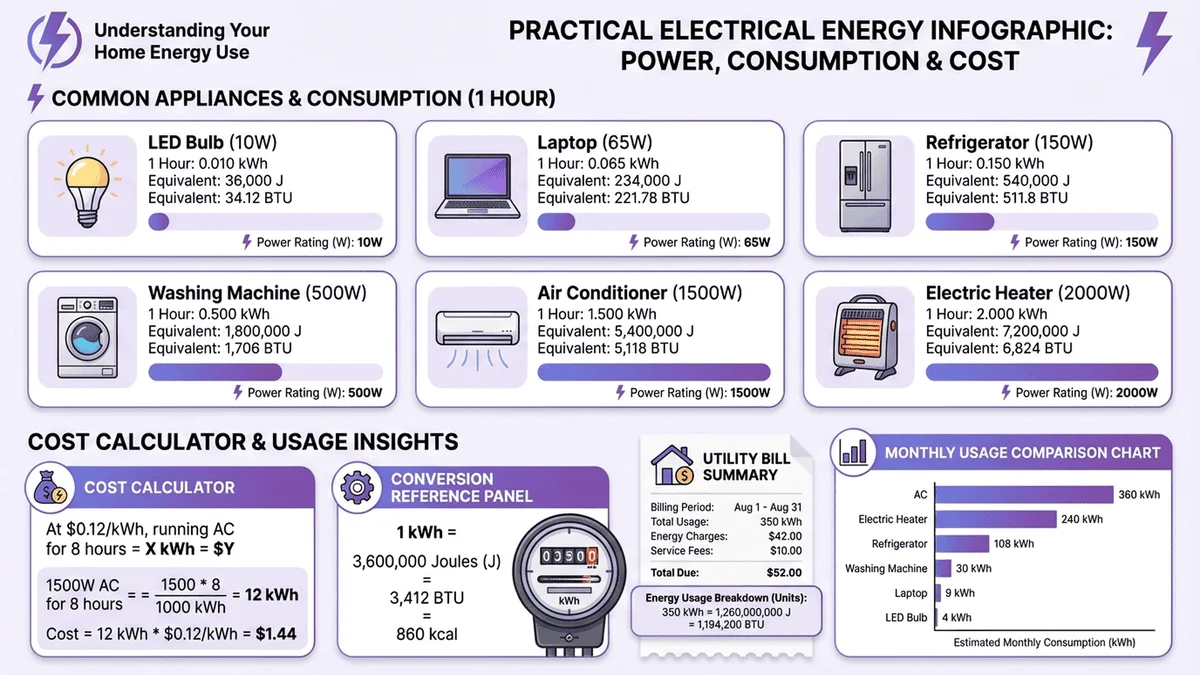
Joules to Calories: The Food Energy Formula
The most confusing energy conversion due to two different "calories."
The Calorie Confusion Explained
Small calorie (cal): Scientific calorie. Energy to heat 1 gram of water by 1°C.
1 calorie (cal) = 4.184 joules (J)
Large Calorie (Cal): Dietary Calorie = kilocalorie (kcal). Used on ALL food labels.
1 Calorie (Cal) = 1,000 calories (cal) = 4,184 joules (J) = 4.184 kilojoules (kJ)
Critical Rule: When discussing food, "calorie" ALWAYS means the large Calorie (kcal), even if lowercase!
Conversion Formulas
Joules to dietary Calories:
Calories (Cal) = Joules (J) ÷ 4,184

Example: 50,000 J ÷ 4,184 = 11.95 Cal
Dietary Calories to joules:
Joules (J) = Calories (Cal) × 4,184

Example: 300 Cal × 4,184 = 1,255,200 J = 1.26 MJ (megajoules)
Food Energy Examples
| Food Item | Calories (Cal) | Kilojoules (kJ) | Joules (J) |
|---|---|---|---|
| Apple (medium) | 95 Cal | 397 kJ | 397,000 J |
| Banana | 105 Cal | 439 kJ | 439,000 J |
| Slice of bread | 80 Cal | 335 kJ | 335,000 J |
| Chicken breast (100g) | 165 Cal | 690 kJ | 690,000 J |
| Hamburger | 540 Cal | 2,260 kJ | 2,260,000 J |
| Soda (12 oz) | 140 Cal | 586 kJ | 586,000 J |
| Daily intake (adult) | 2,000 Cal | 8,368 kJ | 8,368,000 J |
Real-World Application: Australian food labels show both Calories and kilojoules. A chocolate bar might list "220 Cal (920 kJ)"—these are the same amount of energy, just different units.
For a more in-depth understanding of how food energy relates to power consumption in your home, check out our kWh Converter Explained guide, which helps you compare the energy in food to the electricity you use daily.
Pro Tip: When converting food energy to exercise, remember that the human body is only 20-25% efficient at converting dietary Calories to mechanical work. Eating 100 Cal doesn't give you 100 Cal of exercise energy—only about 20-25 Cal of usable mechanical energy!

kWh to Joules: Electrical Energy Conversions
Electricity bills use kilowatt-hours (kWh), but physics uses joules. Here's how they connect.
Conversion Formula
Joules (J) = kWh × 3,600,000

kWh = Joules (J) ÷ 3,600,000
Why 3,600,000?
1 kWh = 1,000 watts × 1 hour × 3,600 seconds/hour
1 kWh = 1,000 × 3,600 watt-seconds
1 watt-second = 1 joule
1 kWh = 3,600,000 joules = 3.6 megajoules (MJ)
Electricity Usage Examples
| Appliance | Power | Runtime | Energy (kWh) | Energy (Joules) |
|---|---|---|---|---|
| LED bulb (10W) | 10 W | 10 hours | 0.1 kWh | 360,000 J |
| Laptop (50W) | 50 W | 8 hours | 0.4 kWh | 1,440,000 J |
| Refrigerator | 150 W | 24 hours | 3.6 kWh | 12,960,000 J |
| Electric oven | 2,400 W | 1 hour | 2.4 kWh | 8,640,000 J |
| AC unit | 3,500 W | 8 hours | 28 kWh | 100,800,000 J |
| EV charging | 7,000 W | 10 hours | 70 kWh | 252,000,000 J |
Electricity Cost Calculation:
Cost = Energy (kWh) × Rate ($/kWh)

Example: 3.6 kWh × $0.12/kWh = $0.43 per day (refrigerator)
Learn detailed electricity cost calculations in our kWh Converter Explained guide.
BTU to kWh Conversion
HVAC systems and natural gas use BTU (British Thermal Units), while electricity uses kWh.
Conversion Formula
kWh = BTU × 0.000293071

BTU = kWh × 3,412.14
Heating Energy Comparisons
| Energy Source | Energy Content | kWh Equivalent | Cost (example) |
|---|---|---|---|
| 1 kWh electricity | 3,412 BTU | 1 kWh | $0.12 |
| 1 therm natural gas | 100,000 BTU | 29.3 kWh | $1.20 |
| 1 gallon propane | 91,500 BTU | 26.8 kWh | $2.50 |
| 1 gallon heating oil | 138,500 BTU | 40.6 kWh | $3.20 |
| 1 cord firewood | 20,000,000 BTU | 5,861 kWh | $250 |
Heating Cost Comparison:
Cost per million BTU:

Natural gas: $1.20 per therm = $12.00 per million BTU
Electricity: $0.12 per kWh × 293 kWh = $35.16 per million BTU
Propane: $2.50 per gallon ÷ 0.0915 = $27.32 per million BTU
Heating oil: $3.20 per gallon ÷ 0.1385 = $23.10 per million BTU

Winner: Natural gas is cheapest (in this example)
Critical Insight: Comparing heating costs requires converting everything to the same energy unit (BTU or kWh), then dividing by fuel cost. The fuel with lowest $/BTU or $/kWh wins!
Watt-Hours to Joules
Battery capacity uses watt-hours (Wh) or milliamp-hours (mAh). Here's how to convert to joules.
Conversion Formula
Joules (J) = Watt-hours (Wh) × 3,600

Watt-hours (Wh) = Joules (J) ÷ 3,600
Battery Capacity Examples
| Device | Capacity (Wh) | Capacity (J) | Capacity (mAh @ voltage) |
|---|---|---|---|
| AA battery | 2.5 Wh | 9,000 J | 2,500 mAh @ 1V |
| Phone battery | 15 Wh | 54,000 J | 4,000 mAh @ 3.7V |
| Laptop battery | 60 Wh | 216,000 J | 5,000 mAh @ 11.1V |
| Power bank | 74 Wh | 266,400 J | 20,000 mAh @ 3.7V |
| EV battery (Tesla) | 75,000 Wh | 270,000,000 J | 75 kWh |
| Home battery (Powerwall) | 13,500 Wh | 48,600,000 J | 13.5 kWh |
Converting mAh to Wh:
Wh = (mAh × Voltage) ÷ 1,000

Example: 10,000 mAh power bank @ 3.7V
Wh = (10,000 × 3.7) ÷ 1,000 = 37 Wh
Joules = 37 × 3,600 = 133,200 J
TSA Battery Limit: Airlines allow batteries up to 100 Wh (360,000 joules) without approval. Larger batteries (100-160 Wh) require airline approval. This is why you can't check large power banks!
Calories to BTU Conversion
Less common, but useful for comparing food energy to heating energy.
Conversion Formula
BTU = Calories (Cal) × 3.966

Calories (Cal) = BTU ÷ 3.966
Food Energy in BTU
| Food Item | Calories (Cal) | BTU Equivalent |
|---|---|---|
| Granola bar | 200 Cal | 793 BTU |
| Big Mac | 563 Cal | 2,233 BTU |
| Pizza (large) | 2,000 Cal | 7,932 BTU |
| Gallon of gasoline | 31,000 Cal | 122,946 BTU |
Fun Comparison: A Big Mac (563 Cal = 2,233 BTU) contains enough energy to heat 22 gallons of water by 1°F, or about 1 gallon from room temperature to boiling!
Human Metabolism: Your body "burns" 2,000 Cal per day = 7,932 BTU = 2.32 kWh. If you could convert it to electricity at 100% efficiency, you'd power a 100W light bulb for 23 hours!
Joules to kWh: Physics to Electricity
Converting small-scale physics (joules) to large-scale electricity (kWh).
Conversion Formula
kWh = Joules (J) ÷ 3,600,000

Joules (J) = kWh × 3,600,000
Physics Examples
| Physics Scenario | Joules (J) | kWh Equivalent |
|---|---|---|
| Lifting 1 kg, 1 meter | 9.8 J | 0.0000027 kWh |
| Throwing baseball (90 mph) | 150 J | 0.000042 kWh |
| Car crash (60 mph) | 500,000 J | 0.14 kWh |
| Lightning strike | 1,000,000,000 J | 278 kWh |
| 1 ton TNT | 4,184,000,000 J | 1,162 kWh |
| Hiroshima bomb | 63 trillion J | 17.5 million kWh |
Kinetic Energy Formula:
Kinetic Energy (J) = ½ × mass (kg) × velocity² (m/s²)

Example: 1,500 kg car @ 60 mph (26.8 m/s)
KE = 0.5 × 1,500 × 26.8² = 538,920 J = 0.15 kWh
Potential Energy Formula:
Potential Energy (J) = mass (kg) × gravity (9.8 m/s²) × height (m)

Example: 80 kg person climbs 100m stairs
PE = 80 × 9.8 × 100 = 78,400 J = 0.022 kWh
To understand how these physics concepts apply to real-world power consumption, explore our comprehensive Power Conversion Guide, which breaks down watts, horsepower, and how energy translates to practical applications.
Learn more physics conversions in our Unit Converter for Physics guide.
Common Energy Conversion Mistakes
Mistake 1: Confusing Calories with calories (85% of Errors!)
Wrong: "This apple has 95 calories = 95 × 4.184 = 397 joules."
Right: "This apple has 95 Calories = 95,000 calories = 397,000 joules."
Solution: In food context, ALWAYS assume uppercase Calorie (kcal), even if written lowercase. Multiply by 4,184 (not 4.184) to get joules.
Mistake 2: Confusing Energy with Power
Wrong: "My 1500W heater uses 1500 watts of energy per hour."
Right: "My 1500W heater uses 1.5 kWh of energy per hour."
Watts measure POWER (rate), not energy. Energy = Power × Time. Learn the difference in our Power Conversion Guide.
Mistake 3: Forgetting Unit Prefixes
Problem: Mixing up kilo, mega, giga prefixes.
Example:
- 1 kJ = 1,000 J (kilo = thousand)
- 1 MJ = 1,000,000 J (mega = million)
- 1 GJ = 1,000,000,000 J (giga = billion)
Common Error: "1 kWh = 3.6 kJ" (WRONG! Should be 3.6 MJ or 3,600 kJ)
Mistake 4: Using Outdated Calorie Definitions
Problem: Old physics textbooks use different calorie definitions.
Thermochemical calorie: 1 cal = 4.184 J (modern standard)
15°C calorie: 1 cal = 4.1855 J (obsolete)
International calorie: 1 cal = 4.1868 J (obsolete)
Solution: Always use 4.184 J/cal for food and modern calculations.
Energy Density: Comparing Fuels
Energy density measures energy per unit mass or volume. Critical for choosing fuels.
Energy Density by Mass (MJ/kg)
| Fuel Type | Energy Density | kWh/kg | Usage |
|---|---|---|---|
| Hydrogen gas | 142 MJ/kg | 39.4 kWh/kg | Fuel cells, rockets |
| Natural gas | 55 MJ/kg | 15.3 kWh/kg | Heating, power |
| Gasoline | 46 MJ/kg | 12.8 kWh/kg | Vehicles |
| Diesel | 45 MJ/kg | 12.5 kWh/kg | Trucks, generators |
| Coal | 30 MJ/kg | 8.3 kWh/kg | Power plants |
| Firewood (dry) | 16 MJ/kg | 4.4 kWh/kg | Heating |
| Lithium battery | 0.9 MJ/kg | 0.25 kWh/kg | EVs, electronics |
| Food (average) | 7 MJ/kg | 1.9 kWh/kg | Nutrition |
Key Insight: Gasoline has 50× more energy per kg than the best lithium batteries. This is why EVs need huge batteries for comparable range!
Energy Density by Volume (MJ/L)
| Fuel Type | Energy Density | kWh/L | Notes |
|---|---|---|---|
| Gasoline | 34 MJ/L | 9.4 kWh/L | High energy, compact |
| Diesel | 38 MJ/L | 10.6 kWh/L | Denser than gasoline |
| Ethanol | 24 MJ/L | 6.7 kWh/L | Lower than gasoline |
| LPG (propane) | 26 MJ/L | 7.2 kWh/L | Compressed gas |
| Hydrogen (700 bar) | 5 MJ/L | 1.4 kWh/L | Very low density |
| Lithium battery | 2 MJ/L | 0.56 kWh/L | Improving yearly |
Vehicle Comparison:
- Gas car: 15 gallons × 9.4 kWh/L × 3.785 L/gal = 533 kWh in tank
- Tesla Model 3: 75 kWh battery capacity
- Gas has 7× more energy in same space (but only 25% efficient vs EV's 85%)
Energy Conversion Formula Reference
Quick Reference Table
| From | To | Multiply By | Divide By |
|---|---|---|---|
| Joules | Calories (cal) | 0.239006 | 4.184 |
| Calories (Cal) | Joules | 4,184 | - |
| kWh | Joules | 3,600,000 | - |
| Joules | kWh | - | 3,600,000 |
| kWh | BTU | 3,412.14 | - |
| BTU | kWh | 0.000293071 | - |
| Wh | Joules | 3,600 | - |
| Joules | Wh | - | 3,600 |
| Calories (Cal) | BTU | 3.966 | - |
| BTU | Calories (Cal) | 0.252 | - |
Exact Conversion Factors (for Science)
1 calorie (cal) = 4.184 joules (exactly, by definition)
1 Calorie (Cal) = 4,184 joules (exactly)
1 kWh = 3,600,000 joules (exactly)
1 BTU = 1,055.06 joules (International Table BTU)
1 Wh = 3,600 joules (exactly)
1 electronvolt (eV) = 1.602176634 × 10⁻¹⁹ joules (exactly, 2019 redefinition)
When Precision Matters:
- Scientific research
- Calorimetry experiments
- Pharmaceutical dosing
- Nuclear calculations
When Approximations Work:
- Dietary nutrition (±5% is fine)
- Electricity cost estimates
- Fuel consumption comparisons
- Household energy calculations
Using Our Unit Converter Tool
Skip the manual calculations! Our Unit Converter handles all energy units instantly.
Features:
✓ Joules, calories (both types), kWh, BTU, watt-hours
✓ Food energy, electricity, physics conversions
✓ Instant bidirectional conversion
✓ Mobile-friendly, works offline
✓ 100% free, no registration
{cta: {
title: "Convert Energy Units Instantly",
description: "Free online converter for joules, calories, kWh, BTU, and all energy units. No installation required.",
primary_button: {
text: "Open Energy Converter",
url: "/tools/unit-converter",
priority: "⭐⭐⭐"
},
secondary_buttons: [
{
text: "View All Conversion Tools",
url: "/categories/conversion.html",
priority: "⭐⭐"
}
]
}}
Related Conversion Guides
Explore our complete conversion toolkit:
- Unit Converter Complete Guide - All conversion types in one place
- Power Conversion Guide - Watts to horsepower formulas
- kWh Converter Explained - Electricity cost calculations
- Cooking Unit Converter - Food measurements and nutrition
- Unit Converter for Physics - Scientific unit conversions
Need Technical Documentation? Check our Unit Converter Implementation guide for developers.
Conclusion: Master Energy Conversions
Energy conversions are essential for:
- Nutrition: Converting food labels between Calories and kilojoules
- Electricity: Understanding consumption, costs, and battery capacity
- Heating: Comparing fuel efficiency and costs
- Physics: Solving kinetic energy, potential energy, and thermodynamics problems
- Sustainability: Evaluating energy storage and renewable options
Key Takeaways:
1. Energy ≠ Power - energy is total amount, power is rate
2. 1 Calorie (food) = 4,184 joules - always use large Calorie for food
3. 1 kWh = 3,600,000 joules - electricity to physics conversion
4. 1 kWh = 3,412 BTU - electricity to heating conversion
5. Energy density matters - gasoline has 50× more energy/kg than batteries
Quick Mental Math:
- Calories → kJ: Multiply by 4 (close enough for nutrition)
- kWh → MJ: Multiply by 3.6 (exact conversion)
- BTU → kWh: Divide by 3,400 (within 1% accuracy)
Use our Unit Converter tool for instant accurate conversions, or bookmark this guide for formulas and detailed explanations.
Curious about specific applications? Check our Cooking Unit Converter for food energy calculations, or our kWh Converter for electricity costs!
Frequently Asked Questions
Q: How many joules are in 1 calorie?
A: 1 calorie (small calorie) equals 4.184 joules. 1 Calorie (large calorie/dietary Calorie) equals 4,184 joules or 4.184 kilojoules. Always check if you're working with calories or Calories—the 1000× difference is critical!
Q: How do I convert kWh to joules?
A: Multiply kilowatt-hours by 3,600,000 (or 3.6 million). For example: 1 kWh = 3,600,000 joules = 3.6 megajoules. This is the energy stored in batteries or consumed by appliances.
Q: What's the difference between energy and power?
A: Energy is the TOTAL amount (joules, kWh, calories), while power is the RATE of energy transfer (watts, HP). Energy = Power × Time. A 100W bulb uses 100 watt-hours (360,000 joules) in one hour.
Q: Why do nutrition labels show Calories, not joules?
A: US nutrition labels use Calories (uppercase C = kilocalories). 1 Calorie = 1,000 calories = 4.184 kilojoules. Some countries (Australia, EU) show both Calories and kilojoules on labels for clarity.
Q: How many Calories does my body burn per day?
A: Average adult: 2,000-2,500 Calories (8,368-10,460 kJ) per day. This varies by age, sex, weight, and activity level. Athletes can burn 3,000-5,000+ Calories daily.
Q: Can I compare gasoline energy to battery energy directly?
A: Not quite. Gasoline has 46 MJ/kg but internal combustion engines are only 20-30% efficient. Batteries have 0.9 MJ/kg but EVs are 85-90% efficient. Net usable energy is closer than raw energy density suggests.
Q: What's the difference between BTU and BTU/hr?
A: BTU is ENERGY (total amount), BTU/hr is POWER (rate of energy transfer). An air conditioner rated at 10,000 BTU/hr removes 10,000 BTU of heat per hour. Don't confuse the two!
Q: How much does 1 kWh of electricity cost?
A: US average: $0.12 per kWh (ranges from $0.08 to $0.30+ depending on state and utility). Check your electricity bill for your exact rate, then calculate costs using our kWh Converter.