QR Code 技術詳解:從原理到應用的完整指南QR Code Technology Explained: A Complete Guide from Principles to Applications
📅發布日期:2025-01-27Published: 2025-01-27
⏱️閱讀時間:約 10 分鐘Reading time: ~10 min
🏷️分類:技術博客Category: Tech Blog
QR Code(Quick Response Code)是一種二維矩陣條碼,由日本 Denso Wave 公司於 1994 年發明,最初用於汽車零件追蹤。相較於傳統一維條碼(如 UPC、EAN),QR Code 能在相同面積內儲存更多資訊,並支援高速掃描和強大的錯誤修正能力。如今 QR Code 已成為全球最廣泛使用的二維碼標準(ISO/IEC 18004),廣泛應用於行動支付、票券驗證、產品溯源、行銷推廣等領域。本文將深入探討 QR Code 的技術原理、結構組成、編碼演算法、錯誤修正機制和未來發展趨勢。QR Code (Quick Response Code) is a two-dimensional matrix barcode invented by Japan's Denso Wave in 1994, originally used for automotive parts tracking. Compared to traditional one-dimensional barcodes (like UPC, EAN), QR Codes can store more information in the same area and support high-speed scanning with powerful error correction capabilities. Today, QR Code has become the world's most widely used 2D code standard (ISO/IEC 18004), with applications in mobile payments, ticket verification, product traceability, and marketing. This article explores QR Code's technical principles, structure, encoding algorithms, error correction mechanisms, and future trends.
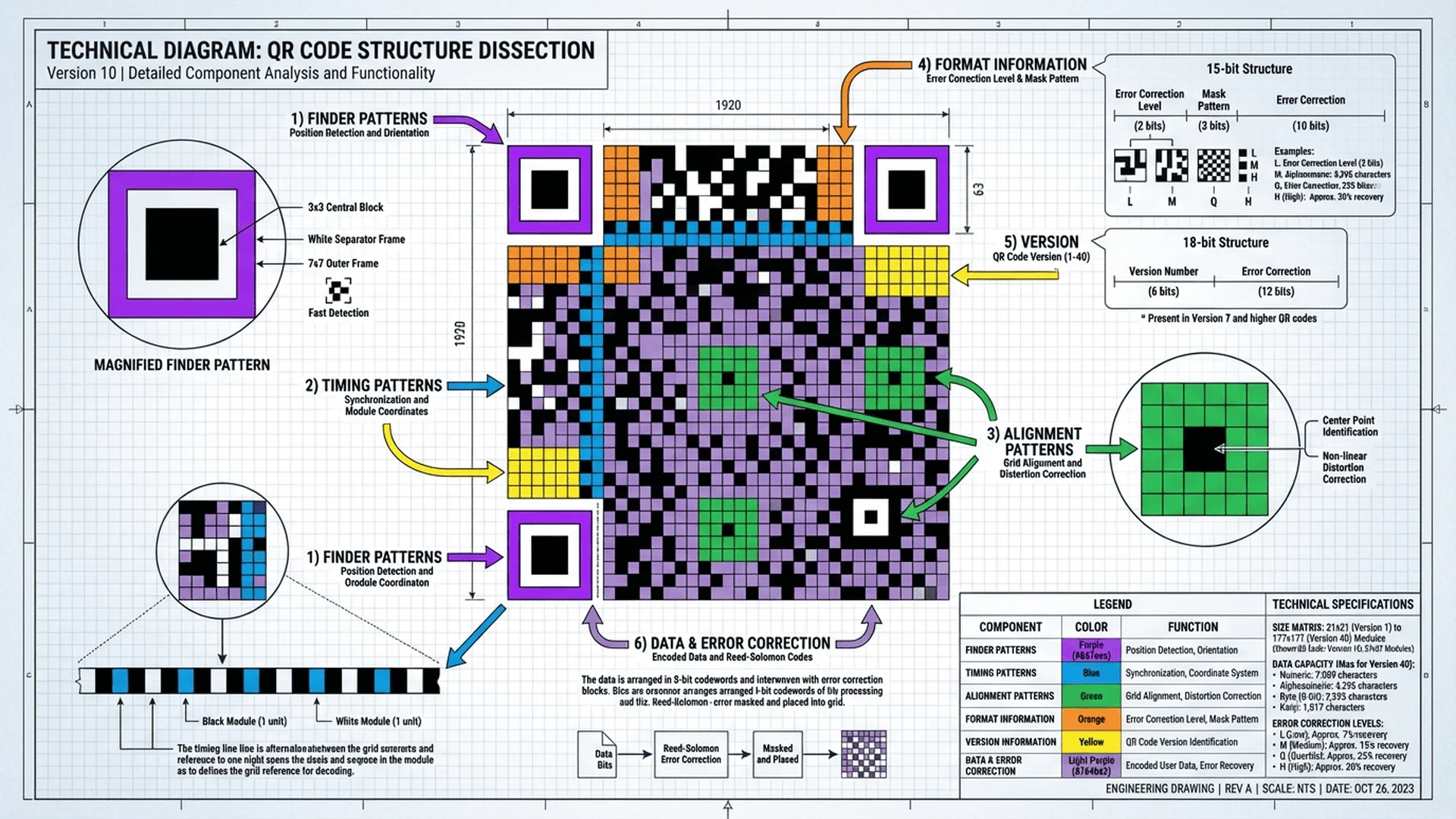
QR Code 結構解析圖,詳細標註定位點、時序圖樣、資料區等關鍵組成部分
📜 QR Code 的歷史與發展📜 History and Development of QR Code
誕生背景(1994年)Birth Background (1994)
QR Code 由 Denso Wave 公司(豐田集團子公司)的原昌宏(Masahiro Hara)團隊開發。當時汽車製造業使用傳統一維條碼追蹤零件,但面臨以下問題:QR Code was developed by Masahiro Hara's team at Denso Wave (a Toyota subsidiary). At that time, the automotive industry used traditional 1D barcodes for parts tracking, but faced the following problems:
資料容量不足:Insufficient data capacity:一維條碼最多只能儲存 20 個字元1D barcodes can only store up to 20 characters
掃描速度慢:Slow scanning speed:需要精確對準掃描器Requires precise alignment with scanner
容錯率低:Low error tolerance:部分損壞即無法讀取Partial damage makes it unreadable
QR Code 的設計目標是「高速讀取」(Quick Response),透過三個角落的定位圖案(Position Detection Pattern)實現 360° 全方向快速識別,大幅提升掃描效率。QR Code was designed for "Quick Response" - using three corner position detection patterns to enable 360° omnidirectional fast recognition, greatly improving scanning efficiency.
標準化與普及(2000年代)Standardization and Adoption (2000s)
2000年::成為 ISO/IEC 18004 國際標準Became ISO/IEC 18004 international standard
2004年::Denso Wave 宣布放棄 QR Code 專利,允許免費使用Denso Wave waived QR Code patents, allowing free use
2010年代:s:智慧型手機普及,內建相機掃描功能推動 QR Code 爆發性成長Smartphone proliferation with built-in camera scanning drove explosive QR Code growth
一個標準 QR Code 由以下七個主要區域組成:A standard QR Code consists of seven main areas:
1. 定位圖案(Position Detection Pattern)1. Position Detection Pattern
三個角落的大型方形圖案(7×7 模組),用於快速識別 QR Code 位置和方向。圖案特徵為「黑-白-黑-白-黑」比例 1:1:3:1:1,具有唯一性,可從任意角度快速偵測。Large square patterns (7×7 modules) in three corners for quick QR Code position and orientation detection. The pattern features a "black-white-black-white-black" ratio of 1:1:3:1:1, unique and detectable from any angle.
2. 校正圖案(Alignment Pattern)2. Alignment Pattern
較高版本(Version 2+)在 QR Code 內部分布的小型方形圖案,用於修正掃描時的扭曲和變形。版本越高、尺寸越大,校正圖案越多。Small square patterns distributed inside higher version (Version 2+) QR Codes to correct distortion during scanning. Higher versions with larger sizes have more alignment patterns.
3. 時序圖案(Timing Pattern)3. Timing Pattern
連接左上和右上定位圖案、左上和左下定位圖案的黑白交替線條,用於確定 QR Code 的網格密度和模組座標。Alternating black-white lines connecting the position detection patterns, used to determine QR Code grid density and module coordinates.
4. 格式資訊(Format Information)4. Format Information
15-bit 資料,儲存容錯等級(L/M/Q/H)和遮罩模式(Mask Pattern)資訊。分別放置在左上定位圖案附近和右上+左下定位圖案之間,具有冗餘以提高可靠性。15-bit data storing error correction level (L/M/Q/H) and mask pattern information. Placed near the top-left position pattern and between top-right + bottom-left patterns, with redundancy for reliability.
5. 版本資訊(Version Information)5. Version Information
18-bit 資料,只存在於 Version 7 以上的 QR Code,儲存版本號碼(7-40)。位於右下角,同樣具有冗餘設計。18-bit data existing only in Version 7+ QR Codes, storing version number (7-40). Located in the bottom-right corner, also with redundant design.
6. 資料與錯誤修正碼(Data and Error Correction Codewords)6. Data and Error Correction Codewords
實際儲存的資料內容和用於錯誤修正的 Reed-Solomon 碼,佔據 QR Code 的大部分區域。資料以之字形(Zigzag)路徑編排,避免局部損壞導致大量資料遺失。The actual data content and Reed-Solomon codes for error correction, occupying most of the QR Code area. Data is arranged in a zigzag path to prevent localized damage from causing massive data loss.
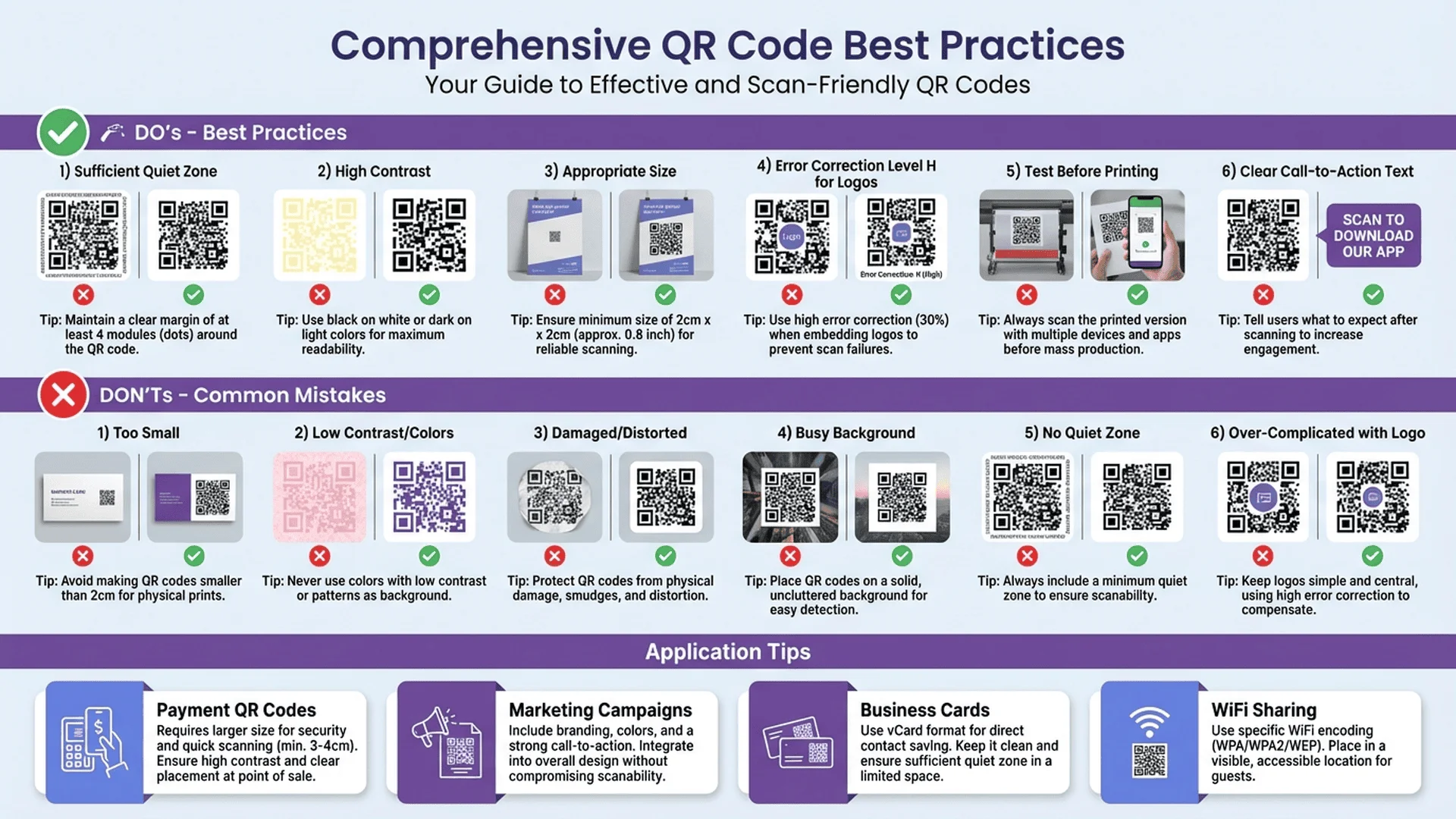
7. 靜區(Quiet Zone)7. Quiet Zone
QR Code 周圍的白色邊框(至少 4 個模組寬度),用於與背景分離,確保掃描器能正確識別邊界。White border around the QR Code (at least 4 modules wide), used to separate from background and ensure scanners correctly identify boundaries.
QR Code 應用案例圖集與最佳實踐建議,包含設計原則和常見錯誤
🧮 版本與容量規格🧮 Version and Capacity Specifications
QR Code 共有 40 個版本,版本號決定 QR Code 的尺寸和資料容量:QR Code has 40 versions; the version number determines the size and data capacity:
版本
尺寸(模組)
數字容量(L級)
英數容量(L級)
二進位容量(L級)
Version 1
21×21
41
25
17 bytes
Version 5
37×37
255
154
106 bytes
Version 10
57×57
652
395
271 bytes
Version 20
97×97
1,700
1,024
703 bytes
Version 40
177×177
7,089
4,296
2,953 bytes
計算公式:Version N 的尺寸 = 21 + (N - 1) × 4 模組
資料編碼模式Data Encoding Modes
QR Code 支援四種主要編碼模式,系統會自動選擇最有效率的模式:QR Code supports four main encoding modes, with the system automatically selecting the most efficient mode:
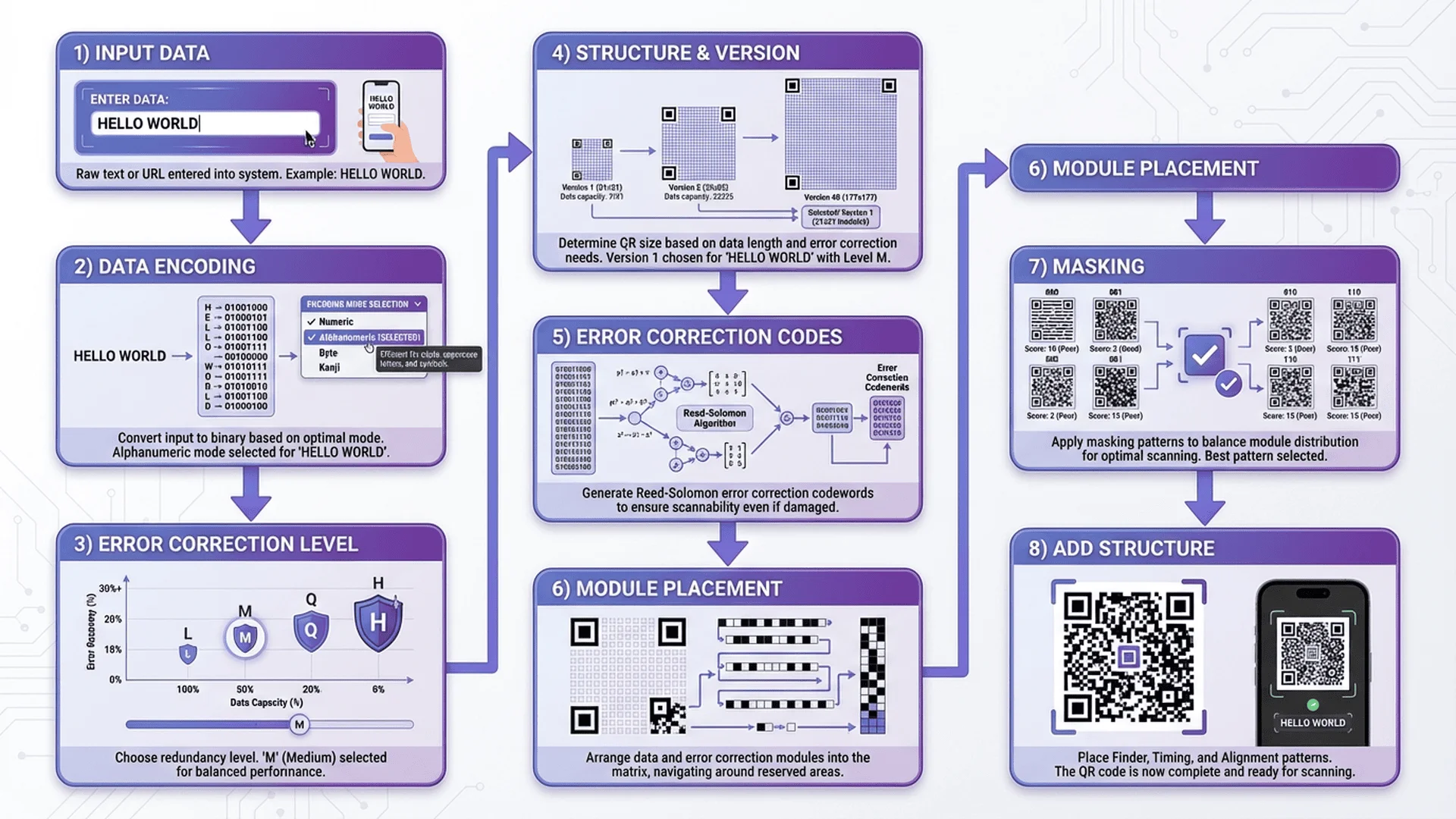
QR Code 使用 Reed-Solomon(RS)錯誤修正碼,即使部分資料損壞或遮蔽,仍可透過冗餘資料恢復原始內容。這是一種前向錯誤修正(Forward Error Correction, FEC)技術,無需重新傳輸即可修正錯誤。QR Code uses Reed-Solomon (RS) error correction codes, allowing recovery of original content through redundant data even when parts are damaged or obscured. This is a Forward Error Correction (FEC) technique that corrects errors without retransmission.
QR Code 從 1994 年誕生至今,已成為連接實體與數位世界的重要橋樑。其技術優勢包括:Since its birth in 1994, QR Code has become an important bridge connecting physical and digital worlds. Its technical advantages include:
大容量儲存:Large capacity:最多 7,089 個數字或 2,953 bytes 二進位資料Up to 7,089 digits or 2,953 bytes of binary data
高速掃描:Fast scanning:360° 全方向識別,1 秒內完成解碼360° omnidirectional recognition, decoded within 1 second
強大容錯:Strong error correction:Reed-Solomon 錯誤修正可修復最多 30% 損壞Reed-Solomon can recover up to 30% damage
國際標準:International standard:ISO/IEC 18004 確保全球相容性ISO/IEC 18004 ensures global compatibility
免費開放:Free and open:無專利限制,任何人都能生成和使用No patent restrictions, anyone can generate and use
未來隨著 5G、IoT、區塊鏈等技術發展,QR Code 將在智慧城市、工業 4.0、數位身份等領域發揮更大作用。理解其技術原理,有助於開發者和產品經理設計更安全、高效的應用解決方案。With the development of 5G, IoT, blockchain and other technologies, QR Code will play a greater role in smart cities, Industry 4.0, and digital identity. Understanding its technical principles helps developers and product managers design safer and more efficient solutions.
🎨 立即試用 QR Code 產生器🎨 Try QR Code Generator Now
免費線上 QR Code 產生工具,支援多種內容類型、容錯率調整、Logo 嵌入。100% 本地處理,保護隱私安全!Free online QR Code generator supporting multiple content types, error correction adjustment, and logo embedding. 100% local processing for privacy protection!