外匯交易時區指南
Forex Trading Time Zone Guide: Best Times to Trade EUR/USD, GBP/USD, USD/JPY (2025)
← Back to Time Zone Converter Complete Guide
Introduction: Why Time Zones Matter in Forex Trading
Missing the London-New York overlap cost you a winning EUR/USD trade? You're experiencing what professional forex traders know intimately—timing isn't just important in forex, it's everything. The foreign exchange market operates 24 hours a day, 5 days a week, but not all trading hours are created equal. 80% of forex volume concentrates in just 8 hours daily when major markets overlap.
Unlike stock markets that have fixed hours, forex trading follows the sun as major financial centers open and close: Sydney, Tokyo, London, and New York. Each session has distinct characteristics—Tokyo favors JPY pairs with moderate volatility, London brings massive EUR/GBP volume, and the London-New York overlap (8 AM - 12 PM EST) generates the highest liquidity and tightest spreads of the entire day.
Understanding forex time zones transforms your trading from guesswork into strategy. Knowing when EUR/USD spreads tighten from 2 pips to 0.5 pips, when GBP/USD volatility spikes 300% during London open, or when to avoid the "dead zone" between New York close and Tokyo open can mean the difference between consistent profits and frustrated losses.
This guide reveals professional strategies for trading across global time zones, optimal entry times for major currency pairs, and how to leverage market overlaps for maximum advantage.
⭐⭐⭐ Track Global Forex Market Hours with Our Free Time Zone Converter →
Understanding the 24-Hour Forex Market
The Four Major Trading Sessions
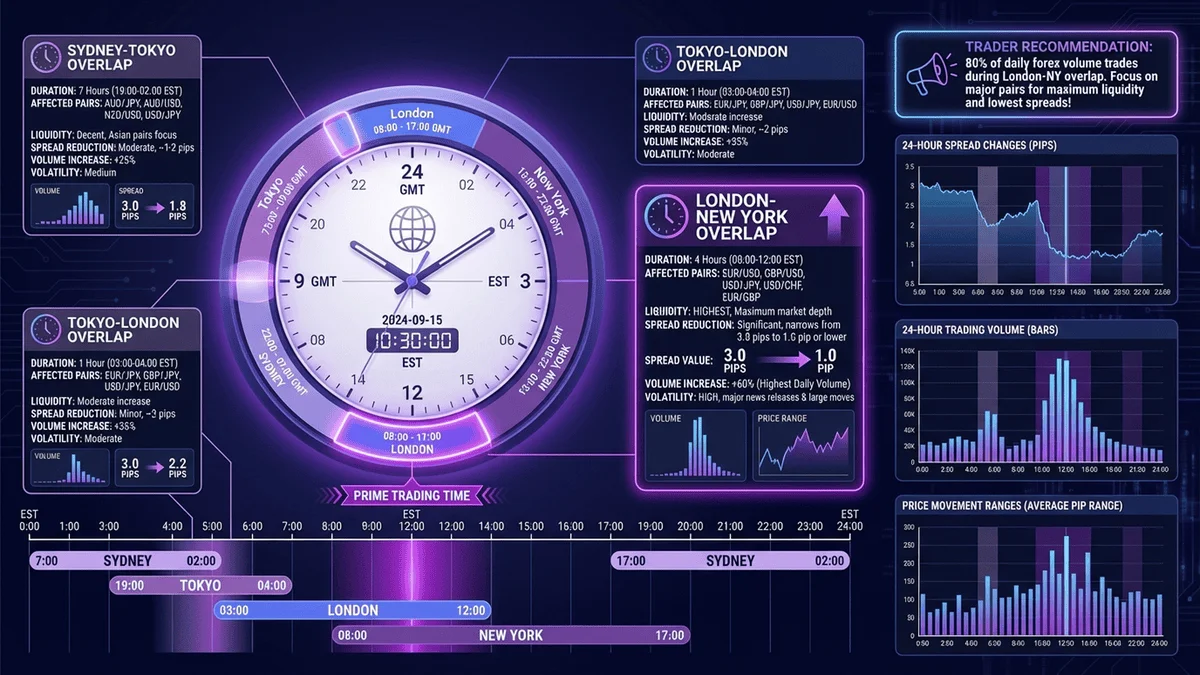
The forex market operates continuously from Sunday 5 PM EST (when Sydney opens) to Friday 5 PM EST (when New York closes), creating a seamless 24-hour trading environment. This continuous operation is divided into four major trading sessions:
1. Sydney (Australian) Session
- Trading Hours: 5:00 PM - 2:00 AM EST (Next Day)
- Peak Hours: 7:00 PM - 11:00 PM EST
- Timezone: Australian Eastern Standard Time (AEDT, UTC+11)
- Characteristics: Lowest volume, widest spreads, quietest session
- Active Pairs: AUD/USD, AUD/JPY, NZD/USD
- Typical Spread EUR/USD: 2-3 pips
2. Tokyo (Asian) Session
- Trading Hours: 7:00 PM - 4:00 AM EST
- Peak Hours: 11:00 PM - 3:00 AM EST
- Timezone: Japan Standard Time (JST, UTC+9)
- Characteristics: Moderate volume, JPY pairs dominate, influenced by Asian economic data
- Active Pairs: USD/JPY, EUR/JPY, AUD/JPY, GBP/JPY
- Typical Spread EUR/USD: 1.5-2 pips
3. London (European) Session
- Trading Hours: 3:00 AM - 12:00 PM EST
- Peak Hours: 3:00 AM - 9:00 AM EST
- Timezone: Greenwich Mean Time / British Summer Time (GMT/BST, UTC+0/+1)
- Characteristics: Highest single-session volume (~35% of daily forex volume), EUR and GBP pairs most active
- Active Pairs: EUR/USD, GBP/USD, EUR/GBP, USD/CHF
- Typical Spread EUR/USD: 0.5-1 pips
4. New York (US) Session
- Trading Hours: 8:00 AM - 5:00 PM EST
- Peak Hours: 8:00 AM - 12:00 PM EST (overlaps with London)
- Timezone: US Eastern Time (EST/EDT, UTC-5/-4)
- Characteristics: Second-highest volume (~20% of daily volume), major US economic releases impact all pairs
- Active Pairs: All major USD pairs, especially EUR/USD, GBP/USD, USD/CAD
- Typical Spread EUR/USD: 0.5-1 pips (during overlap); 1-1.5 pips (after London close)
⭐⭐ Learn More: US Time Zones Complete Guide →
Session Overlaps: Where the Action Happens
The most profitable trading opportunities occur during session overlaps when two major markets are open simultaneously:
Tokyo-London Overlap
- Time: 3:00-4:00 AM EST
- Duration: 1 hour
- Volume: Moderate
- Best Pairs: EUR/JPY, GBP/JPY, AUD/JPY
- Strategy: Cross-currency pairs involving JPY and EUR/GBP
London-New York Overlap (Most Important)
- Time: 8:00 AM - 12:00 PM EST
- Duration: 4 hours
- Volume: 40-50% of daily forex volume
- Best Pairs: EUR/USD, GBP/USD, USD/CHF, USD/CAD
- Strategy: All strategies work; highest liquidity, tightest spreads, most volatility
Why Overlaps Matter:
- ✅ Increased liquidity: More traders = easier order execution
- ✅ Tighter spreads: Competition among brokers reduces costs
- ✅ Higher volatility: Larger price movements = more profit potential
- ✅ Better price discovery: More efficient market pricing
Best Times to Trade Major Currency Pairs
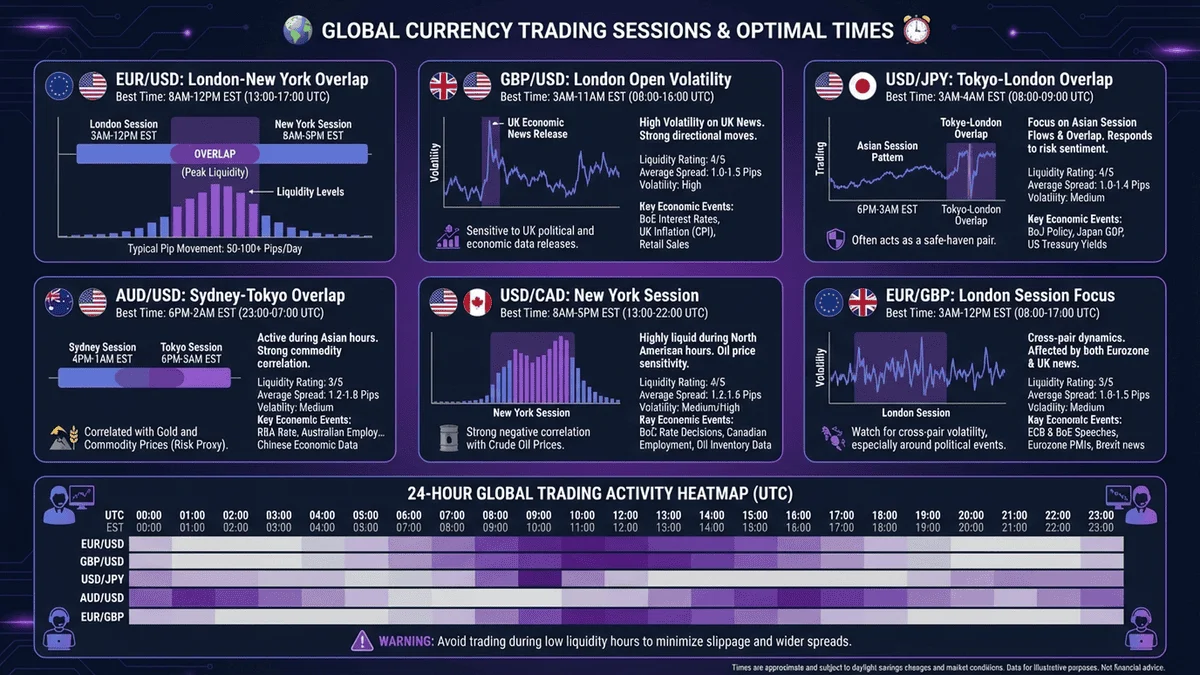
EUR/USD: The King of Forex
EUR/USD accounts for 23% of all forex trading volume, making it the most traded currency pair in the world. Its optimal trading times align with European and US business hours:
Prime Trading Windows:
1. London Open (3:00-4:00 AM EST)
- Volatility: Very High (50-80 pip average hourly range)
- Spread: 0.5-0.8 pips
- Opportunity: European traders return from overnight, reacting to news
- Strategy: Breakout trading on initial London move
2. London-New York Overlap (8:00 AM-12:00 PM EST) ⭐ BEST
- Volatility: Highest (60-100 pip average hourly range)
- Spread: 0.3-0.5 pips (tightest of the day)
- Opportunity: US economic data releases (8:30 AM EST), maximum liquidity
- Strategy: All strategies viable; scalping, day trading, news trading
3. US Session After London Close (12:00-3:00 PM EST)
- Volatility: Moderate (30-50 pip range)
- Spread: 0.8-1.2 pips
- Opportunity: US-specific news, afternoon position adjustments
- Strategy: Trend continuation or reversal trades
Times to Avoid EUR/USD:
- ❌ Sydney/Tokyo Sessions (5:00 PM - 3:00 AM EST): Low volume, wide spreads (1.5-2.5 pips), choppy price action
- ❌ Late NY Session (4:00-5:00 PM EST): Minimal volatility, position squaring before close
- ❌ Weekends (Friday 5 PM - Sunday 5 PM EST): Market closed, only specialist brokers offer quotes
GBP/USD: The High Volatility Pair
Known as "Cable," GBP/USD is the fourth most traded pair, famous for dramatic intraday swings reaching 100-150 pips. Best trading times:
Prime Trading Windows:
1. London Open (3:00-5:00 AM EST) ⭐ BEST FOR GBP
- Volatility: Extreme (80-120 pip average range)
- Spread: 0.8-1.2 pips
- Opportunity: UK economic releases (2:00 AM and 4:30 AM EST), market opens with gaps
- Strategy: Momentum trading, riding strong directional moves
2. London-New York Overlap (8:00 AM-11:00 AM EST)
- Volatility: Very High (70-110 pips)
- Spread: 0.6-1 pip
- Opportunity: US data impacts dollar side; continued from London session
- Strategy: Scalping during tight ranges, breakout when volatility spikes
3. Late London Session (10:00 AM-12:00 PM EST)
- Volatility: Moderate-High (50-80 pips)
- Spread: 0.8-1.5 pips
- Opportunity: London traders close positions before lunch
- Strategy: Reversal trading, fading extreme moves
GBP/USD Trader Warning: This pair's volatility cuts both ways. While 100-pip moves create profit opportunities, they also trigger stop losses quickly. Use wider stops (30-50 pips typical) and reduce position sizes compared to EUR/USD trades.
USD/JPY: The Asian Session Champion
USD/JPY is the second most traded pair (13.5% of volume), showing unique characteristics due to Tokyo's dominance:
Prime Trading Windows:
1. Tokyo Session (8:00 PM - 2:00 AM EST) ⭐ BEST FOR JPY
- Volatility: Moderate (30-50 pips)
- Spread: 0.5-0.8 pips
- Opportunity: Japanese economic data (6:50 PM and 8:30 PM EST releases), Bank of Japan activity
- Strategy: Range trading, technical level bounces
2. Tokyo-London Overlap (3:00-4:00 AM EST)
- Volatility: Moderate-High (40-60 pips)
- Spread: 0.4-0.6 pips
- Opportunity: European traders enter, dual-market liquidity
- Strategy: Breakout trading as London volatility hits JPY positions
3. London Session (3:00 AM-8:00 AM EST)
- Volatility: Moderate-High (40-70 pips)
- Spread: 0.4-0.7 pips
- Opportunity: European trading volume adds liquidity
- Strategy: Continuation of Tokyo trends or reversal trading
4. New York Session (8:00 AM-12:00 PM EST)
- Volatility: Moderate (35-55 pips)
- Spread: 0.5-0.8 pips
- Opportunity: US data affects dollar side
- Strategy: USD-driven moves, less about JPY specifically
USD/JPY Special Considerations:
- Risk-off moves: During market stress, JPY strengthens rapidly as safe haven (can move 200+ pips in hours)
- Bank of Japan interventions: Rare but dramatic; can reverse 300-500 pip moves in minutes
- Correlation: Strong negative correlation with equity markets (S&P 500 down = JPY up)
Market Overlap Trading Strategies
Strategy 1: London-New York Overlap Momentum Trading
The 8 AM-12 PM EST window offers the highest probability setups due to maximum liquidity and volatility.
Setup Requirements:
- Currency Pairs: EUR/USD, GBP/USD (primary); USD/CHF, USD/CAD (secondary)
- Timeframe: 5-minute or 15-minute charts
- Indicators: Moving Averages (20 EMA, 50 EMA), RSI, Volume
Entry Rules:
1. Identify pre-overlap trend (3-8 AM EST London session): Is EUR/USD trending up/down or ranging?
2. Wait for 8:30 AM EST (major US economic data release time)
3. Confirm momentum continuation: Price breaks previous hour high/low with increased volume
4. Enter on pullback: Don't chase; wait for 20 EMA retest on 5-min chart
5. Stop loss: 15-20 pips below entry for EUR/USD; 25-30 pips for GBP/USD
Exit Rules:
- Target 1 (50% position): 20-30 pips profit
- Target 2 (30% position): 40-60 pips profit
- Target 3 (20% position): Trail stop at 20 EMA until 12 PM EST London close
Why It Works: US economic data at 8:30 AM EST injects volatility into already-active London session, creating powerful directional moves. Combined liquidity from both markets reduces slippage and allows larger position sizes.
Strategy 2: Tokyo Range Breakout
The Tokyo session (8 PM-3 AM EST) typically establishes ranges that break during London open.
Setup Requirements:
- Currency Pairs: USD/JPY, AUD/JPY, EUR/JPY
- Timeframe: 1-hour charts
- Indicators: Support/Resistance levels, Bollinger Bands
Entry Rules:
1. Identify Tokyo range (8 PM-2 AM EST): Mark high and low of the range
2. Wait for London open (3 AM EST)
3. Breakout confirmation: Price closes above/below Tokyo range with strong candle (body > 50% of candle)
4. Enter on retest (optional conservative approach): Wait for pullback to broken level
5. Stop loss: Inside Tokyo range (10-15 pips below range low for long, above range high for short)
Exit Rules:
- Target: 1.5-2x the Tokyo range size
- Example: If Tokyo range was 40 pips, target 60-80 pip move
- Trail stop: Once up 30 pips, move stop to breakeven
Why It Works: Tokyo's lower volume creates consolidation. London's higher volume provides the catalyst to break and run. Classic breakout mechanics.
Strategy 3: Dead Zone Avoidance and Session Close Fading
The period between 4 PM-7 PM EST (after New York close, before Tokyo peaks) is the forex "dead zone"—lowest volume and directionality.
What NOT to Do:
- ❌ Don't initiate new positions (wide spreads, low liquidity)
- ❌ Don't expect strong directional moves (typical range: 10-20 pips)
- ❌ Don't use tight stops (random price fluctuations)
What TO Do (Advanced):
- Fade extreme moves from NY session: If EUR/USD moved 100+ pips during NY, expect 20-30% retracement during dead zone
- Use wide stops: 30-40 pip stops minimum due to low liquidity causing erratic price action
- Target small profits: 15-25 pips realistic; don't expect trending moves
Better Alternative: Stay out and wait for Tokyo session to establish direction (8 PM EST onward).
Time Zone Conversion Tools for Traders
Essential Features for Forex Traders
Generic time zone converters don't meet forex traders' specialized needs. Look for these features:
Must-Have:
- ✅ Forex session markers: Visual indicators showing Sydney/Tokyo/London/NY sessions
- ✅ Market open/close alerts: Notifications when major sessions begin
- ✅ Multiple timezone display: Show 3-4 timezones simultaneously (EST, GMT, JST, AEDT)
- ✅ Economic calendar integration: Highlight high-impact news release times
- ✅ DST automatic adjustment: Forex never stops for Daylight Saving Time confusion
Advanced Features:
- 🎯 Pip volatility indicators: Show average pip range by hour
- 🎯 Spread tracking: Display typical spreads for different sessions
- 🎯 Session overlap highlighting: Visual emphasis on London-NY overlap
- 🎯 Historical volatility data: Compare current hour to historical averages
⭐⭐⭐ Use Our Forex-Optimized Time Zone Converter Tool →
Recommended Tools for Forex Traders
| Tool | Best For | Forex-Specific Features | Price |
|---|---|---|---|
| Forex Market Hours | Session tracking | Visual session clock, volatility heat map | Free |
| MetaTrader 4/5 | All-in-one | Built-in session markers, economic calendar | Free (with broker) |
| TradingView | Charting + time | Session indicators, multi-timezone charts | Free-$59.95/mo |
| Forex Factory Calendar | News timing | Economic event scheduler with timezone conversion | Free |
| Our Time Zone Converter | Quick conversion | Multi-zone display, no signup | Free |
Trading Across Daylight Saving Time Changes
Challenge: Different regions transition to DST on different dates:
- US/Canada: Second Sunday in March, first Sunday in November
- Europe: Last Sunday in March, last Sunday in October
- Australia: First Sunday in October, first Sunday in April
- Japan: No DST
Impact on Trading:
- London-NY overlap shifts by 1 hour for 2-3 weeks in March and October
- Broker platform times may or may not adjust (depends on broker timezone)
- Economic data release times stay consistent in their local timezone
Solution:
1. Use UTC reference: London session always opens at 8:00 AM GMT (or 7:00 AM BST during UK DST)
2. Check broker timezone: MT4/MT5 platforms often use GMT+2 or GMT+3; understand your broker's convention
3. Update calendars manually: Don't rely on recurring calendar events; update when DST changes
4. Follow economic calendar tools: Forex Factory and similar automatically adjust news times
⭐⭐ Related: Understanding UTC Time Zone →
Common Forex Trading Time Zone Mistakes
Mistake 1: Trading Outside Your Strategy's Optimal Session
Scenario: You have a scalping strategy designed for high liquidity (tested during London-NY overlap), but you use it during Tokyo session because you're awake then.
Why It Fails:
- Different sessions have different characteristics (volatility, spread, liquidity)
- Tokyo's 30-pip average hourly range doesn't support strategies requiring 50-pip moves
- Spreads widen from 0.5 pips to 1.5 pips, eating into scalping profits
Solution:
- Match your strategy to appropriate session
- Develop different strategies for different sessions
- Use forward-tested results specific to each session's characteristics
- If you must trade Tokyo from US timezone, create Tokyo-specific strategies (range trading, not momentum)
Mistake 2: Ignoring Economic Data Release Times
Scenario: You enter a EUR/USD trade at 8:25 AM EST, unaware that US Non-Farm Payrolls releases at 8:30 AM.
Why It Fails:
- High-impact news can move EUR/USD 100+ pips in seconds
- Spreads widen dramatically during releases (0.5 pips → 5-10 pips)
- Stop losses get triggered by volatility spikes that then reverse
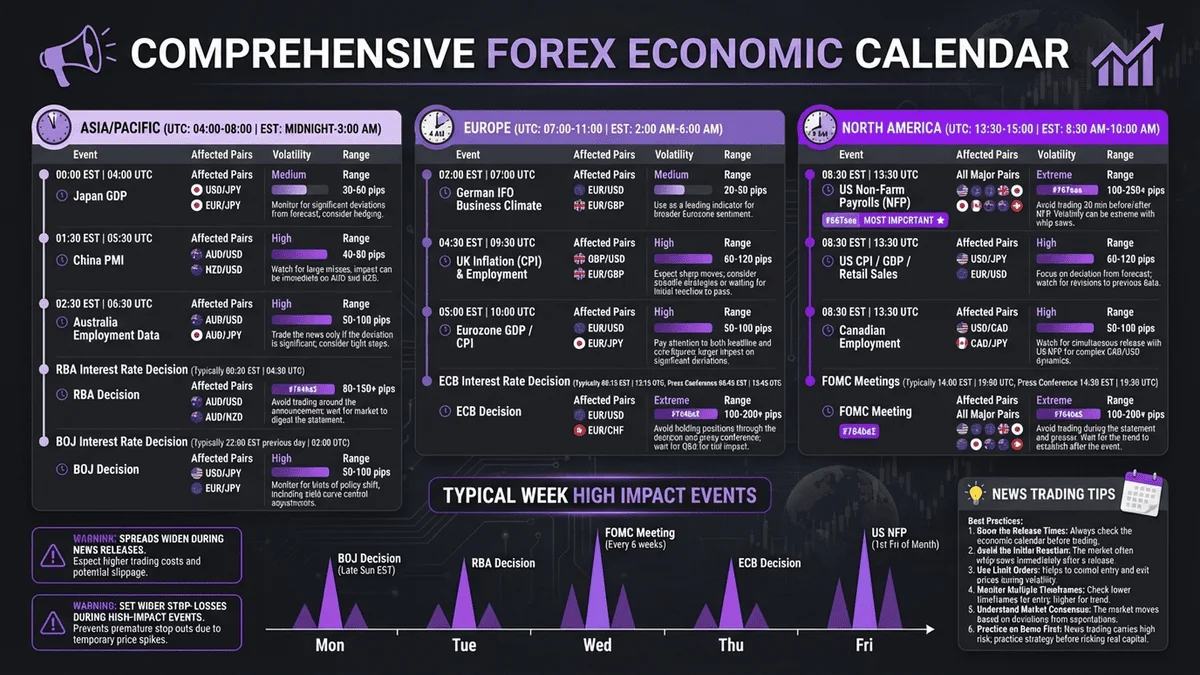
Major Release Times (EST):
- US Data: 8:30 AM (employment, CPI, retail sales); 10:00 AM (consumer confidence, housing)
- European Data: 3:00-5:00 AM (CPI, GDP, PMI from various EU countries)
- UK Data: 2:00 AM and 4:30 AM (employment, CPI, Bank of England statements)
- Japanese Data: 6:50 PM and 8:30 PM (GDP, Tankan survey, trade balance)
Solution:
- Check economic calendar every morning before trading
- Avoid entering positions 5-10 minutes before high-impact releases
- Either trade the news deliberately (with proper strategy) or stay out entirely
- Set wider stops if holding through data releases (or close positions)
Mistake 3: Misjudging Weekend Gap Risk
Scenario: You hold a USD/JPY position over the weekend. Markets open Sunday 5 PM EST with a 150-pip gap due to North Korean missile test over weekend.
Why It Happens:
- Forex closes Friday 5 PM EST but world events don't stop
- Sydney opens Sunday 5 PM EST with price reflecting weekend news
- Gaps can be 50-300 pips depending on event severity
- Your stop loss doesn't work (market jumps past it)
High-Risk Events for Weekend Gaps:
- Geopolitical crises (military actions, terrorist attacks)
- Emergency central bank meetings or statements
- Natural disasters affecting major economies
- Elections and political upheavals
Solution:
- Close all positions before Friday 5 PM EST unless you accept gap risk
- Use extremely wide stops if you must hold (100+ pips)
- Reduce position size to account for gap potential
- Avoid holding CHF/JPY over weekends (safe havens gap most dramatically)
Frequently Asked Questions (FAQ)
1. What is the best time to trade forex?
The best time to trade forex is during the London-New York overlap (8:00 AM - 12:00 PM EST), when 40-50% of daily forex volume occurs. This 4-hour window offers the tightest spreads (0.3-0.5 pips for EUR/USD), highest liquidity, and most significant price movements (60-100 pips average hourly range). For EUR/USD and GBP/USD traders, this is the optimal period. Asian session traders should focus on Tokyo hours (8:00 PM - 2:00 AM EST) for USD/JPY and JPY crosses.
2. What time does the forex market open and close?
The forex market opens Sunday 5:00 PM EST (when Sydney opens) and closes Friday 5:00 PM EST (when New York closes), creating a continuous 24-hour, 5-day-per-week trading environment. However, specific trading sessions have distinct hours: Sydney (5 PM-2 AM EST), Tokyo (7 PM-4 AM EST), London (3 AM-12 PM EST), and New York (8 AM-5 PM EST). Markets are closed from Friday 5 PM to Sunday 5 PM EST each week.
3. Why are spreads wider during certain forex sessions?
Spreads widen during low-liquidity periods (like the "dead zone" between 4-7 PM EST after New York closes and before Tokyo peaks) because fewer market participants means less competition among liquidity providers. During peak sessions like the London-New York overlap, hundreds of banks and institutions compete to offer the best prices, compressing spreads to 0.3-0.5 pips for EUR/USD. During Sydney session, spreads can reach 2-3 pips for the same pair due to minimal volume.
4. Should I trade forex during the Asian session from the US?
Only if you develop Asia-session-specific strategies. The Tokyo session (7 PM-4 AM EST) has fundamentally different characteristics than London/NY: lower volatility (30-50 pip average ranges), wider spreads, and range-bound price action. Strategies designed for London's breakout trading won't work in Tokyo's range environment. If you're in the US and must trade Tokyo hours, focus on USD/JPY, AUD/JPY, and other Asia-Pacific pairs using range-trading strategies.
5. What happens to forex prices over the weekend?
Forex markets close Friday 5:00 PM EST and reopen Sunday 5:00 PM EST, but world events continue. If significant news occurs over the weekend (geopolitical events, natural disasters, emergency central bank actions), the market reopens with a gap—the price jumps from Friday's close to Sunday's open, sometimes 50-300 pips away. Your stop losses don't activate during this gap; the market simply opens beyond your stop level, resulting in larger-than-intended losses. This is why many traders close positions before weekends.
6. How do I convert forex trading times to my local timezone?
Use a forex-specific time zone converter that displays multiple major sessions (EST, GMT, JST, AEDT) simultaneously. Our free time zone converter tool is optimized for traders. Key conversion: London session opens at 3:00 AM EST / 8:00 AM GMT / 5:00 PM JST / 7:00 PM AEDT. The London-New York overlap is 8:00 AM-12:00 PM EST / 1:00 PM-5:00 PM GMT. Remember that Daylight Saving Time shifts these by 1 hour during transitions (March-April and October-November).
7. Which currency pairs are best to trade during London session?
EUR/USD and GBP/USD dominate London session trading, accounting for over 50% of volume during European hours. These pairs see their highest volatility and tightest spreads during London hours (3:00 AM-12:00 PM EST). EUR/GBP is exclusively a London play, as both currencies are European. USD/CHF also sees significant London activity. Avoid trading AUD/USD or NZD/USD during London—their optimal times are during Sydney/Tokyo sessions when Australian markets are active.
8. How does Daylight Saving Time affect forex trading?
DST changes create temporary misalignments between major sessions because different regions transition on different dates. For example, when the US enters DST in March but Europe hasn't yet transitioned, the London-New York overlap shortens by 1 hour for 2-3 weeks. Japan doesn't observe DST at all, so the Tokyo-London overlap shifts permanently when UK changes clocks. Use UTC-based timing to avoid confusion: London always opens at 08:00 GMT (07:00 BST during UK summer time), regardless of US DST status.
9. What is the quietest time in forex trading?
The "dead zone" between 4:00-7:00 PM EST is the quietest forex period. After New York closes (5 PM EST) and before Tokyo peaks (8 PM EST), volume drops to daily lows. Sydney is open but accounts for less than 5% of global volume. During this window, EUR/USD spreads widen to 1.5-2.5 pips, average hourly range drops to 10-15 pips, and price action becomes choppy and directionless. Professional traders either avoid this period entirely or use it only for mean-reversion strategies with wide stops.
10. Can I scalp forex during all trading sessions?
No—scalping requires tight spreads and high liquidity, available only during major sessions (especially London-New York overlap). During Sydney session, EUR/USD spreads of 2-3 pips make scalping unprofitable; you'd need 5-6 pip moves just to break even. Successful scalpers focus on the London open (3-5 AM EST) and London-NY overlap (8 AM-12 PM EST) when EUR/USD spreads compress to 0.3-0.5 pips and volatility provides 60-100 pip hourly ranges. If you must scalp outside these hours, switch to long-term strategies or sit out.
11. How do economic news releases interact with trading sessions?
Major economic data releases are timed to each region's market hours: US data releases at 8:30 AM and 10:00 AM EST (during NY session), UK data at 2:00 AM and 4:30 AM EST (during London session), and Japanese data at 6:50 PM and 8:30 PM EST (during Tokyo session). The most volatile events occur when high-impact US data releases during the London-New York overlap (8:30 AM EST Non-Farm Payrolls, CPI, FOMC) because both markets are active, multiplying the volatility impact. Check economic calendars daily to avoid unexpected volatility.
12. What forex trading strategy works best for each session?
Match your strategy to session characteristics: Tokyo (7 PM-4 AM EST) favors range trading and technical level bounces due to lower volatility and defined ranges; London (3 AM-12 PM EST) excels for breakout and momentum strategies as European volume creates strong directional moves; London-NY Overlap (8 AM-12 PM EST) supports all strategies (scalping, day trading, news trading) due to maximum liquidity; Late NY (12 PM-5 PM EST) suits mean-reversion and counter-trend strategies as trends exhaust. Avoid using momentum strategies during Sydney/dead zone hours—they'll fail due to insufficient volatility.
Conclusion: Timing Is Everything in Forex
Key Takeaways
Forex trading success isn't just about what you trade or how you trade—when you trade determines 60% of your profitability potential:
-
The London-New York overlap (8 AM-12 PM EST) is the golden window: 40-50% of daily volume, 0.3-0.5 pip spreads, and 60-100 pip hourly ranges create ideal conditions for all trading strategies.
-
Match your strategy to the session: Momentum and breakout strategies thrive during London/NY hours; range-trading strategies work in Tokyo; scalping requires London-NY overlap liquidity; mean-reversion suits late NY session.
-
Avoid the dead zone (4-7 PM EST): After New York closes and before Tokyo peaks, spreads widen 3-5x, volatility drops 70%, and price action becomes unpredictable. Stay out or trade entirely different strategies.
-
Economic data releases amplify session volatility: US data at 8:30 AM EST during London-NY overlap creates explosive moves (100+ pips in minutes). Either trade the news deliberately with proper preparation or stay out completely—there's no middle ground.
-
Use forex-specific time zone tools: Generic converters don't show session overlaps, volatility patterns, or economic event timing. Specialized forex tools save hours of calculation and prevent costly timing errors.
The forex market's 24/5 operation creates an illusion that you can trade anytime. The reality: 80% of opportunities concentrate in 33% of trading hours (London and London-NY overlap periods). Professional traders structure their schedules around these high-probability windows rather than forcing trades during sub-optimal hours.
Your Action Plan
Immediate Steps:
- 🕐 Identify your available trading hours and match them to appropriate forex sessions
- 📊 Backtest your strategies by session to verify they work during the hours you can trade
- 🔔 Set session alerts for London open (3 AM EST) and London-NY overlap start (8 AM EST)
Weekly Routine:
- 📅 Check economic calendar every Sunday night for the week's high-impact news
- 🎯 Plan which sessions you'll trade based on your schedule and strategy
- 📝 Journal trades by session to identify your highest-win-rate hours
Long-term Development:
- 🧪 Develop session-specific strategies: one for London, one for Tokyo, one for overlaps
- 📊 Track performance by session to focus on your most profitable times
- 🔄 Adjust your schedule (if possible) to align with your best-performing sessions
The difference between break-even traders and consistently profitable traders often comes down to session selection. When you trade during London-NY overlap with appropriate strategies, you're competing with favorable odds. Trading during Sydney session with London-optimized strategies puts you at immediate disadvantage before you even enter a position.
⭐⭐⭐ Start Tracking Forex Sessions with Our Free Time Zone Tool →
Master the timing, and you've solved half the forex puzzle. The rest—strategy, risk management, psychology—becomes dramatically easier when you're trading during high-probability hours with tight spreads and predictable volatility patterns.
Related Resources
- Time Zone Converter Complete Guide - Master all aspects of time zone conversion
- Meeting Planner for Global Teams - Coordinate across multiple time zones
- US Time Zones Guide - Understanding EST, PST, and DST for NY session
- UTC Time Zone Guide - Use UTC as stable reference for forex timing
- Browse All Conversion Tools - Explore our complete suite of conversion utilities