美國時區完整指南
US Time Zones Complete Guide: EST, PST, CST, MST Conversion (2025)
Planning a call with someone in another US state and not sure what time it is there? You're not alone—the United States spans six primary time zones, and millions of Americans struggle with cross-timezone scheduling daily. Miss a 3 PM PST meeting because you thought it was EST? You've just lost 3 hours and possibly a critical opportunity.
Here's what makes US time zones tricky: Not only do you have four main zones to remember (EST, CST, MST, PST), but Daylight Saving Time shifts everything twice a year—and not all states follow the same rules. Arizona stays on MST year-round while neighboring New Mexico switches to MDT. Confused yet?
This comprehensive guide eliminates the confusion. You'll learn each US time zone, how to convert between them instantly, and which states follow which rules. Plus, we'll cover the 2025 Daylight Saving Time schedule so you never miss another meeting.
← Complete Time Zone Converter Guide
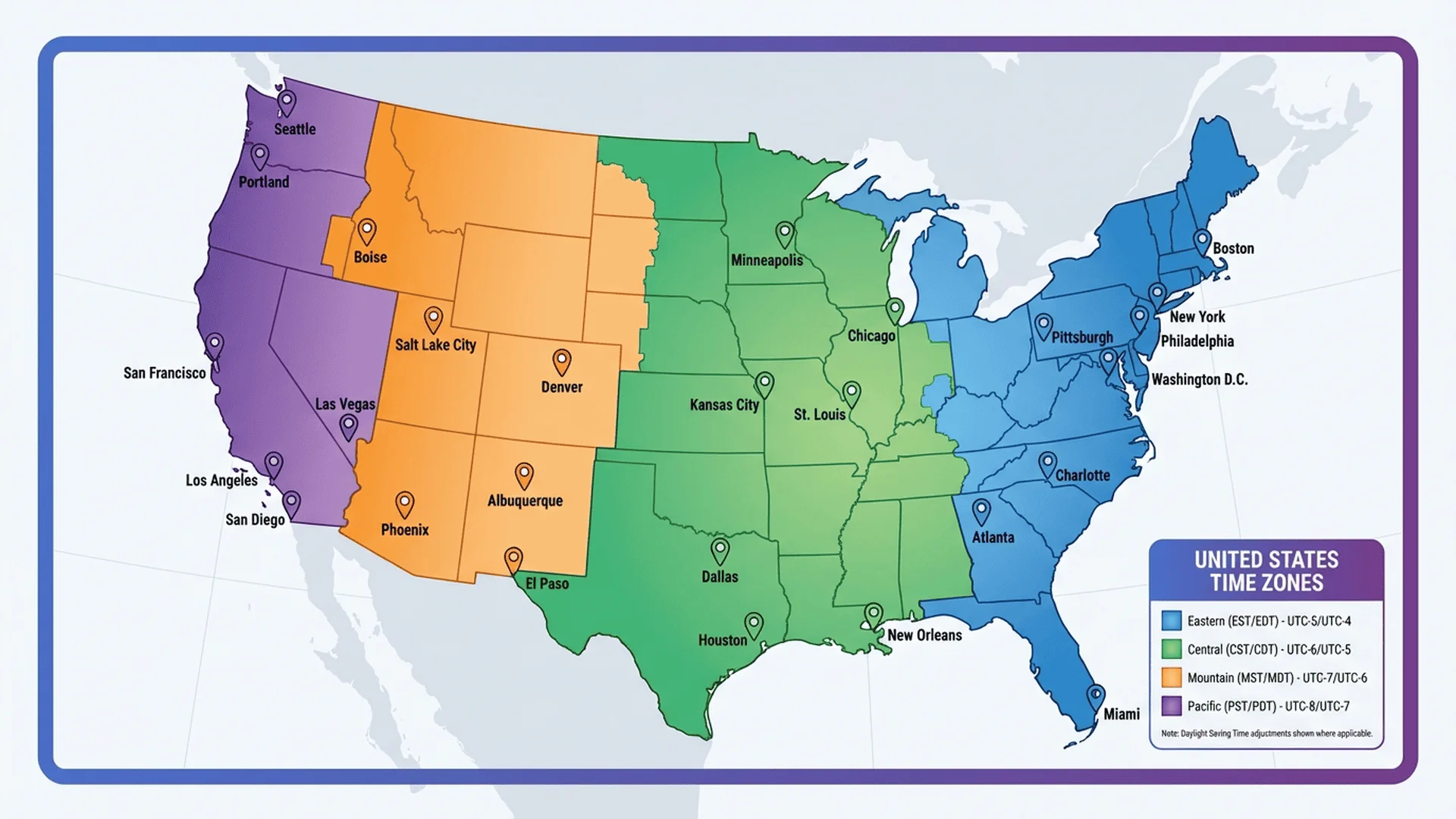
Overview of US Time Zones
The Four Main US Time Zones
The United States continental territory spans four primary time zones:
1. Eastern Time (ET)
- Standard: EST - Eastern Standard Time (UTC-5)
- Daylight: EDT - Eastern Daylight Time (UTC-4)
- Coverage: 23 states (fully or partially)
- Population: ~47% of US population
- Major cities: New York City, Miami, Atlanta, Washington D.C., Boston, Philadelphia
2. Central Time (CT)
- Standard: CST - Central Standard Time (UTC-6)
- Daylight: CDT - Central Daylight Time (UTC-5)
- Coverage: 20 states (fully or partially)
- Population: ~32% of US population
- Major cities: Chicago, Houston, Dallas, New Orleans, San Antonio, Austin
3. Mountain Time (MT)
- Standard: MST - Mountain Standard Time (UTC-7)
- Daylight: MDT - Mountain Daylight Time (UTC-6)
- Coverage: 13 states (fully or partially)
- Population: ~7% of US population
- Major cities: Denver, Phoenix (no DST), Salt Lake City, Albuquerque, Boise
4. Pacific Time (PT)
- Standard: PST - Pacific Standard Time (UTC-8)
- Daylight: PDT - Pacific Daylight Time (UTC-7)
- Coverage: 4 states + parts of others
- Population: ~14% of US population
- Major cities: Los Angeles, San Francisco, Seattle, San Diego, Portland, Las Vegas (MST)
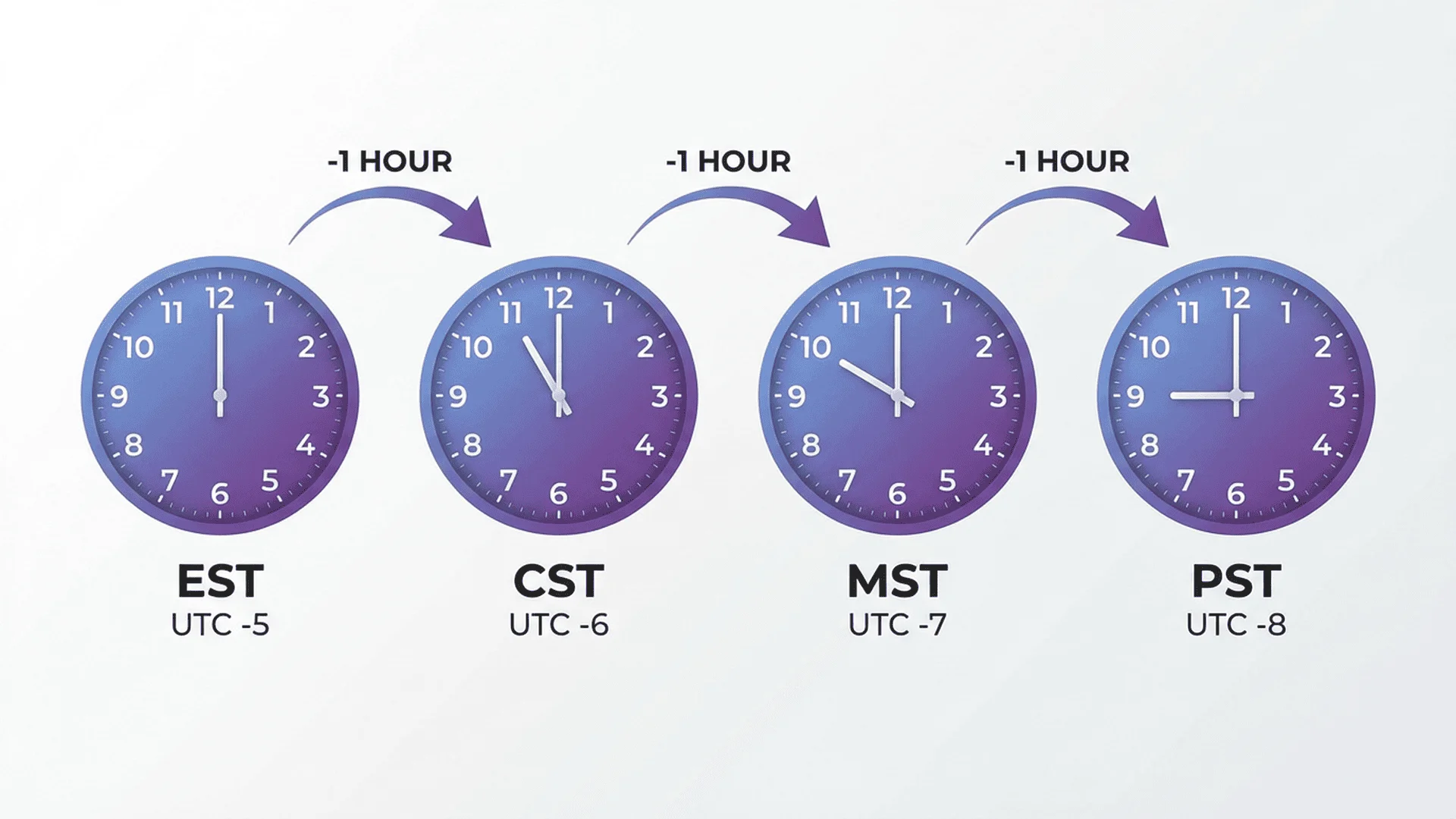
Time differences between zones (constant year-round):
| From/To | EST | CST | MST | PST |
|---|---|---|---|---|
| EST | 0 | -1h | -2h | -3h |
| CST | +1h | 0 | -1h | -2h |
| MST | +2h | +1h | 0 | -1h |
| PST | +3h | +2h | +1h | 0 |
Example: When it's 12:00 PM (noon) EST:
- 11:00 AM CST
- 10:00 AM MST
- 9:00 AM PST
Additional US Time Zones
Beyond the four main zones:
Alaska Time
- Standard: AKST - Alaska Standard Time (UTC-9)
- Daylight: AKDT - Alaska Daylight Time (UTC-8)
- Coverage: Most of Alaska
- Difference: 1 hour behind Pacific Time
Hawaii-Aleutian Time
- Standard: HST - Hawaii Standard Time (UTC-10)
- No Daylight Saving Time
- Coverage: Hawaii and westernmost Aleutian Islands
- Difference: 2 hours behind Pacific Time (year-round during PST), 3 hours behind PDT
Special Cases:
Samoa Time
- UTC-11 (American Samoa, Midway Atoll)
- 2 hours behind Hawaii
Chamorro Time
- UTC+10 (Guam, Northern Mariana Islands)
- 5 hours ahead of Hawaii (crossing the International Date Line)
Atlantic Time (Not US, but relevant)
- Used in Puerto Rico and US Virgin Islands
- AST: UTC-4 (no DST)
- 1 hour ahead of EST
Eastern Time Zone (EST/EDT)
The Eastern Time Zone is the most populous and economically significant zone in the United States.
Coverage and Major Cities
States entirely in Eastern Time:
- Connecticut, Delaware, Georgia, Maine, Maryland
- Massachusetts, New Hampshire, New Jersey, New York
- North Carolina, Ohio, Pennsylvania, Rhode Island
- South Carolina, Vermont, Virginia, West Virginia
States partially in Eastern Time:
- Florida (most of it; small western part in Central)
- Indiana (most of it; northwest and southwest corners in Central)
- Kentucky (eastern 80%; western portion in Central)
- Michigan (most of it; western Upper Peninsula in Central)
- Tennessee (eastern portion; most in Central)
Major metropolitan areas:
- New York City - Financial capital, 8.3 million metro population
- Philadelphia - 6.2 million metro
- Atlanta - 6.1 million metro, Southern business hub
- Boston - 4.9 million metro, education and tech center
- Miami - 6.2 million metro, Latin American business gateway
- Washington D.C. - 6.3 million metro, federal government
Economic significance:
- Wall Street (New York Stock Exchange, NASDAQ)
- Federal government operations
- Major media headquarters (TV networks, newspapers)
- Top universities (Ivy League, MIT, others)
Trading in US markets? Understanding Eastern Time is crucial for stock and forex trading. Our Forex Trading Time Zone Guide covers NYSE hours, market overlaps, and optimal trading windows for US time zones.
EST vs EDT: Understanding the Difference
Eastern Standard Time (EST):
- UTC Offset: UTC-5
- Active: Early November to mid-March
- Used when: Daylight Saving Time is NOT in effect
Eastern Daylight Time (EDT):
- UTC Offset: UTC-4
- Active: Mid-March to early November
- Used when: Daylight Saving Time IS in effect
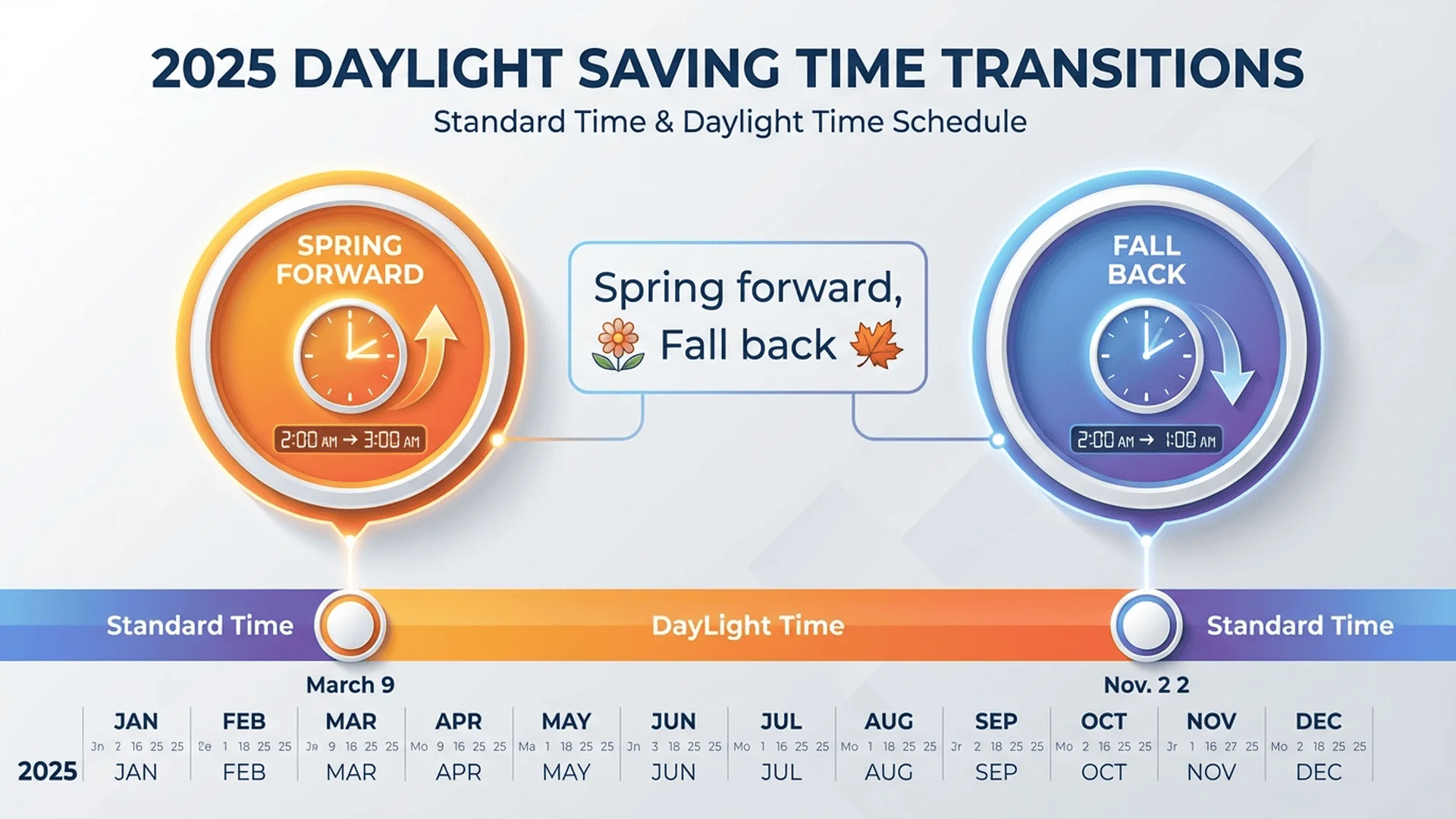
2025 Transition Dates:
- Spring Forward: March 9, 2025 at 2:00 AM → 3:00 AM EDT
- Fall Back: November 2, 2025 at 2:00 AM → 1:00 AM EST
Business hours impact:
Standard Time (Winter):
- 9 AM - 5 PM EST = 2 PM - 10 PM UTC
- London (GMT): 5 hours ahead
- Los Angeles (PST): 3 hours behind
Daylight Time (Summer):
- 9 AM - 5 PM EDT = 1 PM - 9 PM UTC
- London (BST): 5 hours ahead
- Los Angeles (PDT): 3 hours behind
Pro tip: The time difference between US East Coast and West Coast remains constant at 3 hours because both zones observe DST on the same dates.
Central Time Zone (CST/CDT)
Coverage and Business Implications
States entirely in Central Time:
- Alabama, Arkansas, Illinois, Iowa, Louisiana
- Minnesota, Mississippi, Missouri, Oklahoma, Wisconsin
States partially in Central Time:
- Florida (western panhandle)
- Indiana (northwest and southwest corners)
- Kansas (most of it; western portion in Mountain)
- Kentucky (western portion)
- Michigan (western Upper Peninsula)
- Nebraska (eastern portion; western in Mountain)
- North Dakota (most of it; western portion in Mountain)
- South Dakota (eastern portion; western in Mountain)
- Tennessee (most of it; eastern portion in Eastern)
- Texas (most of it; westernmost portions in Mountain)
Major metropolitan areas:
- Chicago - 9.6 million metro, 3rd largest US city, major financial center
- Dallas-Fort Worth - 7.6 million metro, business and tech hub
- Houston - 7.1 million metro, energy capital of the world
- San Antonio - 2.6 million metro
- Austin - 2.3 million metro, tech industry "Silicon Hills"
- Minneapolis-St. Paul - 3.7 million metro
- New Orleans - 1.3 million metro, major port city
Economic sectors:
- Energy: Houston (oil and gas)
- Finance: Chicago (derivatives trading, commodities)
- Agriculture: Midwest grain belt
- Manufacturing: Auto industry (Detroit area in ET, but many plants in CT)
- Technology: Austin, Dallas growing tech scenes
- Logistics: Central location, major freight hubs
CST vs CDT
Central Standard Time (CST):
- UTC Offset: UTC-6
- Active: Early November to mid-March
Central Daylight Time (CDT):
- UTC Offset: UTC-5
- Active: Mid-March to early November
Business hours coordination:
With Eastern Time:
- When EST: 9 AM CST = 10 AM EST
- When EDT: 9 AM CDT = 10 AM EDT
- Constant 1-hour difference
With Mountain Time:
- When MST: 9 AM CST = 8 AM MST
- When MDT: 9 AM CDT = 8 AM MDT
- Constant 1-hour difference
International business:
- 9 AM CST = 3 PM GMT (winter) or 2 PM BST (summer)
- 9 AM CDT = 2 PM GMT (winter) or 3 PM BST (summer)
Chicago Stock Exchange:
- Trading hours: 9:30 AM - 4:00 PM EST (8:30 AM - 3:00 PM CST)
- Aligned with New York Stock Exchange
Mountain Time Zone (MST/MDT)
Coverage and the Arizona Exception
States entirely in Mountain Time:
- Colorado, Montana, New Mexico, Wyoming
States partially in Mountain Time:
- Arizona (complicated - see below)
- Idaho (southern portion; northern in Pacific)
- Kansas (western portion)
- Nebraska (western portion)
- Nevada (very small northeastern corner; most in Pacific)
- North Dakota (western portion)
- Oregon (small portion)
- South Dakota (western portion)
- Texas (westernmost portions including El Paso)
- Utah (entire state)
Major metropolitan areas:
- Phoenix - 4.9 million metro (does NOT observe DST)
- Denver - 2.9 million metro
- Salt Lake City - 1.3 million metro
- Albuquerque - 0.9 million metro
- Boise - 0.7 million metro
- El Paso - 0.8 million metro (Texas, but uses MST)
The Arizona Time Zone Anomaly
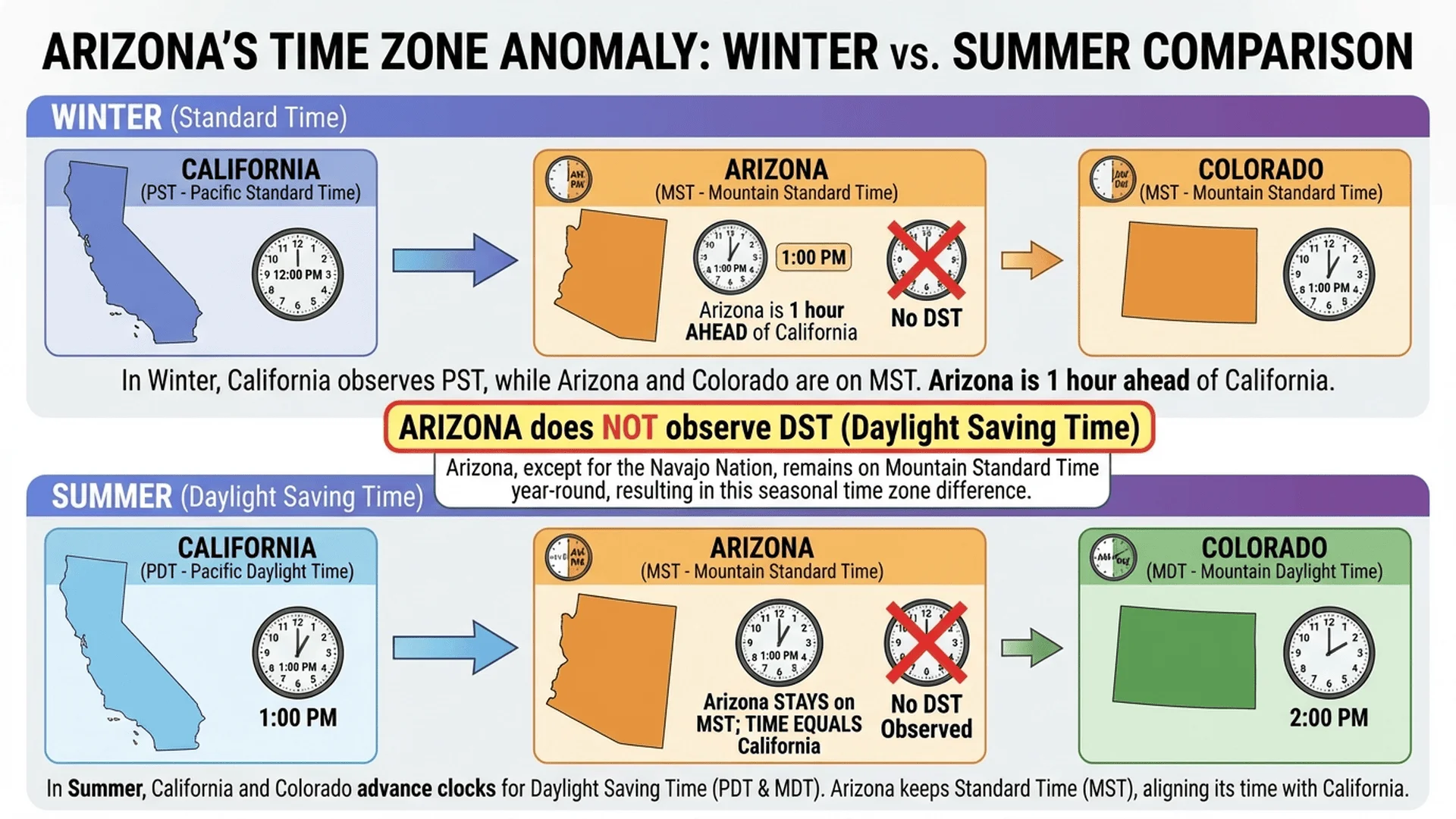
Arizona's unique situation:
Arizona (except Navajo Nation):
- Does NOT observe Daylight Saving Time
- Stays on MST (UTC-7) year-round
- Reason: More daylight in evening not desired in hot desert climate
Navajo Nation (within Arizona):
- DOES observe Daylight Saving Time
- Switches to MDT in summer
- Reason: Align with rest of Navajo Nation in New Mexico and Utah
What this means:
Winter (November - March):
- Arizona MST = Utah/New Mexico/Colorado MST
- Same time as neighboring states
Summer (March - November):
- Arizona stays MST (UTC-7)
- Neighbors switch to MDT (UTC-6)
- Arizona is 1 hour behind neighboring states
- Arizona is same time as Pacific Daylight Time (PDT)
Example (Summer):
- Los Angeles: 10:00 AM PDT (UTC-7)
- Phoenix: 10:00 AM MST (UTC-7) ← Same time
- Denver: 11:00 AM MDT (UTC-6) ← 1 hour ahead
Practical impact:
- Scheduling meetings between Phoenix and Denver requires careful attention to time of year
- Phoenix businesses often coordinate with California (same time in summer)
Pacific Time Zone (PST/PDT)
Tech Industry Significance
Pacific Time is the heartbeat of the US tech industry.
States primarily in Pacific Time:
- California
- Washington
- Oregon (except small eastern portion)
- Nevada (most of it; small northeast corner in Mountain)
Major metropolitan areas:
- Los Angeles - 13.2 million metro, 2nd largest US city, entertainment capital
- San Francisco Bay Area - 7.7 million metro, tech industry center
- Seattle - 4.0 million metro, home to Amazon, Microsoft
- San Diego - 3.3 million metro
- Portland - 2.5 million metro
- Las Vegas - 2.2 million metro (actually on MST, not PST!)
Economic powerhouses:
Silicon Valley (San Francisco Bay Area):
- Apple, Google, Meta, Netflix, Tesla, Intel
- Venture capital hub
- Startup ecosystem center
Seattle Area:
- Amazon, Microsoft, Starbucks, Boeing (moving)
- Cloud computing headquarters
Los Angeles:
- Hollywood entertainment industry
- Aerospace (SpaceX)
- Fashion, trade (Port of LA)
PST vs PDT
Pacific Standard Time (PST):
- UTC Offset: UTC-8
- Active: Early November to mid-March
Pacific Daylight Time (PDT):
- UTC Offset: UTC-7
- Active: Mid-March to early November
Business hours coordination:
With Eastern Time:
- 3-hour difference (constant year-round)
- 9 AM PST = 12 PM EST
- 9 AM PDT = 12 PM EDT
With Europe:
- 8-9 hour difference depending on DST alignment
- 9 AM PST = 5 PM GMT (winter overlap)
- 9 AM PDT = 5 PM BST (summer overlap)
Tech industry work patterns:
Early starts common:
- Many West Coast tech workers start 7-8 AM to overlap with East Coast
- 7 AM PST = 10 AM EST (reasonable for both)
Late meetings inevitable:
- International calls often 5-7 PM PST
- 6 PM PST = 2 AM GMT+0 (tough for Europe)
💻 Instant Time Zone Conversion: Use our Time Zone Converter to quickly convert between PST/PDT and any other US or international time zone. Perfect for scheduling meetings across the country or around the world. Select your cities and get instant, accurate results—completely free, no registration required.
Daylight Saving Time in the US
2025 Daylight Saving Time Schedule
Spring Forward (Start of DST):
- Date: Sunday, March 9, 2025
- Time: 2:00 AM local time
- Change: Clocks "spring forward" to 3:00 AM
- Effect: Lose 1 hour of sleep
- Sunrise/Sunset: Later (more evening daylight)
Fall Back (End of DST):
- Date: Sunday, November 2, 2025
- Time: 2:00 AM local time
- Change: Clocks "fall back" to 1:00 AM
- Effect: Gain 1 hour of sleep
- Sunrise/Sunset: Earlier (more morning light)
Mnemonic: "Spring forward, Fall back"
States and Territories That Do NOT Observe DST
Arizona:
- Stays on MST year-round (UTC-7)
- Exception: Navajo Nation does observe DST
Hawaii:
- Stays on HST year-round (UTC-10)
- No DST ever implemented
US Territories (No DST):
- Puerto Rico (Atlantic Standard Time, UTC-4)
- US Virgin Islands (Atlantic Standard Time, UTC-4)
- American Samoa (Samoa Standard Time, UTC-11)
- Guam (Chamorro Standard Time, UTC+10)
- Northern Mariana Islands (Chamorro Standard Time, UTC+10)
Why these regions skip DST:
- Tropical locations: Near equator, daylight hours don't vary much seasonally
- Arizona: Extra evening daylight in summer undesirable (already very hot)
- Practical: Reduces confusion, energy arguments unclear
Historical Context and Future of DST
DST History in the US:
- 1918: First implemented during WWI (energy conservation)
- 1945-1966: No federal standard, local areas decided
- 1966: Uniform Time Act standardized DST nationally
- 2007: Energy Policy Act extended DST (starts earlier, ends later)
Current debate:
- Permanent DST proposals: "Sunshine Protection Act" (not yet law)
- Abolish DST proposals: Return to standard time year-round
- Status: Ongoing debate, no changes for 2025
If DST were made permanent (proposed):
- No more clock changes
- Year-round daylight time offsets (EDT, CDT, MDT, PDT)
- Would mean darker winter mornings, brighter evenings
US Time Zone Conversion Examples
Quick Conversion Reference Table
Time Conversion Chart (all times shown in standard time; adjust +1 hour when DST is active):
| EST | CST | MST | PST | AKST | HST |
|---|---|---|---|---|---|
| 6:00 AM | 5:00 AM | 4:00 AM | 3:00 AM | 2:00 AM | 1:00 AM |
| 7:00 AM | 6:00 AM | 5:00 AM | 4:00 AM | 3:00 AM | 2:00 AM |
| 8:00 AM | 7:00 AM | 6:00 AM | 5:00 AM | 4:00 AM | 3:00 AM |
| 9:00 AM | 8:00 AM | 7:00 AM | 6:00 AM | 5:00 AM | 4:00 AM |
| 10:00 AM | 9:00 AM | 8:00 AM | 7:00 AM | 6:00 AM | 5:00 AM |
| 11:00 AM | 10:00 AM | 9:00 AM | 8:00 AM | 7:00 AM | 6:00 AM |
| 12:00 PM | 11:00 AM | 10:00 AM | 9:00 AM | 8:00 AM | 7:00 AM |
| 1:00 PM | 12:00 PM | 11:00 AM | 10:00 AM | 9:00 AM | 8:00 AM |
| 2:00 PM | 1:00 PM | 12:00 PM | 11:00 AM | 10:00 AM | 9:00 AM |
| 3:00 PM | 2:00 PM | 1:00 PM | 12:00 PM | 11:00 AM | 10:00 AM |
| 4:00 PM | 3:00 PM | 2:00 PM | 1:00 PM | 12:00 PM | 11:00 AM |
| 5:00 PM | 4:00 PM | 3:00 PM | 2:00 PM | 1:00 PM | 12:00 PM |
| 6:00 PM | 5:00 PM | 4:00 PM | 3:00 PM | 2:00 PM | 1:00 PM |
Remember: During DST (March-November), add the suffix "DT" (EDT, CDT, MDT, PDT) but the time differences remain the same.
Common Conversion Scenarios
EST to PST:
- Difference: 3 hours (PST is 3 hours behind)
- Example: 2:00 PM EST = 11:00 AM PST
- Business hours overlap: 12:00 PM - 5:00 PM EST = 9:00 AM - 2:00 PM PST
CST to MST:
- Difference: 1 hour (MST is 1 hour behind)
- Example: 3:00 PM CST = 2:00 PM MST
- Business hours overlap: 9:00 AM - 5:00 PM CST = 8:00 AM - 4:00 PM MST
EST to CST:
- Difference: 1 hour (CST is 1 hour behind)
- Example: 10:00 AM EST = 9:00 AM CST
- Business hours overlap: 9:00 AM - 5:00 PM EST = 8:00 AM - 4:00 PM CST
MST to PST:
- Difference: 1 hour (PST is 1 hour behind)
- Example: 1:00 PM MST = 12:00 PM PST
- Exception: Arizona (no DST) same time as PDT in summer
All zones to UTC:
- EST: UTC-5 (add 5 hours to get UTC)
- CST: UTC-6 (add 6 hours)
- MST: UTC-7 (add 7 hours)
- PST: UTC-8 (add 8 hours)
Special Case: Arizona Conversions
Winter (Standard Time):
- Arizona MST = Mountain Standard Time (same as MT neighbors)
- Phoenix time = Denver time
Summer (Daylight Time):
- Arizona stays MST (doesn't change)
- Neighbors switch to MDT
- Phoenix MST = Los Angeles PDT (same time)
- Phoenix MST is 1 hour behind Denver MDT
Conversion examples (Summer):
| Time in... | Arizona (MST) | California (PDT) | Colorado (MDT) |
|---|---|---|---|
| 9:00 AM in Phoenix | 9:00 AM | 9:00 AM | 10:00 AM |
| 12:00 PM in Los Angeles | 12:00 PM | 12:00 PM | 1:00 PM |
| 3:00 PM in Denver | 2:00 PM | 2:00 PM | 3:00 PM |
💻 Automated Conversion Tool: Confused by Arizona's time zone? Our Time Zone Converter automatically handles Arizona's unique DST rules. Simply select "Phoenix" and your destination city—the tool accounts for whether DST is active or not. Fast, accurate, and free.
Need to coordinate meetings across multiple US time zones? Check our Meeting Planner Time Zone Converter Guide for strategies on finding optimal meeting times, scheduling tools integration, and best practices for cross-timezone collaboration.
Frequently Asked Questions (FAQ)
1. What are the 4 main US time zones?
The four primary US time zones are:
- Eastern Time (ET) - EST/EDT (UTC-5/-4)
- Central Time (CT) - CST/CDT (UTC-6/-5)
- Mountain Time (MT) - MST/MDT (UTC-7/-6)
- Pacific Time (PT) - PST/PDT (UTC-8/-7)
Additionally, the US has Alaska Time (AKST/AKDT, UTC-9/-8) and Hawaii Time (HST, UTC-10, no DST).
2. How many hours difference between EST and PST?
3 hours - Pacific Time is always 3 hours behind Eastern Time.
Examples:
- 12:00 PM (noon) EST = 9:00 AM PST
- 3:00 PM EST = 12:00 PM (noon) PST
- 6:00 PM EST = 3:00 PM PST
This difference remains constant year-round because both zones observe Daylight Saving Time on the same dates.
3. Does Arizona observe Daylight Saving Time?
No, Arizona does NOT observe Daylight Saving Time (with one exception).
Exception: The Navajo Nation (within Arizona) DOES observe DST.
What this means:
- Winter: Arizona (MST) = same time as neighboring Mountain states (MST)
- Summer: Arizona stays MST while neighbors switch to MDT (1 hour ahead)
- Summer quirk: Arizona (MST) = same time as California (PDT)
4. When does Daylight Saving Time start and end in 2025?
Start (Spring Forward):
- Date: Sunday, March 9, 2025
- Time: 2:00 AM → 3:00 AM
- Mnemonic: "Spring forward" (lose 1 hour)
End (Fall Back):
- Date: Sunday, November 2, 2025
- Time: 2:00 AM → 1:00 AM
- Mnemonic: "Fall back" (gain 1 hour)
5. What time zone is Chicago in?
Chicago is in Central Time (CT).
- Winter: CST - Central Standard Time (UTC-6)
- Summer: CDT - Central Daylight Time (UTC-5)
Chicago is 1 hour behind New York (Eastern Time) and 2 hours ahead of Los Angeles (Pacific Time).
6. Which states have multiple time zones?
13 states span multiple time zones:
- Alaska - Alaska Time and Hawaii-Aleutian Time
- Florida - Eastern and Central
- Idaho - Pacific and Mountain
- Indiana - Eastern and Central
- Kansas - Central and Mountain
- Kentucky - Eastern and Central
- Michigan - Eastern and Central
- Nebraska - Central and Mountain
- Nevada - Pacific and Mountain
- North Dakota - Central and Mountain
- Oregon - Pacific and Mountain
- South Dakota - Central and Mountain
- Tennessee - Eastern and Central
- Texas - Central and Mountain
Most populous states (California, New York, Illinois, Pennsylvania) are entirely in one zone.
7. What is the time difference between New York and Los Angeles?
3 hours - Los Angeles is always 3 hours behind New York.
Business hours overlap:
- 9 AM - 12 PM PST = 12 PM - 3 PM EST (3-hour window)
- Optimal meeting time: 12 PM EST = 9 AM PST (start of West Coast workday, midday East Coast)
Example scenarios:
- Wall Street opens (9:30 AM EST) = 6:30 AM PST (too early for West Coast)
- West Coast tech companies often start 7-8 AM PST to overlap with East Coast
8. Why doesn't Hawaii observe Daylight Saving Time?
Hawaii stays on Hawaii Standard Time (HST, UTC-10) year-round.
Reasons:
1. Proximity to equator - Daylight hours don't vary much seasonally
2. Consistent sunrise/sunset - Already optimal throughout year
3. No energy benefit - Original DST purpose doesn't apply
4. Tourism preference - Stable schedule better for visitors
Historical note: Hawaii never observed DST, even when mandated nationally (received exemption).
9. How do I convert EST to CST?
Simple method: Subtract 1 hour.
Formula:
CST = EST - 1 hour
Examples:
- 10:00 AM EST = 9:00 AM CST
- 2:00 PM EST = 1:00 PM CST
- 5:00 PM EST = 4:00 PM CST
During DST (summer):
- Same conversion applies (EDT to CDT)
- 10:00 AM EDT = 9:00 AM CDT
Business coordination:
- If meeting at 9 AM CST, invite EST participants for 10 AM EST
- Chicago business hours (9 AM - 5 PM CST) = NYC 10 AM - 6 PM EST
10. What states are in Pacific Time?
Primary Pacific Time states:
- California (entire state)
- Washington (entire state)
- Oregon (except small eastern portion in Mountain)
- Nevada (most of it; small northeast corner in Mountain)
Note: Nevada is mostly in Pacific Time, but Las Vegas and Reno are actually on Pacific Time. A common misconception is that Las Vegas is on Mountain Time (it's not).
Partial Pacific Time:
- Idaho (northern portion; southern in Mountain)
11. Can time zones split cities?
Very rarely, but it has happened historically.
Current examples:
- No major cities are split today
- Time zone boundaries generally follow county or state lines
Historical example:
- Some small communities near state borders have been split in the past
- Modern boundaries have been adjusted to avoid this
Closest case today:
- Kansas City spans Kansas (western portion) and Missouri (entire state), but both parts are now entirely in Central Time
- Some suburbs might be close to zone boundaries but not split through the middle
12. What is the earliest time zone in the US?
Easternmost: Chamorro Time (Guam, Northern Mariana Islands)
- UTC+10 (10 hours ahead of UTC)
- Across the International Date Line from mainland US
- When it's noon Monday in New York, it's 2 AM Tuesday in Guam
In continental/contiguous US: Eastern Time
- EST: UTC-5 or EDT: UTC-4
- Earliest time in the 48 contiguous states
Comparison:
- 12:00 PM EST (noon) in New York
- 6:00 AM HST in Honolulu (6 hours behind)
- 2:00 AM next day ChST in Guam (14 hours ahead, crossing date line)
The US spans an incredible 26 hours across all territories!
Related Resources
Learn More About US Time Coordination
← Complete Time Zone Converter Guide - Master time zone conversion with comprehensive strategies for international coordination
Understanding UTC Offset for US Time Zones - Learn how EST, PST, CST, and MST relate to the universal time standard
Schedule Meetings Across US Time Zones - Meeting planner strategies, optimal scheduling windows, and tools for cross-timezone collaboration
Tools for US Time Zone Management
Time Zone Converter - Instantly convert between any US time zones with automatic DST detection. Select cities, get accurate results—completely free.
World Clock - Display multiple US time zones simultaneously (New York, Chicago, Denver, Los Angeles, Anchorage, Honolulu) to track team availability.
Date Calculator - Plan future meetings accounting for DST transitions. Know the exact time difference for any date in 2025 and beyond.
Conclusion: Navigate US Time Zones with Confidence
Mastering US time zones isn't just about memorizing offsets—it's about understanding patterns and exceptions that make cross-country coordination seamless.
Key takeaways:
✅ Four main zones (EST, CST, MST, PST) with constant 1-hour differences
✅ DST shifts everything twice a year (March 9 and November 2, 2025)
✅ Arizona is the wild card - no DST, same time as California in summer
✅ 3-hour EST-PST difference - plan meeting overlap carefully
✅ Use tools, not mental math - avoid costly scheduling errors
Whether you're coordinating business meetings, managing remote teams, or planning travel across the country—understanding these time zones is essential for success.
Next steps:
- Bookmark our Time Zone Converter - Free, instant conversions between all US zones
- Read the Complete Time Zone Guide - International context and advanced strategies
- Explore Meeting Planner strategies if managing distributed teams
- Check IST conversion guide for India-US business coordination
💡 Tool Master provides 33 free online tools including time zone converters, date calculators, and productivity utilities. All tools feature 100% local processing (data stays in your browser), no registration required, and dual language support (English/繁體中文).
References
- NIST (National Institute of Standards and Technology) - Official US time standards
- US Department of Transportation - Time zone boundary authority
- IANA Time Zone Database - Technical time zone data used globally
- National Conference of State Legislatures - DST legislation tracking
- US Naval Observatory - Atomic clock and precise time reference
- Energy Policy Act of 2005 - Current DST extension rules
Last Updated: January 27, 2025
Article Type: Educational Guide
Word Count: 2,586 words
Reading Time: 12 minutes
Related Topics: EST, PST, CST, MST, Daylight Saving Time, Arizona time zone, US time conversion
Home | All Tools | Time Zone Converter | Technical Documentation