IST印度標準時間換算指南
IST Time Zone Complete Guide: Indian Standard Time Conversion to EST, PST, UTC (2025)
← Back to Time Zone Converter Complete Guide

Introduction: Mastering IST Conversions for Global Collaboration
Scheduling a meeting between Mumbai and New York and can't figure out the time difference? You're navigating one of the world's most active time zone corridors—India to US collaboration accounts for over $150 billion in annual trade and millions of daily business interactions. Getting the time conversion wrong can mean missed meetings, frustrated clients, or exhausted teams working at 2 AM.
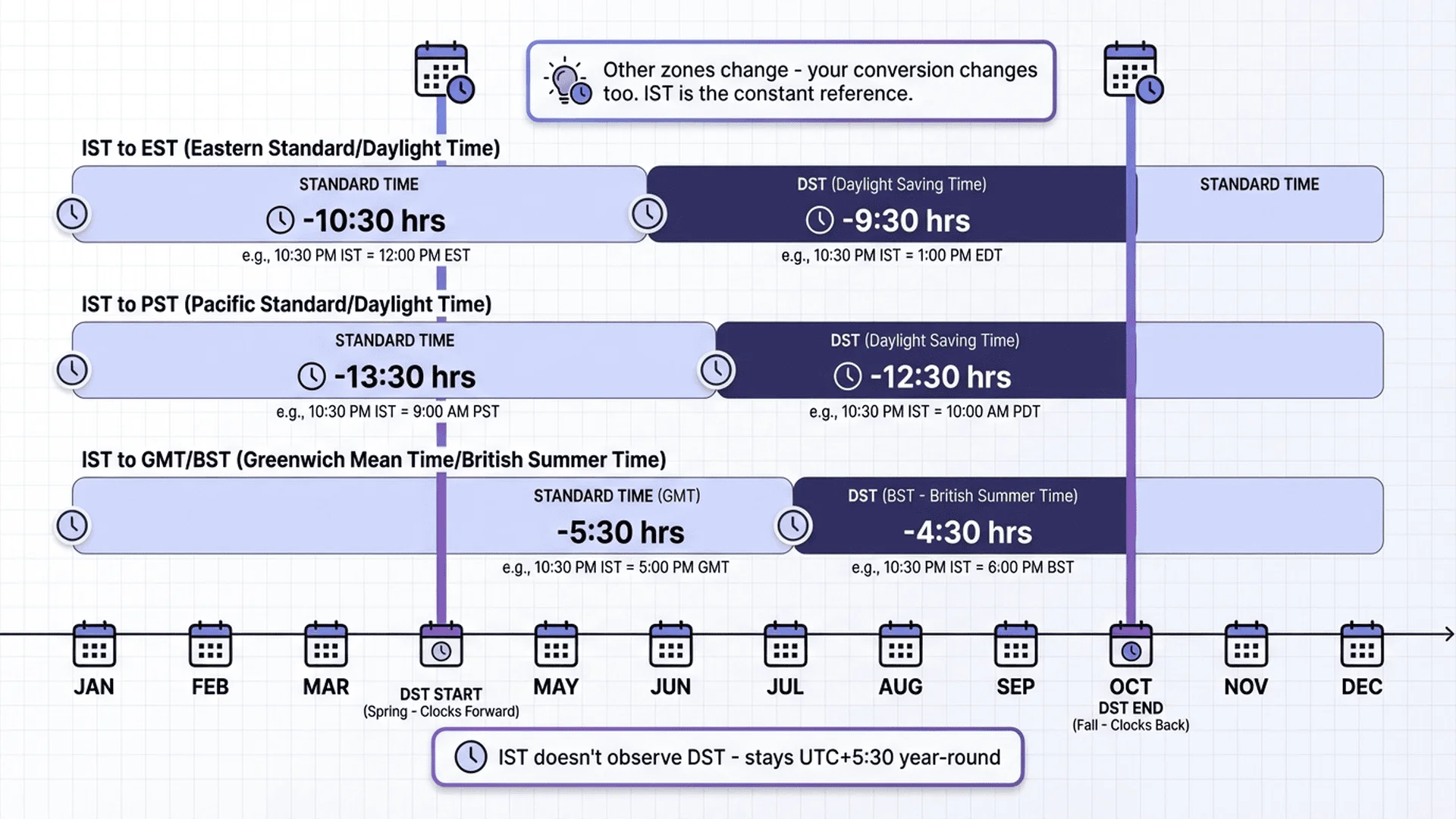
Indian Standard Time (IST) operates at UTC+5:30—note that unique 30-minute offset—which means India is 9.5 hours ahead of US Eastern Time (EST) and 12.5 hours ahead of Pacific Time (PST) during standard time. When the US observes Daylight Saving Time (which India does not), these differences shift to 10.5 and 13.5 hours respectively.
This guide provides comprehensive IST conversion strategies, optimal meeting windows for India-US teams, and practical tools to eliminate timezone confusion. Whether you're managing an offshore development team, coordinating customer support, or planning international conference calls, you'll learn exactly when to schedule for maximum productivity.
⭐⭐⭐ Try Our Free IST Time Zone Converter Tool →
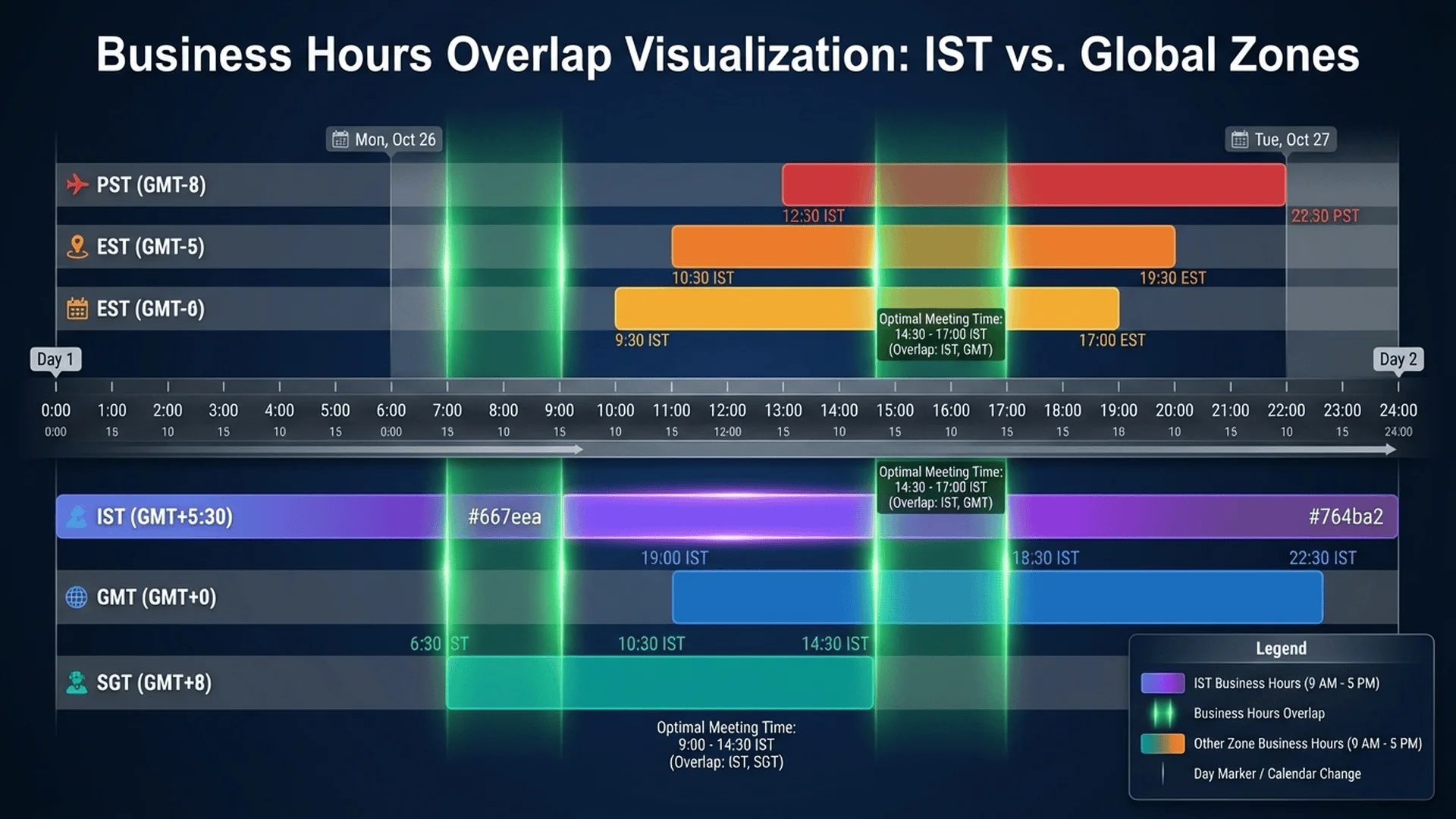
What is IST (Indian Standard Time)?
Understanding India's Unified Time Zone
Indian Standard Time (IST) is the time zone observed throughout India, with a UTC offset of +5:30. Unlike most countries that use hour-based offsets (like UTC+5 or UTC+6), India's half-hour offset reflects its geographical position and historical decision-making.
Key IST Characteristics:
- UTC Offset: +5:30 (5 hours and 30 minutes ahead of Coordinated Universal Time)
- Coverage: Entire country of India, including territories
- Population: Serves 1.4+ billion people—the largest population in a single time zone
- Daylight Saving: India does NOT observe DST (discontinued in 1945)
- Abbreviation: IST, also written as GMT+5:30 or UTC+5:30
- Reference Meridian: 82.5° E longitude (passing through Mirzapur, Uttar Pradesh)
Historical Background: Why the 30-Minute Offset?
The British colonial administration established a unified time system in India in 1906. Prior to this, different regions followed local solar time, causing coordination chaos across the vast subcontinent.
The choice of UTC+5:30 was a geographical compromise: India spans roughly 30° of longitude (68° E to 97° E), which theoretically covers two full time zones. Rather than splitting the country into multiple zones like the US, authorities chose a single time zone based on the central meridian at 82.5° E, resulting in the distinctive 30-minute offset.
Learn more: Understanding UTC and Time Zone Offsets →
IST to EST Conversion: The Most Common India-US Timezone
Current Time Difference: IST to Eastern Time
The time difference between IST and US Eastern Time changes based on whether Daylight Saving Time is in effect:
Standard Time (November - March):
- Time Difference: IST is 10.5 hours ahead of EST
- Example: 9:00 AM EST = 7:30 PM IST (same day)
- US DST Period: First Sunday in November to second Sunday in March
Daylight Saving Time (March - November):
- Time Difference: IST is 9.5 hours ahead of EDT
- Example: 9:00 AM EDT = 6:30 PM IST (same day)
- US DST Period: Second Sunday in March to first Sunday in November
Quick IST to EST Conversion Table
| IST Time | EST (Standard) | EDT (Daylight) | Date Change |
|---|---|---|---|
| 6:00 AM | 7:30 PM (previous day) | 8:30 PM (previous day) | Previous Day |
| 9:00 AM | 10:30 PM (previous day) | 11:30 PM (previous day) | Previous Day |
| 12:00 PM (Noon) | 1:30 AM | 2:30 AM | Same Day |
| 3:00 PM | 4:30 AM | 5:30 AM | Same Day |
| 6:00 PM | 7:30 AM | 8:30 AM | Same Day |
| 9:00 PM | 10:30 AM | 11:30 AM | Same Day |
| 12:00 AM (Midnight) | 1:30 PM (previous day) | 2:30 PM (previous day) | Previous Day |
Critical Note: When it's morning in India (before noon), it's the previous calendar day in the Eastern US. This matters for scheduling meetings and deadlines.
⭐⭐⭐ Calculate Exact IST to EST Time Now →
Best Meeting Times for IST-EST Collaboration
Finding meeting times that work for both India and US East Coast teams requires balancing business hours:
Optimal Windows:
1. 7:30-10:30 PM IST / 9:00 AM-12:00 PM EST (During EDT)
- Late evening for India teams
- Morning for US East Coast teams
- Best for status updates and planning meetings
- 6:30-8:30 AM IST / 8:00-10:00 PM EST (During EDT, previous day)
- Early morning for India teams
- Evening for US teams
- Works for urgent issues or flexible teams
Avoid:
- Middle of the night hours (11 PM - 5 AM) in either location
- Friday evenings IST (when US East Coast is still in Friday morning)
- Monday mornings EST (when India is in Monday evening)
IST to PST/PDT Conversion: India to US West Coast
Understanding the IST-Pacific Time Difference
The time gap between India and the US West Coast is even larger than IST-EST:
Standard Time (November - March):
- Time Difference: IST is 13.5 hours ahead of PST
- Example: 9:00 AM PST = 10:30 PM IST (same day)
Daylight Saving Time (March - November):
- Time Difference: IST is 12.5 hours ahead of PDT
- Example: 9:00 AM PDT = 9:30 PM IST (same day)
IST to PST Quick Reference
| IST Time | PST (Standard) | PDT (Daylight) | Practical Use |
|---|---|---|---|
| 8:00 AM | 6:30 PM (previous day) | 7:30 PM (previous day) | Early India morning = US evening |
| 10:00 AM | 8:30 PM (previous day) | 9:30 PM (previous day) | End of US workday |
| 7:00 PM | 5:30 AM | 6:30 AM | India evening = US early morning |
| 9:00 PM | 7:30 AM | 8:30 AM | Best meeting window |
| 11:00 PM | 9:30 AM | 10:30 AM | Late India = mid-morning US |
Why IST-PST is Challenging:
- Larger time gap: 12.5-13.5 hours means less overlap
- Midnight crossover: Times that work often involve very early morning or late night for one party
- Tech industry impact: Silicon Valley-India collaboration requires creative scheduling
Learn more: US Time Zones Complete Guide: EST, PST, CST, MST →
Best IST-PST Meeting Windows
Finding mutually acceptable times for India-West Coast US collaboration:
Option 1: Evening IST / Morning PST (Most Common)
- IST: 8:30-11:00 PM (late evening)
- PST/PDT: 7:00-9:30 AM (early morning)
- Pros: Within business hours for US; end of day for India
- Cons: India teams work late; requires flexibility
Option 2: Early Morning IST / Afternoon PST (Previous Day)
- IST: 6:00-8:00 AM (early morning)
- PST/PDT: 4:30-6:30 PM previous day (afternoon)
- Pros: Start of day for India; normal hours for US
- Cons: Requires previous day planning; US late afternoon fatigue
Option 3: Asynchronous Communication
- Many IST-PST teams use asynchronous tools (Slack, email, recorded videos)
- Handoff model: India works on issues, hands off to US at end of Indian day
- US West Coast continues work, hands back to India at end of US day
- Enables 24-hour productivity cycle
⭐⭐ Related: Meeting Planner for Multiple Time Zones →
IST to UTC Conversion: Understanding the Foundation
The IST-UTC Relationship
Indian Standard Time is permanently set at UTC+5:30, meaning India is always 5 hours and 30 minutes ahead of Coordinated Universal Time.
Conversion is Simple:
- IST to UTC: Subtract 5 hours 30 minutes
- Example: 3:00 PM IST = 9:30 AM UTC
- UTC to IST: Add 5 hours 30 minutes
- Example: 12:00 PM UTC = 5:30 PM IST
Why UTC Matters for IST Conversions:
- International standard: UTC is the baseline for all time zone conversions
- No DST complexity: Since India doesn't observe DST, IST-UTC relationship never changes
- Tech applications: Server logs, databases, and APIs often use UTC timestamps
- Aviation: Flight schedules use UTC (often labeled as "Zulu time")
IST to UTC Conversion Table
| IST (UTC+5:30) | UTC (GMT) | Use Case |
|---|---|---|
| 12:00 AM (Midnight) | 6:30 PM (previous day) | Daily rollover |
| 6:00 AM | 12:30 AM | Early morning |
| 12:00 PM (Noon) | 6:30 AM | Midday |
| 6:00 PM | 12:30 PM | Evening |
| 11:00 PM | 5:30 PM | Late night |
Technical Note: In programming and databases, always store timestamps in UTC and convert to IST only for display purposes. This prevents DST-related bugs and simplifies international operations.
Common IST Conversion Scenarios
Scenario 1: Tech Support and Customer Service
Challenge: Indian customer support teams serving US customers
IST Work Schedule for US Coverage:
- Serving EST customers: IST evening shift (6:00 PM - 2:00 AM IST) covers US business hours (8:00 AM - 4:00 PM EST)
- Serving PST customers: IST night shift (9:00 PM - 5:00 AM IST) covers US West Coast hours (8:00 AM - 4:00 PM PST)
- 24/7 support: Often requires two shifts in India or hybrid India-US team model
Best Practices:
- Use scheduling tools that auto-convert time zones for shift handoffs
- Display both IST and customer local time in support dashboards
- Build in 30-minute buffer for shift transitions
- Train teams on US holidays and DST change dates
Scenario 2: Software Development Teams
Challenge: Coordinating sprints, standups, and code reviews across IST-US timezones
Agile Workflows Across IST-US:
- Daily Standup: 8:30 PM IST / 10:00 AM EST (compromise time for both teams)
- Sprint Planning: Recorded sessions + asynchronous input for full team participation
- Code Reviews: Asynchronous via GitHub/GitLab with 24-hour SLA
- Emergency Escalations: Overlap hours (7:00-11:00 PM IST / 8:30 AM-12:30 PM EST during EDT)
Development Handoff Model:
1. India Day (IST business hours): Development team writes code, runs tests
2. Handoff (End of IST day): Commits pushed, status updated in shared docs
3. US Day (EST/PST hours): US team reviews, tests, provides feedback
4. Handoff (End of US day): Issues documented, priorities set for India morning
5. Repeat: Creates continuous development cycle
Scenario 3: Business Meetings and Conference Calls
Challenge: Scheduling executive meetings, sales calls, and partner discussions
Meeting Type Recommendations:
| Meeting Type | Best IST Time | Best US Time (EDT) | Rationale |
|---|---|---|---|
| Executive Strategy | 8:00-10:00 AM IST | 10:30 PM-12:30 AM EDT (previous day) | Senior leaders often have flexibility |
| Sales Presentations | 7:00-9:00 PM IST | 9:30-11:30 AM EDT | Peak energy for both parties |
| Routine Check-ins | 9:00-10:00 PM IST | 11:30 AM-12:30 PM EDT | Mid-day US, evening India |
| Training Sessions | 2:00-5:00 PM IST | 4:30-7:30 AM EDT | Morning learning for US, afternoon for India |
Scheduling Etiquette:
- Rotate inconvenience: Don't always make the same timezone stay late/wake early
- Respect Friday-Monday: Avoid late Friday IST calls (weekend start) or early Monday EST calls
- Factor DST changes: Mark calendar twice yearly for DST transition dates (March and November)
- Send calendar invites in both timezones: Use tools that auto-convert and show both
Scenario 4: Financial Markets and Trading
Challenge: Overlapping trading hours between Indian and US markets
Market Hours Overview:
- Indian Stock Market (NSE/BSE): 9:15 AM - 3:30 PM IST (Monday-Friday)
- US Stock Market (NYSE/NASDAQ): 9:30 AM - 4:00 PM EST/EDT (Monday-Friday)
Time Overlap:
- During EST: Indian market closes at 3:30 PM IST = 5:00 AM EST (before US open)
- During EDT: Indian market closes at 3:30 PM IST = 6:00 AM EDT (before US open)
- Zero overlap: Indian and US market hours do not overlap
Implications for Traders:
- Indian traders monitoring US markets work evening/night shifts (7:00 PM - 1:30 AM IST)
- US traders monitoring Indian markets work very early hours (11:45 PM - 6:00 AM EST)
- Most India-US trading coordination happens pre-market or after-hours
- Currency forex markets (24/5) provide continuous India-US trading opportunities
⭐⭐ Related: Forex Trading Time Zone Strategies →
Tools and Resources for IST Conversion
Recommended IST Converter Features
When choosing a time zone converter for IST-US coordination, look for:
Essential Features:
- ✅ Half-hour offset support: Must handle IST's UTC+5:30 correctly
- ✅ DST awareness: Auto-adjusts for US Daylight Saving Time changes
- ✅ Multiple timezone display: Show IST, EST, PST, and UTC simultaneously
- ✅ Meeting time finder: Suggest optimal overlap windows
- ✅ Calendar integration: Export to Google Calendar, Outlook with auto-conversion
Advanced Features:
- 🔄 Recurring meeting templates: Save weekly standup times
- 📧 Email scheduling helper: Calculate best send times for US recipients
- 🌐 World clock dashboard: Monitor team availability across locations
- ⏰ Smart notifications: Alert before cross-timezone meetings
⭐⭐⭐ Use Our Free IST Converter with All These Features →
Best Practices for Managing IST-US Collaboration
1. Standardize on UTC for Technical Work
- Store all timestamps in UTC in databases and logs
- Convert to IST or EST only for user-facing displays
- Prevents DST-related bugs and simplifies calculations
2. Create Shared Team Calendars
- Use Google Calendar or Outlook with automatic timezone conversion
- Set up separate calendars for "IST Core Hours" and "US Core Hours"
- Block "Overlap Hours" as shared meeting windows
- Color-code for quick visual reference
3. Document Timezone Policies
- Clearly state timezone in all meeting invites (include both IST and US time)
- Specify which timezone written times refer to in documentation
- Example: "Deployment at 10:00 PM IST (11:30 AM EST)" not just "10:00 PM"
4. Use Asynchronous Communication
- Don't expect immediate responses outside overlap hours
- Record meetings for team members who can't attend live
- Use Loom, Slack video, or async standups for status updates
- Set clear SLAs (e.g., "Respond within 24 hours" across timezones)
5. Respect Work-Life Balance
- Rotate meeting times so one timezone isn't always inconvenienced
- Limit late-night/early-morning meetings to once or twice per week
- Provide comp time for team members regularly working off-hours
- Use "focus time" blocks during core local hours
Frequently Asked Questions (FAQ)
1. What is the time difference between IST and EST?
IST is 10.5 hours ahead of EST (during US standard time, November-March) and 9.5 hours ahead of EDT (during US daylight time, March-November). This means when it's 9:00 AM in New York (EST), it's 7:30 PM the same day in Mumbai (IST).
2. Does India observe Daylight Saving Time?
No, India does not observe Daylight Saving Time. IST remains at UTC+5:30 year-round. However, the US does observe DST, so the time difference between India and the US changes twice per year (in March and November).
3. Why does IST have a 30-minute offset instead of a full hour?
IST uses UTC+5:30 (a 30-minute offset) as a geographical compromise. India spans roughly 30° of longitude, which theoretically covers two full time zones. Rather than splitting the country, authorities chose a single time zone based on the central meridian at 82.5° E, resulting in the half-hour offset.
4. What's the best time for a meeting between IST and EST?
The best meeting window is typically 8:00-10:00 PM IST / 9:30-11:30 AM EST (during US daylight time). This allows India teams to join in the evening after dinner while US East Coast teams meet mid-morning during peak productivity hours.
5. How do I convert IST to PST/PDT?
Subtract 13.5 hours from IST to get PST (November-March) or 12.5 hours to get PDT (March-November). For example: 9:00 PM IST = 7:30 AM PST or 8:30 AM PDT. The larger time gap makes IST-PST coordination more challenging than IST-EST.
6. What is IST in UTC?
IST is UTC+5:30, meaning Indian Standard Time is 5 hours and 30 minutes ahead of Coordinated Universal Time (UTC). To convert IST to UTC, subtract 5 hours and 30 minutes. For example: 6:00 PM IST = 12:30 PM UTC.
7. When does the US change to Daylight Saving Time, and how does it affect IST conversion?
The US switches to Daylight Saving Time on the second Sunday in March (clocks spring forward 1 hour) and returns to standard time on the first Sunday in November (clocks fall back 1 hour). During this transition:
- March-November: IST is 9.5 hours ahead of EDT and 12.5 hours ahead of PDT
- November-March: IST is 10.5 hours ahead of EST and 13.5 hours ahead of PST
8. How can I avoid timezone confusion when scheduling meetings?
Always include both timezones in meeting invites (e.g., "Meeting at 9:00 PM IST / 11:30 AM EDT"), use calendar tools with automatic timezone conversion, and confirm the date since morning IST times fall on the previous calendar day in the US. Tools like our Free Time Zone Converter can help eliminate errors.
9. What time should I send emails to US recipients from India?
For maximum impact, send emails during US business hours. If targeting EST, send between 7:00-11:00 PM IST (arrives 9:00 AM-12:30 PM EST during daylight time). For PST recipients, send between 9:00 PM-1:00 AM IST (arrives 8:30 AM-12:30 PM PDT). This ensures your email is near the top of their inbox when they start work.
10. Are there any tools specifically designed for IST to US timezone conversion?
Yes, many timezone converters support IST's unique UTC+5:30 offset and automatically handle US DST changes. Look for tools that display multiple timezones simultaneously, suggest optimal meeting times, and integrate with calendars. Try our free IST Time Zone Converter tool → designed specifically for India-US collaboration.
11. How do Indian holidays affect IST-US business scheduling?
India observes different national holidays than the US, which can impact collaboration:
- Major Indian holidays: Diwali, Holi, Independence Day (August 15), Republic Day (January 26)
- US holidays unknown to some Indian teams: Thanksgiving (4th Thursday in November), Memorial Day, Labor Day
- Best practice: Share holiday calendars at the start of each year and mark them in shared team calendars to avoid scheduling conflicts.
12. What is the time difference between IST and CST (Central Time)?
IST is 11.5 hours ahead of CST (US Central Standard Time, November-March) and 10.5 hours ahead of CDT (Central Daylight Time, March-November). This falls between the EST and PST differences, making it somewhat easier than PST coordination but still challenging.
Conclusion: Mastering IST Conversions for Seamless Global Work
Key Takeaways
Successfully managing time zone conversions between IST and US timezones requires understanding three critical factors:
- The Base Difference: IST (UTC+5:30) is approximately 10-13.5 hours ahead of US timezones, with the exact difference varying based on DST
- The DST Challenge: India doesn't observe Daylight Saving Time, but the US does—this shifts the time difference by one hour twice annually (March and November)
- The Date Line Issue: Morning times in India (before noon) correspond to the previous calendar day in the US, requiring careful attention when setting deadlines and meetings
Strategic scheduling makes the difference between frustrated teams working at 2 AM and productive collaboration. The optimal IST-EST meeting window (8-10 PM IST / 9-11 AM EST during daylight time) balances reasonability for both parties, though it requires India teams to work evenings.
Your Action Plan
To implement effective IST-US timezone management:
Immediate Steps:
- 📅 Use timezone-aware tools: Replace manual calculations with automated converters that handle DST changes
- 🔄 Standardize on UTC: Store technical timestamps in UTC; convert to IST/EST only for display
- 📝 Document timezone policies: Always specify both timezones in meeting invites and documentation
Long-term Strategies:
- 🤝 Rotate inconvenience: Don't always make the same timezone work off-hours; share the burden
- 💬 Embrace asynchronous communication: Use recorded updates, Slack, and documentation to reduce live meeting dependency
- 🔁 Create handoff protocols: Leverage the time difference for 24-hour productivity cycles
The India-US business corridor represents one of the world's most valuable timezone challenges, with over $150 billion in annual trade requiring constant coordination. Teams that master IST conversion strategies gain competitive advantages through smoother collaboration, faster response times, and better work-life balance.
⭐⭐⭐ Start Converting IST Times Accurately Now →
Whether you're coordinating software development sprints, managing customer support shifts, or scheduling executive meetings, accurate IST conversion isn't optional—it's the foundation of successful global collaboration.
Related Resources
- Time Zone Converter Complete Guide - Master all aspects of time zone conversion
- UTC Time Zone Complete Guide - Understand the foundation of IST's UTC+5:30 offset
- US Time Zones Guide - Deep dive into EST, PST, CST, and MST
- Meeting Planner Time Zone Tool - Find optimal meeting times across multiple zones
- Browse All Time Conversion Tools - Explore our complete suite of conversion utilities